Home backup sizing guide
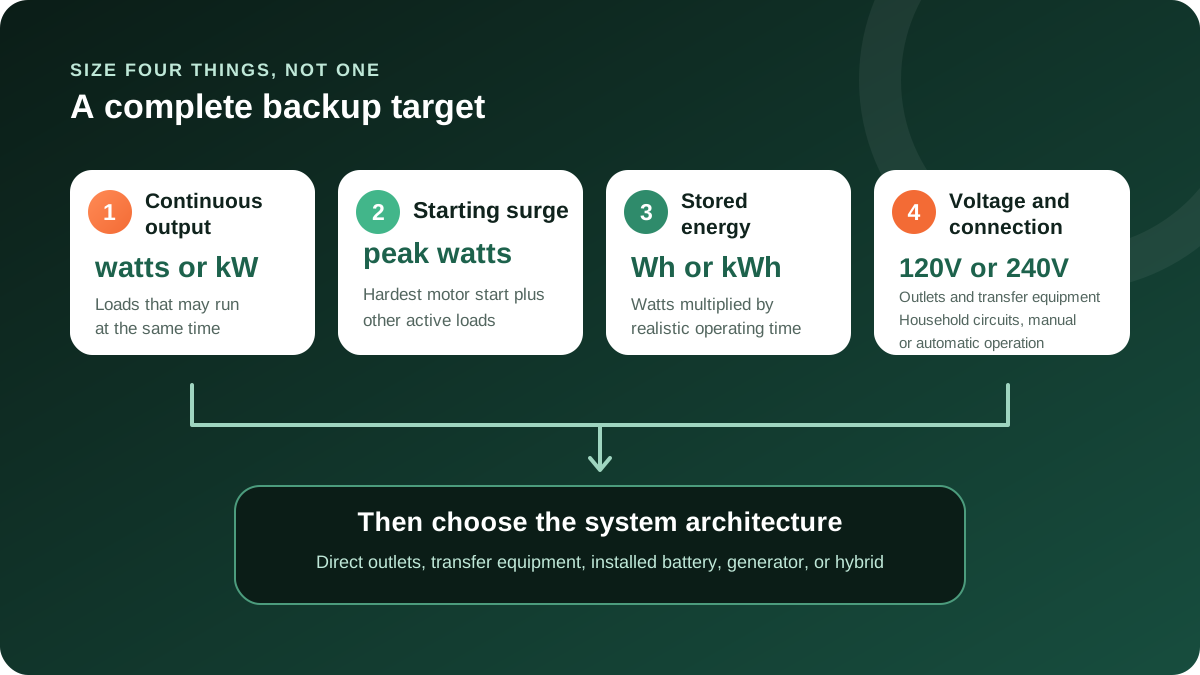
The right backup system is not defined by one watt number. It must supply enough continuous power, survive the hardest motor start, store enough energy for the outage, provide the correct voltage, and connect to the home safely.

Size backup power around four targets: running output, starting surge, stored energy, and voltage
Add the watts of appliances that may operate together. Then test the hardest motor start while the other planned loads remain on. Separately, multiply each appliance's watts by its expected outage operating time to estimate watt-hours. Finally, confirm whether any load needs 240V and decide how the source will connect to appliances or household circuits.
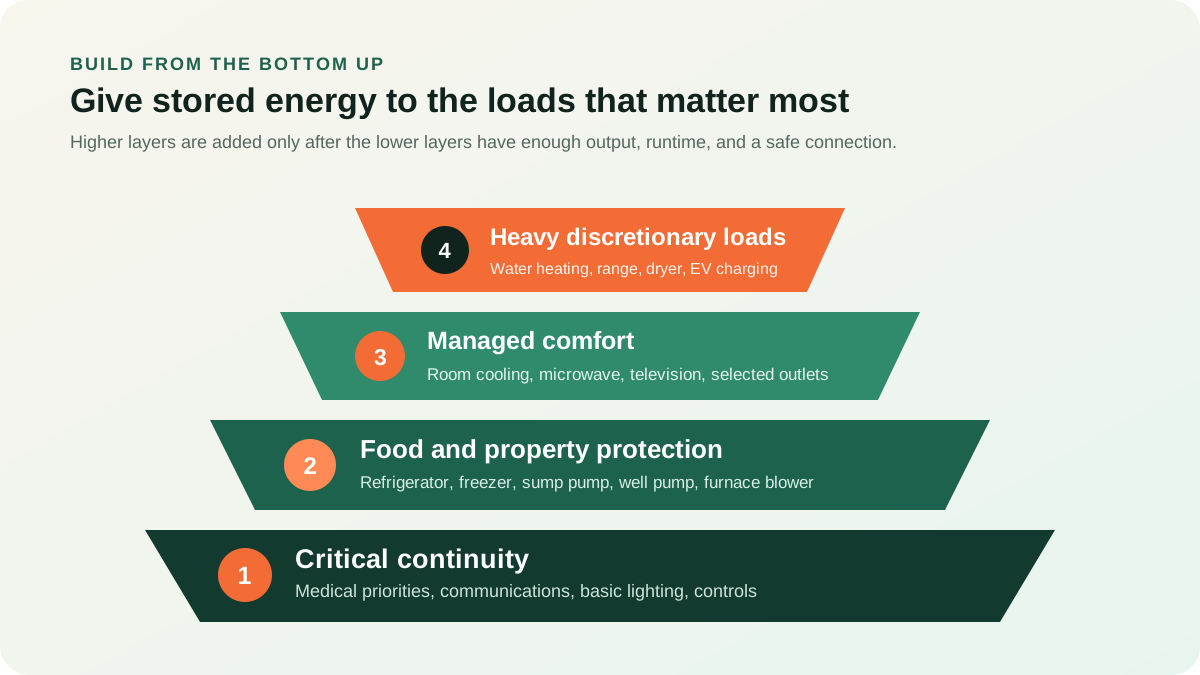
For many homes, a focused essential-load plan is more practical than trying to reproduce normal grid use. Refrigeration, communications, selected lighting, medical priorities, pumps, and heating controls usually earn backup power before electric water heating, a range, a dryer, central cooling, or EV charging.
The four targets every backup plan needs
A product page may highlight inverter watts, battery kilowatt-hours, or a maximum expanded configuration. None of those values is a complete answer by itself. A useful plan produces four household requirements first, then compares the exact equipment configuration with those requirements.
Continuous output
Add the running watts of loads that may overlap. Preserve headroom so normal cycling and small unlisted loads do not keep the source at its limit.
Starting output
For each motor, add its starting watts to the running watts of other loads that will remain active during that start.
Stored energy
Calculate watt-hours for a realistic outage day. Then allow for reserve, inverter loss, standby use, temperature, aging, and uncertainty.
Voltage and connection
Confirm 120V or 240V, direct outlets or household circuits, manual or automatic transfer, and the current available on each output.
First decide what level of backup you are planning
Do not begin with every device that is normally plugged in. Begin with consequences. Which loads protect health, food, water, heat, communications, security, or the building itself? Which comforts can wait? A smaller prioritized plan is easier to power, recharge, test, and maintain.
Connectivity essentials
Typical priorities: modem, router, phones, a laptop, and selected LED lights.
Main issue: low loads may run a long time, so inverter standby consumption can become meaningful.
Food and communication
Typical priorities: refrigerator or freezer, internet, lighting, device charging, and a television or radio.
Main issue: compressor starting demand and actual daily cycling energy.
Safety and heating support
Typical priorities: core loads plus a sump pump, well pump, furnace blower, medical device, or security system.
Main issue: motor surge, automatic operation, hardwired circuits, and possible 240V loads.
Managed comfort
Typical priorities: a window air conditioner, microwave, coffee maker, selected outlets, or garage door.
Main issue: high-power loads may be used one at a time but can consume stored energy quickly.
Broad circuit access
Typical priorities: most household circuits remain available through transfer equipment, a backup panel, or a compatible smart panel.
Main issue: active load management, 240V support, service size, installation, and a realistic recovery plan.
| Backup level | Planning energy starting point | Output focus | Likely architecture |
|---|---|---|---|
| Connectivity essentials | Often about 1 to 2 kWh for an extended day | Low continuous demand | Small or mid-size portable battery |
| Food and communication | Often about 3 to 8 kWh per outage day | Compressor startup | Expandable portable station or essential-load battery |
| Safety and heating support | Often about 8 to 20 kWh per day | Motors, hardwired loads, possible 240V | Larger split-phase battery, generator, or hybrid |
| Managed comfort | Often about 10 to 30 kWh per day | Load sequencing and high-power appliances | Expandable battery, installed battery, generator, or hybrid |
| Broad circuit access | Can exceed 20 to 40 kWh per day | Service integration and active load control | Installed battery, standby generator, or integrated hybrid |
These are orientation ranges, not purchase recommendations. Climate, appliance type, household behavior, motor sizes, and outage duration can move a home far outside them. Use measured loads and the calculators below for a personal result.
Watts and watt-hours solve different parts of the problem
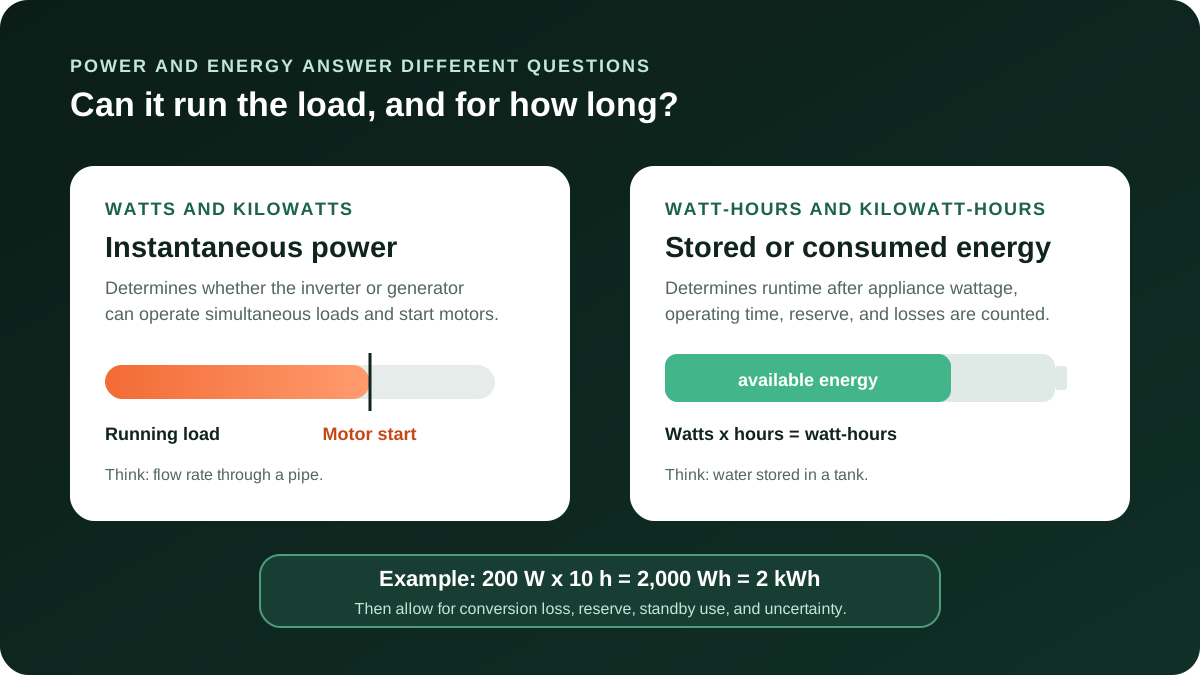
Watts measure the rate at which a load uses power at a moment in time. They tell you whether an inverter or generator can operate the planned loads. Watt-hours measure energy over time. They tell you how quickly a battery is depleted or how much fuel-backed generation or solar recovery is needed.
Energy formula
watts x operating hours = watt-hours
A 200 W load operating for 10 hours uses 2,000 Wh, or 2 kWh. A 1,500 W microwave operating for 12 minutes uses about 300 Wh. The microwave demands much more instantaneous power, but the smaller load uses more total energy because it runs longer.
Nominal battery formula
A battery's nameplate energy is not the same as energy delivered at a wall outlet. A planning calculation can divide the expected load energy by a delivery factor that represents usable state of charge and conversion efficiency.
Example: if a plan needs 4 kWh at the outlets and assumes a combined delivery factor of 0.76, the nominal battery target is about 5.3 kWh before any extra uncertainty buffer.
Why nameplate capacity is not outlet energy
Usable outlet energy is normally lower than the battery nameplate because of several factors:
- Reserve: the homeowner may intentionally keep part of the battery unused for critical loads or battery protection.
- Inverter conversion: converting battery DC energy to household AC power creates loss.
- Standby consumption: an inverter, controls, displays, networking, heaters, or cooling fans can consume power even when appliance load is small.
- Temperature: very hot or cold conditions can affect available capacity, charging, output, and battery protection behavior.
- Battery age and operating limits: usable capacity changes over time, and a system may protect itself before the display reaches a theoretical zero.
- Small-load inefficiency: a large inverter serving a tiny continuous load can spend a noticeable share of total energy on itself.
A seven-step method for sizing home backup power
Work through these steps in order. Product comparison is the last step, not the first. The method applies whether the eventual source is a portable power station, installed battery, portable generator, standby generator, or battery-generator hybrid.
-
1
List only the loads that matter during an outage
Record appliance, quantity, voltage, running watts, starting watts, expected operating time, and whether the load is continuous, cycling, scheduled, or event-based. Identify any medical or safety-critical load that needs a separate contingency plan.
-
2
Separate simultaneous loads from managed loads
Mark what may run together. A refrigerator, router, lights, and furnace blower may overlap. A microwave, coffee maker, window air conditioner, or well pump may be intentionally sequenced. Load management can reduce the required output without reducing energy reserved for essentials.
-
3
Calculate continuous output
Add the running watts of overlapping loads. Include the source's own connection or charging loads where relevant, then preserve practical headroom. Do not assume a product should operate continuously at its absolute published ceiling.
-
4
Test each motor-start event
For a refrigerator, pump, blower, or compressor, add that appliance's starting watts to the running watts of other loads expected to stay on. Repeat for each motor and keep the highest event. The largest individual surge value by itself can understate the real requirement.
-
5
Calculate energy for a realistic outage day
Multiply watts by expected operating hours for each load, then add the watt-hours. Use measured energy for cycling appliances when possible. Scheduled loads such as CPAP or overnight heating should not automatically be cut in half just because the outage lasts 12 hours.
-
6
Add reserve, losses, uncertainty, and autonomy
Convert outlet energy into a nominal battery target using transparent assumptions. Preserve enough energy to reach the next reliable charging opportunity. For long outages, keep at least one realistic period of autonomy even if daily solar or generator charging is planned.
-
7
Confirm voltage, connection, transfer, and recovery
Verify 120V or 240V, current on each leg or outlet, neutral and grounding requirements, direct appliance connection or listed transfer equipment, automatic operation, recharge input, solar limits, and generator compatibility. Then compare complete configurations.
Build an appliance worksheet that reflects the actual outage
Use appliance labels and manuals as a starting point, but measure when the consequence of undersizing is high. A plug-in electricity meter can capture energy for many ordinary 120V appliances. A qualified electrician or compatible circuit monitor may be needed for hardwired and 240V loads. Do not open energized equipment or improvise measurements.
| Load | Use pattern | Record | Best evidence | Common sizing mistake |
|---|---|---|---|---|
| Modem and router | Continuous | Combined watts and full outage hours | Plug-in meter over several hours | Ignoring optical network terminals, mesh nodes, or inverter standby use |
| Refrigerator or freezer | Cycling motor | 24-hour energy plus startup watts | Plug-in meter over a representative day and manufacturer data | Multiplying maximum running watts by 24 or ignoring compressor startup |
| Furnace blower | Cycling motor | Voltage, running watts, startup, winter runtime | Equipment label, manual, professional measurement | Forgetting controls, ignition, condensate pumps, or hardwired connection |
| Sump pump | Event-based motor | Voltage, running watts, startup, cycles per hour | Pump data and observation during wet conditions | Using a dry-day cycle estimate for a severe storm |
| Well pump | Event-based motor | 120V or 240V, horsepower, startup, expected cycles | Nameplate, controller information, electrician measurement | Choosing enough watts without the required voltage or leg current |
| CPAP or medical device | Scheduled or continuous | Exact configuration, hours, humidifier or heater use | Device manufacturer and measured setup | Assuming a consumer battery is a complete medical contingency plan |
| Microwave or coffee maker | Intermittent | Input watts and minutes of use | Nameplate or plug-in meter | Oversizing daily energy because the appliance runs only briefly |
| Window air conditioner | Cycling compressor | Running watts, startup, duty cycle, temperature | Manufacturer data and measurement in hot weather | Using mild-weather energy for a heat emergency |
Use four load-behavior categories
Continuous and scheduled
Continuous loads operate for most or all of the outage, such as communications equipment. Scheduled loads need a defined block of time, such as a CPAP used overnight. Both should be counted according to the actual outage window, not a generic fraction of a day.
Cycling and event-based
Cycling loads turn on and off to maintain temperature or pressure. Event-based loads operate when a condition occurs, such as water reaching a sump pit. Their energy depends on duty cycle or event frequency, while their output requirement still includes motor startup.
Three worked planning examples
These examples show the method, not guaranteed equipment sizes. Actual appliance data, climate, household behavior, battery design, and source limits can change the result. The energy allowances shown include a general planning buffer, but a real calculation should expose each assumption separately.
Connectivity and lighting
- Router and network equipment: 20 W for 24 h
- Four LED lights: 32 W for 6 h
- Laptop and phone charging: 100 W for 4 h
Outlet energy: about 1.1 kWh. A buffered nominal target may land around 1.4 to 1.7 kWh depending on reserve, efficiency, and standby use.
Output: the simultaneous load is modest. A system with a few hundred watts of clean continuous output may be enough, but USB and DC options can reduce inverter loss.
Food, internet, and heat support
- Measured refrigerator energy: 1.2 kWh/day
- Router, lights, and electronics: 1.1 kWh/day
- Furnace blower: 600 W for 4 h
Outlet energy: about 4.7 kWh/day. A buffered nominal target may be roughly 6 to 7 kWh for one day before dependable recharge.
Output: if the blower starts while the refrigerator and smaller loads remain on, the surge event can matter more than the normal combined load. A 2.5 to 3 kW class inverter may be a reasonable planning range only after exact startup data is confirmed.
Well pump and managed comfort
- 240V well pump with high motor start
- Refrigeration, internet, lighting, and outlets
- Window air conditioner used in scheduled blocks
Outlet energy: household use and climate can move this plan from about 10 kWh to well above 20 kWh per day.
Output: split-phase 120/240V capability, per-leg current, pump startup, and load sequencing become decisive. This may point to a larger battery, generator, or hybrid rather than a single portable base unit.
Use the calculator that matches the decision
The flagship Home Backup Calculator combines the complete planning problem. The focused calculators are better when one part of the system is already known and you need to test a specific question.
Home Backup Calculator
Build a categorized load list with quantity, running watts, starting watts, runtime, voltage, use pattern, load overlap, outage duration, and recharge assumptions. The result separates battery, inverter, surge, generator, and system-route targets.
Estimate my full backup needsBattery Runtime Calculator
Estimate delivered runtime from battery capacity, state of charge, reserve, inverter efficiency, standby loss, and load watts.
Estimate battery runtimeGenerator Size Calculator
Combine simultaneous running load with each motor-start event, environmental derating, voltage, and a practical loading allowance.
Estimate generator sizeSolar Recharge Calculator
Estimate daily solar production, energy left after outage loads, battery refill time, weather allowance, and the effect of a battery's solar-input limit.
Model solar recoveryVoltage and connection can rule out an otherwise large system
A battery can have enough kilowatt-hours and still be unable to serve the home. Check whether the loads are ordinary 120V plug-in appliances, hardwired circuits, or 240V equipment. Then verify continuous watts, surge watts, current on each outlet or leg, connector type, neutral and grounding requirements, and supported transfer equipment.
Direct appliance outlets
Plug selected appliances into the source using appropriately rated cords and the product's approved outlets. This can work for a refrigerator, internet equipment, lamps, electronics, or other clearly identified plug-in loads.
Manual transfer equipment
A listed inlet, transfer switch, or approved interlock arrangement can serve household circuits while isolating the utility. Design, permits, conductor sizing, protection, neutral treatment, and operation must match the source and local rules.
Automatic transfer or smart panel
An installed battery or standby generator may transfer supported circuits automatically. Confirm transfer time, backed-up circuits, load-management behavior, low-energy logic, communications dependencies, and what happens during equipment faults.
When 240V support matters
Common 240V candidates include many well pumps, central air conditioners, heat pumps, electric water heaters, ranges, clothes dryers, larger workshop equipment, and EV charging. The presence of a 240V outlet does not guarantee enough power to operate the appliance. Verify voltage, continuous current, motor startup, output balance, and whether the product requires two inverters, a hub, a transformer, or a particular panel accessory.
Long outages are an energy-recovery problem
Adding batteries extends the time before the system is empty, but it does not create energy. If the target outage may last several days, compare daily energy consumed with daily energy that can be restored. A resilient plan should survive realistic bad conditions, not only a perfect sunny day or uninterrupted fuel delivery.
Fast recharge after service returns
Confirm AC charging input and whether the home can recharge the battery while selected loads remain active. Large battery banks can take much longer than a marketing headline suggests if the circuit or charger limits input.
Production after loads
Estimate array watts, local solar resource, season, shade, weather, panel orientation, conversion loss, and battery input limits. Daily solar must serve the active outage loads before the remainder can refill the battery.
Fuel-backed battery charging
A generator can recharge a battery in concentrated runs, allowing quiet battery operation later. Check charger draw, generator loading, fuel, outdoor placement, compatibility, and whether start and stop are manual or automatic.
A useful daily balance
daily recovery - daily outage loads = energy available to refill the battery
If solar produces 6 kWh after weather and system losses but the home consumes 5 kWh that day, only about 1 kWh remains for recovery. If daily loads exceed production, the battery continues to decline even while it charges for part of the day.
- Keep a conservative autonomy floor before planned recharge.
- Model poor weather and short winter days, not annual averages alone.
- Respect battery solar-input voltage, current, and watt limits.
- Confirm generator charging power and fuel use at that load.
- Plan what loads will be shed when recovery falls short.
- Test the actual charging sequence before severe weather.
Safety limits belong inside the sizing decision
A source that cannot be placed, ventilated, connected, fueled, charged, or transferred safely is not correctly sized for the property. Follow the equipment manuals and local requirements. Permanent batteries, transfer equipment, standby generators, new circuits, and panel work commonly require qualified design, permits, installation, and inspection.
Medical and life-safety loads need a layered plan
Do not treat a consumer battery estimate as a guarantee for medical equipment. Confirm requirements with the device manufacturer and care team. Preserve reserve, test the exact configuration, maintain required alarms and backup supplies, know how long the device can operate without external power, and have an evacuation or alternate-power plan if the system fails or the outage lasts longer than expected.
Test the plan before the outage
- Start each motor while other planned loads remain active.
- Verify automatic and manual transfer procedures.
- Confirm which circuits are actually backed up.
- Observe runtime and standby consumption overnight.
- Test solar or generator charging under real limits.
- Document shutdown, low-battery, and return-to-grid steps.
- Teach household members the load-shedding priorities.
- Repeat the exercise after equipment or appliance changes.
How HomeBackup.net evaluates sizing claims
We compare the capability required by the stated household scenario with the capability of the exact equipment configuration. We do not treat a platform's largest expandable number as the capability of its base unit. We separate continuous output, surge output, stored energy, voltage, transfer, recharge input, environmental limits, expandability, installation, warranty, and ownership requirements.
What this guide can and cannot do
This guide provides a transparent planning method and editorial examples. It does not replace appliance documentation, product manuals, site inspection, electrical design, medical planning, local permitting, or qualified installation. We do not claim hands-on testing or professional electrical review where none occurred.
Turn the requirement into a system shortlist
Once you have continuous watts, worst-case starting watts, daily kWh, outage duration, voltage, connection, and recharge targets, compare only configurations that meet all of them. A lower-capacity product with the right voltage and motor-start capability can be more useful than a larger battery with the wrong output architecture.
Frequently asked questions
How many watts do I need to back up a house?
There is no reliable house-wide watt number. Add the running watts of loads that may operate together, then test each major motor start while the other planned loads remain on. A focused essential-load plan may need only a few kilowatts, while a home attempting central HVAC, pumps, cooking, water heating, or broad simultaneous use may need much more.
How many kWh do I need for a one-day outage?
Add the watt-hours of each essential load for a realistic 24-hour period, then allow for reserve, conversion loss, standby use, temperature, aging, and uncertainty. Connectivity-only plans may use about 1 to 2 kWh, while refrigeration, pumps, heating support, or cooling can move the result into much larger ranges. Measure your own loads whenever possible.
Should I size from my monthly electricity bill?
Use the bill only as broad energy context. It includes loads you may shed during an outage and does not show motor startup, simultaneous demand, 120V versus 240V, or circuit-level priorities. A load inventory is more useful for backup design.
How much extra battery capacity should I add?
The allowance should be transparent rather than a universal percentage. Account separately for usable state of charge, inverter efficiency, standby consumption, temperature, battery aging, measurement uncertainty, and the time until dependable recharge. Critical-load plans normally deserve more reserve than convenience-only plans.
How do starting watts change inverter size?
A motor can briefly require much more power when it starts. Test each motor as its starting watts plus the running watts of other loads that stay active. This is more realistic than comparing only the largest standalone surge value with the inverter rating.
Can load management reduce the system size?
Yes. Preventing a microwave, pump, room air conditioner, coffee maker, or other large load from overlapping can reduce the continuous and surge requirement. Load management does not reduce the total energy used if all those loads still operate for the same duration, so power and energy must be recalculated separately.
Do I need 240V backup power?
Not for most ordinary plug-in essentials. You may need 240V for a well pump, central air conditioner, heat pump, electric water heater, range, dryer, large workshop tool, or EV charger. Check the exact equipment label and electrical panel. Then verify current and startup capability, not voltage alone.
Can solar keep a home battery running indefinitely?
Only when daily solar energy consistently exceeds daily outage loads after weather, season, shading, orientation, controller, wiring, and conversion losses. Several poor-solar days can create a deficit. Preserve autonomy and a safe secondary charging or load-shedding plan for critical loads.
Is a generator sized only by running watts?
No. Generator planning should include simultaneous running load, motor-start demand, voltage, environmental and fuel considerations, recommended continuous loading, and any battery charger the generator will support. A generator may also need to serve unbalanced 120V loads across a 120/240V output.
When should I choose a hybrid battery and generator?
A hybrid can make sense when quiet indoor battery operation is valuable but multiday outage duration, winter heating, pumps, or uncertain solar makes stored energy alone impractical. The battery can cover instant transfer and small overnight loads, while the generator restores energy in controlled runs. Compatibility and control logic must be confirmed.
Get a personal result before comparing products
Enter the loads that must operate, how they overlap, how long they run, whether they need 240V, and how the system may recharge. The calculator will turn that list into separate battery, inverter, surge, generator, and system-route targets.
Sources and planning notes
This guide uses general electrical relationships, government safety guidance, and transparent editorial planning assumptions. It is not a product specification sheet or a substitute for site-specific design. Product capabilities, local codes, utility requirements, and manufacturer instructions can change.
- CDC power-outage and portable-generator safety guidance
- U.S. Department of Energy inverter and outage-capable solar overview
- NREL PVWatts solar production estimator
- U.S. Consumer Product Safety Commission portable-generator connection guidance
Planning, formula, safety, link, and image review: July 24, 2026. Worked examples are editorial planning illustrations, not measured product-test results, electrical designs, or runtime guarantees. Hero image created for HomeBackup.net. Diagrams are original HomeBackup.net graphics.