A transparent process for useful, independent, source-led home backup guidance.
Editorial decisions are based on homeowner usefulness, evidence quality, safety, and scenario fit. Revenue opportunities can help prioritize commercially useful work, but they cannot purchase a conclusion, hide a limitation, or turn an undocumented claim into a fact.
Every page should answer a defined homeowner question or route the reader to a better next step.
Current manuals, data sheets, official guidance, and adopted requirements carry the most weight.
Base-unit capability, optional accessories, parallel systems, and theoretical maximums are not blended.
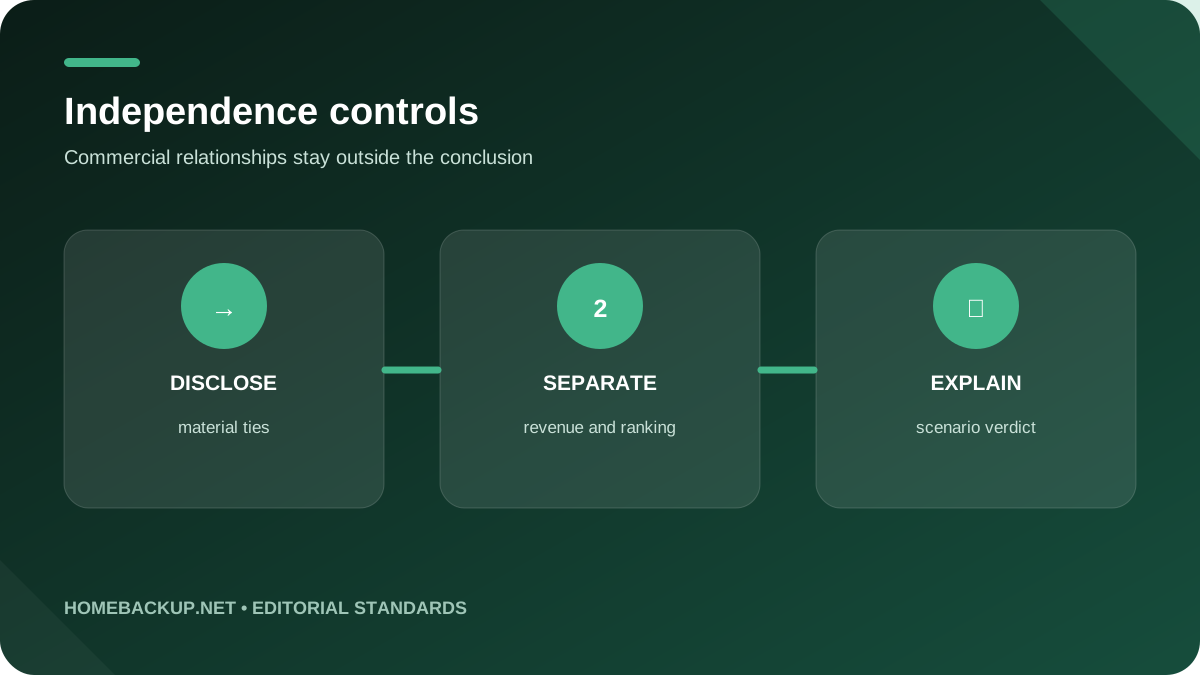
Affiliate programs and advertising do not set scores, winners, or factual conclusions.
A disclosure appears close enough to commercial recommendations to be noticed before a decision.
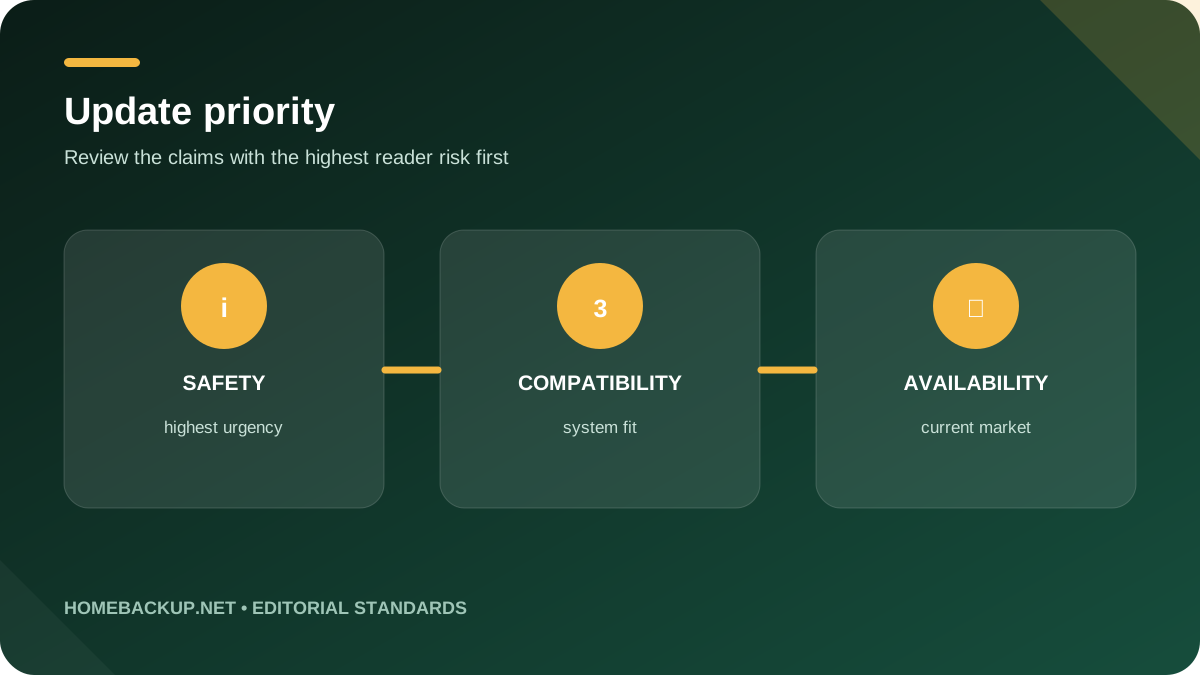
Safety, availability, specifications, compatibility, and incentives receive priority in updates.
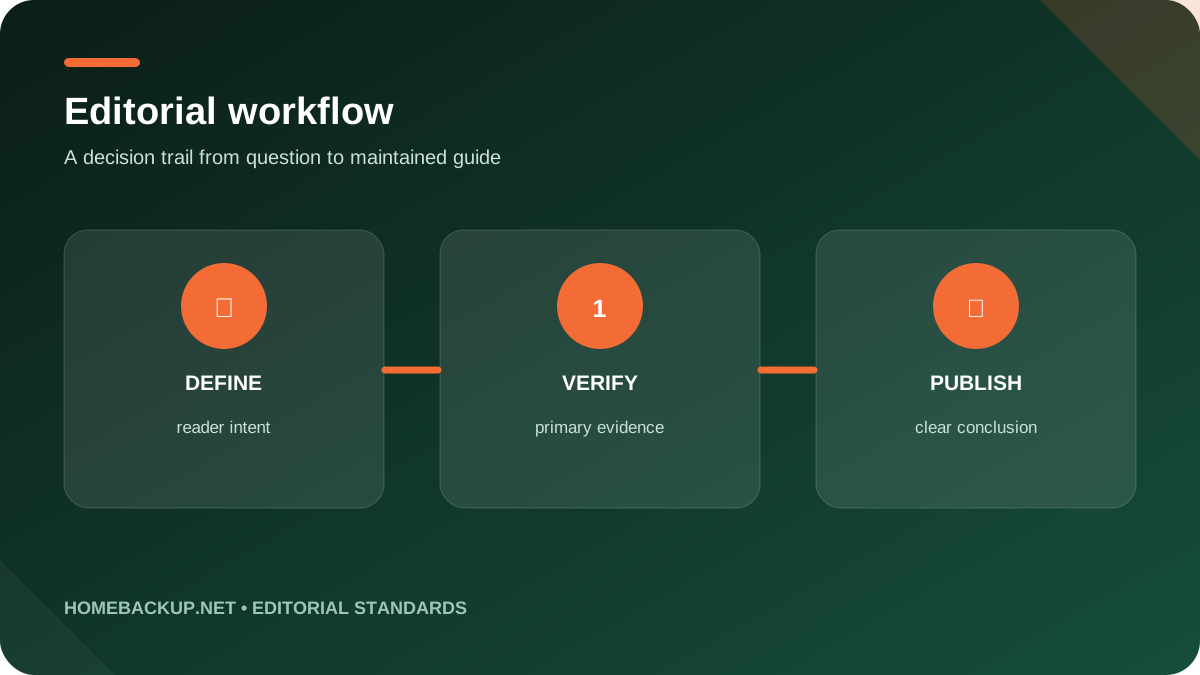
Editorial purpose and audience
HomeBackup.net publishes for people making practical decisions about residential backup power. The central editorial question is not which product has the largest number on a sales page. It is which system architecture can support the reader’s actual loads, voltage, outage duration, noise tolerance, fuel access, installation limits, and budget while respecting safety and local requirements.
Content is organized to move from education to calculation and then to selection. Educational pages explain concepts. Appliance guides translate a load into running power, starting demand, and energy. Calculators make assumptions visible. Brand and product pages explain ecosystem limits. Comparisons apply consistent criteria. Installation pages prepare readers for site surveys, permits, and quotes.
How topics are selected
Topics are chosen from recurring homeowner decisions, outage risks, search demand, product changes, safety gaps, and the need to support an existing content cluster. A new page must have a distinct purpose. If it would duplicate the intent of an existing guide, the preferred response is to improve the existing page rather than create a second page that competes for the same question.
Commercial value can be one input because the site must fund research and maintenance. It is not the only input and does not exempt a topic from the usefulness test. Safety pages, correction policies, calculators, and installation warnings may have little direct commercial value but are necessary for an honest homeowner resource.
Research and source hierarchy
The preferred source hierarchy begins with current manufacturer manuals, data sheets, installation instructions, warranty terms, certification records, government agencies, national laboratories, utilities, and authorities having jurisdiction. Official product marketing can identify a feature but may not explain all conditions, so it is checked against technical documentation whenever possible.
Credible secondary sources can provide context, identify disputes, or reveal questions that primary documents do not address. User reports may reveal failure patterns or service concerns, but they do not establish universal performance without corroboration. Search snippets, retailer summaries, copied specification tables, and AI-generated recaps are not treated as authoritative evidence.
- Prefer a dated technical document over an undated promotional summary.
- Record whether a specification applies to one unit, an expanded system, or a special operating mode.
- Preserve important conditions such as voltage, fuel, temperature, altitude, panel, and accessory requirements.
- Link readers to primary documentation when it materially supports the decision.
Writing and recommendation standards
Facts, calculations, and editorial judgments are labeled by context. A fact must be traceable. A calculation must disclose the inputs or method. A recommendation must explain the homeowner scenario it serves and the tradeoffs that remain. Absolute language such as always, guaranteed, safest, or best is avoided unless the evidence and scope genuinely support it.
A comparison uses the same categories for both sides: continuous output, surge behavior, usable energy, 120/240-volt support, transfer, solar, generator integration, expandability, installation, noise, warranty, service, and fit. A base configuration is not compared with the competitor’s multi-unit maximum without making the difference unmistakable.
Affiliate, advertising, and sponsor independence
HomeBackup.net may use affiliate links, display advertising, or lead-generation forms. These relationships are disclosed. The editorial team does not promise positive coverage, advance approval, a preferred ranking, or removal of a valid criticism in exchange for money, equipment, access, commission rate, or a business relationship.
FTC guidance emphasizes that material connections should be clear and conspicuous. For that reason, a sitewide policy in the footer is supported by a short disclosure placed near commercial recommendations. A vague statement hidden on an About page is not treated as sufficient for a reader who is deciding whether to trust a product recommendation.
Reviews, samples, and hands-on claims
A product page must not imply hands-on testing when the work was document-based. If a product is physically evaluated, the page should explain who supplied it, whether it can be kept, how long it was used, which configuration and firmware were tested, which instruments or procedures were used, and what could not be tested. A sample does not guarantee coverage or a favorable result.
Research-based evaluations remain valuable when they carefully interpret specifications, manuals, installation architecture, and warranty terms. They must be described accurately. The Testing Methodology defines the evidence levels and the repeatable criteria used for home backup systems.
Safety, medical, electrical, and legal boundaries
Safety statements receive conservative editing and primary-source review. Generator content includes carbon monoxide and backfeed warnings. Battery content distinguishes chemistry from system certification and placement approval. Installation content distinguishes a model code or test standard from the locally adopted rule and the authority’s decision.
Medical-device pages do not promise that a generic battery will protect a person. Readers are directed to the device manufacturer, clinician, utility programs, and an emergency plan. Legal, tax, privacy, and incentive discussions are informational and should not be represented as individualized professional advice.
Updates, corrections, and page retirement
Pages are reviewed based on risk and volatility. Product generations, compatibility, incentives, safety notices, and availability can require rapid updates. Foundational explanations change less often but are still checked when standards, terminology, or site methods evolve. A visible modified date is not by itself proof of a substantive review, so the internal process records what was checked.
When a page is outdated but still useful, it is updated and redirected only when another page fully replaces its intent. A retired page should not be redirected to an unrelated homepage merely to preserve traffic. Material errors are handled under the Corrections Policy, with priority based on potential reader harm.
Use of automation and AI assistance
Automation may help organize research, detect missing fields, check links, compare structured specifications, format tables, or identify language that needs review. It does not remove editorial responsibility. A human publisher remains responsible for the accuracy, originality, safety framing, disclosures, and final publication decision.
Generated text is not treated as a source. Any factual claim introduced through an automated workflow must be checked against evidence appropriate to its risk. Pages are reviewed for fabricated capabilities, outdated model names, mismatched configurations, unsupported superlatives, accidental duplication, and citations that do not support the nearby claim.
Pre-publication quality review
Before publication, an editor checks whether the title, description, heading, introduction, comparison framework, and conclusion all answer the same intent. Internal links must lead only to useful published destinations. Tables must remain readable on smaller screens, images need meaningful alternative text, and calls to action must describe the destination honestly. A long page does not pass merely because it reaches a word count.
The reviewer also checks for duplicate paragraphs, generic filler, keyword repetition, unclosed links, copied manufacturer language, inaccessible controls, and unsupported urgency. Product pages must not use retailer copy as original analysis. Calculators must state their assumptions near the result. Commercial pages must place the affiliate notice where a reader can see it before acting, not only in a distant footer policy.
Publication can be delayed when the page lacks a current manual, the configuration cannot be resolved, a safety statement has no suitable source, or the comparison applies different standards to each side. It is better to publish a narrower conclusion with visible limits than a broad answer that creates false confidence.
After publication, the same checklist supports maintenance. Search performance can reveal that a title or introduction misses the reader’s question, but rankings do not overrule accuracy. An update must improve usefulness without changing a supported conclusion merely to imitate a competitor. Editorial quality is measured by the decision the page helps a homeowner make, not by traffic alone.
Frequently asked questions
Do affiliate commissions determine rankings?
No. Commission availability or rate does not determine the editorial winner. A page may include products without an affiliate relationship and may decline to recommend a product that offers compensation.
Can a manufacturer review a draft?
A manufacturer may be asked to verify factual specifications or compatibility. It does not receive the right to approve the conclusion, remove supported criticism, or rewrite independent judgment. Material responses may be incorporated with context.
Does HomeBackup.net accept sponsored content?
Sponsored material may be accepted only if it is clearly labeled, does not imitate an independent review, and meets the site’s safety and accuracy requirements. Sponsorship does not modify independent pages.
How are best categories defined?
A category is defined by a homeowner scenario, required capability, and decision criteria before a product is selected. This reduces the risk of inventing a category around a commissionable product.
What happens when sources conflict?
Editors compare document dates, model and regional scope, configuration, and source authority. The conflict is disclosed when it affects a decision and cannot be resolved confidently.
Are anonymous user reviews used?
They can identify questions or service themes, but they are not treated as proof of universal performance. Important claims require corroboration and should distinguish reported experience from verified fact.
How often are pages updated?
Frequency depends on risk and volatility. Product, incentive, compatibility, and safety pages are reviewed more often than stable educational explanations. A correction can trigger immediate review.
How can I challenge an editorial conclusion?
Use the Contact page with the exact page, claim, configuration, and supporting evidence. A commercial disagreement alone does not require a change, but new evidence receives a documented review.
Sources and policy review basis
Policy reviewed July 22, 2026. Laws, program rules, search guidance, advertising requirements, product documents, and site practices can change.
- Google Search Central: title link best practices
- Google Search Central: snippets and meta descriptions
- Google Search Central: structured data introduction
- FTC: Endorsement Guides questions and answers
- FTC: digital advertising disclosure guidance
- FTC: endorsements, influencers, and reviews
These pages describe the site’s editorial and operational standards. Privacy and legal pages are general templates for the documented site behavior, not a substitute for advice about the operator’s specific obligations.