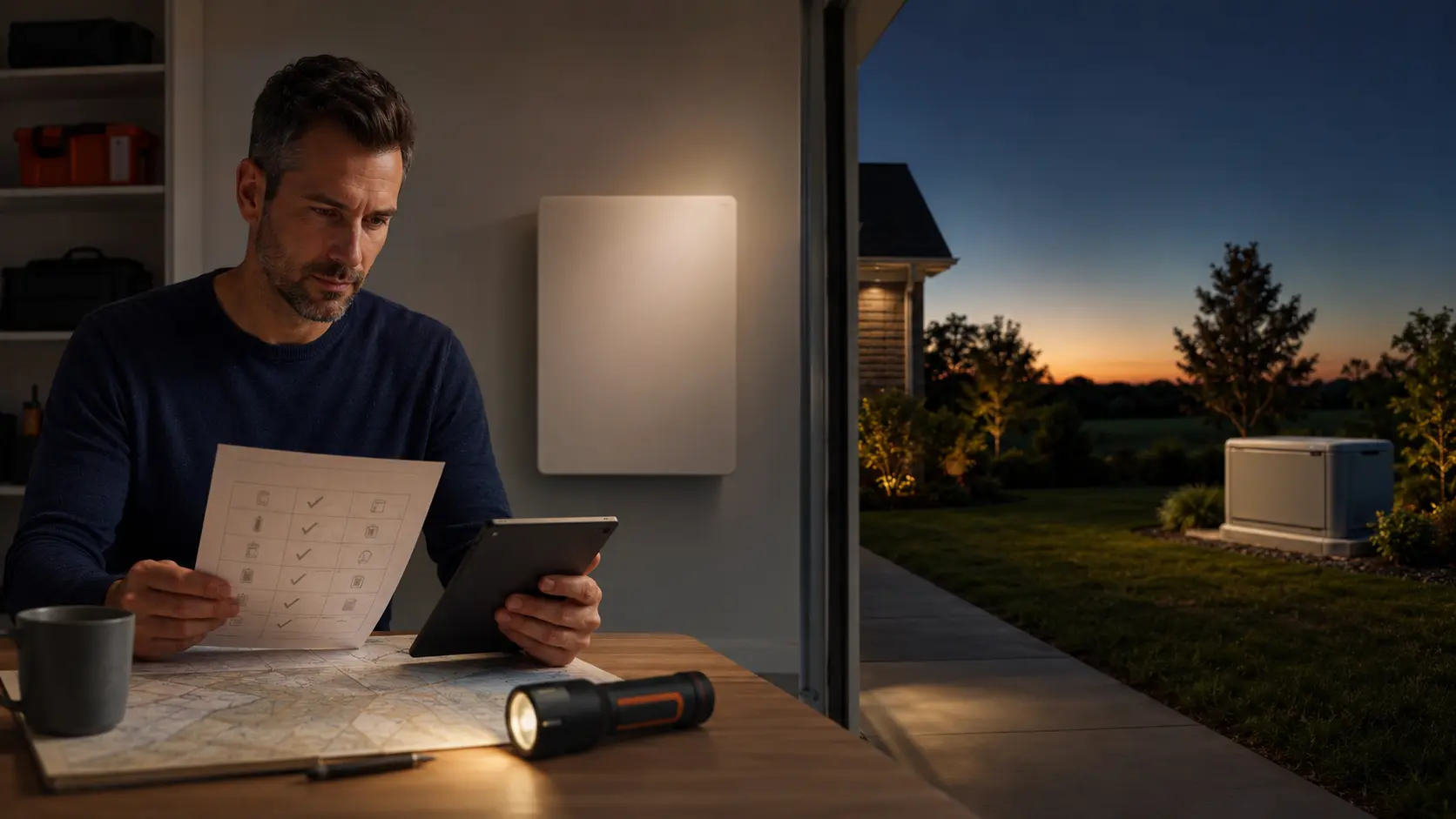
Battery versus generator comparison
A battery and a generator can both keep the power on, but they solve different outage problems. A battery stores a finite amount of electricity and supplies it quietly. A generator converts fuel into electricity and can continue as long as the machine, fuel supply, and maintenance plan hold up. The strongest choice depends on what must run, how long outages last, and how much installation or manual operation you will accept.

Choose a battery for quiet automatic coverage, a generator for fuel-backed duration, or a hybrid when you need both
A battery is usually the better fit for frequent short outages, indoor-compatible portable power, silent overnight use, solar integration, and homes that can manage a defined set of essential loads.
A standby generator is usually the better fit when multi-day outages are common, large 240V loads matter, automatic operation is required, and the property has a dependable fuel path plus a compliant outdoor installation location.
A portable generator is a manual, outdoor-only option for occasional outages when the household can safely deploy, connect, fuel, monitor, and shut down the machine. A hybrid system uses a battery for quiet instant response and a generator or outage-capable solar for recovery.
Choose battery
Best when short outages are common, noise matters, the load list is disciplined, and charging can be restored from the grid or solar.
Evaluate battery backupChoose standby generator
Best when the home needs automatic fuel-backed operation, large motors, broader circuit access, or several days of service.
Evaluate standby generatorsChoose portable generator
Best only when a capable adult can operate it outdoors, maintain safe separation, manage fuel, and use a proper connection plan.
Evaluate portable generatorsChoose hybrid
Best when critical loads cannot wait, night noise matters, and long outages require solar or generator-backed battery recovery.
Evaluate hybrid backupSide-by-side
Battery vs generator comparison
The table compares four architectures rather than pretending that every battery or generator behaves the same. Exact output, storage, fuel consumption, transfer equipment, weather limits, and installation requirements depend on the selected configuration.
| Decision factor | Battery backup | Standby generator | Portable generator | Hybrid |
|---|---|---|---|---|
| Energy source | Stored electricity | Natural gas, propane, or another approved fuel | Gasoline, propane, dual-fuel, or tri-fuel depending on model | Stored electricity plus solar or generator recovery |
| Outage response | Instant or near-instant when properly integrated | Automatic after a short startup and transfer delay | Manual deployment, startup, and connection | Battery responds first; recovery source follows |
| Duration | Limited by usable kWh and recharge | Limited by fuel, duty cycle, maintenance, and operating conditions | Limited by stored fuel, refueling, duty cycle, and supervision | Battery autonomy extended by controlled recovery |
| Noise at the home | Very low during discharge | Engine and exhaust noise outdoors | Engine and exhaust noise outdoors, often closer to occupied areas | Quiet battery windows with shorter generator runs |
| Point-of-use emissions | No combustion exhaust during discharge | Combustion exhaust outdoors | Combustion exhaust outdoors with strict carbon monoxide controls | No battery exhaust; generator exhaust only while recovering |
| Indoor operation | Listed batteries may be installed or used in approved locations | No, engine unit remains outdoors | Never indoors, in a garage, basement, shed, porch, or carport | Battery may be in an approved location; generator remains outdoors |
| Large motor support | Configuration-specific; surge and voltage must be verified | Often strong when correctly sized | Possible, but output, receptacles, voltage, and connection must match | Load control can reserve starts for the stronger source |
| 240V loads | Only with a split-phase or 240V-capable configuration | Common in residential standby systems | Only on models with the required 120/240V output and connection | Configuration-specific, often paired with load management |
| Solar compatibility | Strong when the inverter and controls support outage operation | Not a solar storage device | Can charge some batteries through an approved charger | Solar can reduce generator runtime if the system supports it |
| Routine maintenance | Monitoring, updates, inspection, capacity checks, and environmental control | Engine service, exercise, fuel system, starting battery, and inspections | Fuel management, engine service, test runs, cords, and safe storage | Battery care plus maintenance for each recovery source |
| Best fit | Quiet essential loads, short outages, solar homes, apartments with portable units | Long outages, automatic operation, larger homes, pumps, heating, broad circuits | Occasional manual backup where outdoor operation is practical | Critical continuity plus long-outage resilience |
Little changes inside the home
With a properly integrated system, the household may notice only an app notification, a brief transfer event, and the need to avoid heavy loads. There is no outdoor engine to start or refuel, but remaining charge becomes a visible countdown. The homeowner's main job is to protect the reserve and confirm that recharging is actually occurring.
Behavior that helps: shed resistance heat, stagger cooking, lower cooling demand, and preserve a protected reserve for overnight essentials.Automatic power with an engine running
The transfer can be automatic, but the generator is still an operating machine. The household will hear it, neighbors may hear it, and a long event accumulates engine hours. Owners should monitor status, keep the area clear, follow service intervals, and notice unusual noise, smell, alarms, leaks, or changes in performance.
Behavior that helps: manage very large loads, preserve fuel, keep access and airflow clear, and never ignore a CO alarm.Every outage becomes an operating procedure
The household must wait for safe outdoor conditions, move the unit, establish separation, check oil and fuel, connect loads, start the engine, and monitor it. Shutdown and refueling also require discipline. A printed procedure, trained backup operator, working alarms, flashlights, and preinstalled transfer equipment can reduce mistakes made in darkness or severe weather.
Behavior that helps: practice before storm season and never improvise placement, cords, fueling, or electrical connections.Buyer routing
Best choice by outage scenario
Start with the consequence of losing power. The same house may need one architecture for a two-hour summer interruption and a different one for an ice storm that blocks roads and fuel delivery.
Battery usually wins
Instant response, quiet operation, and no refueling make battery backup well suited to refrigeration, internet, medical priorities, lights, office equipment, and heating controls during short interruptions.
Watch for: enough inverter output for motor starts and enough stored energy for the longest credible short outage.Standby generator or hybrid
Fuel-backed generation can support a furnace blower, pumps, refrigeration, and selected household circuits for longer than a small battery. A hybrid can preserve quiet night operation and reduce engine hours.
Watch for: actual fuel availability, cold-weather performance, snow clearance, service access, and CO risk.Portable battery is usually practical
Combustion equipment is generally incompatible with indoor use and shared-building constraints. A portable battery can support plug-in essentials without exhaust, but building rules and charging arrangements still matter.
Watch for: no panel backfeed, safe charging, exit access, weight, storage rules, and realistic capacity.Generator or large split-phase battery
Pumps may require 240V, high starting current, and automatic response. A generator can provide endurance, while a correctly configured battery can bridge startup and short interruptions.
Watch for: pump label data, measured surge, cycle frequency, transfer, and whether two motors can overlap.Battery has the natural advantage
Storage can capture solar energy for later use, but ordinary grid-tied solar normally shuts down during an outage unless the inverter, isolation equipment, controls, and backup architecture are designed for islanded operation.
Watch for: outage-capable inverter design, backup circuits, solar input limits, winter production, and recovery after a cloudy day.Use a layered plan
Do not make one consumer backup device the only safety plan. Match the exact equipment specifications, use automatic backup where interruption is unacceptable, maintain charged secondary power, and establish an evacuation or care plan.
Watch for: manufacturer requirements, alarms, caregiver procedures, travel backup, and local emergency resources.Option 1
Battery backup is quiet, fast, and energy-limited
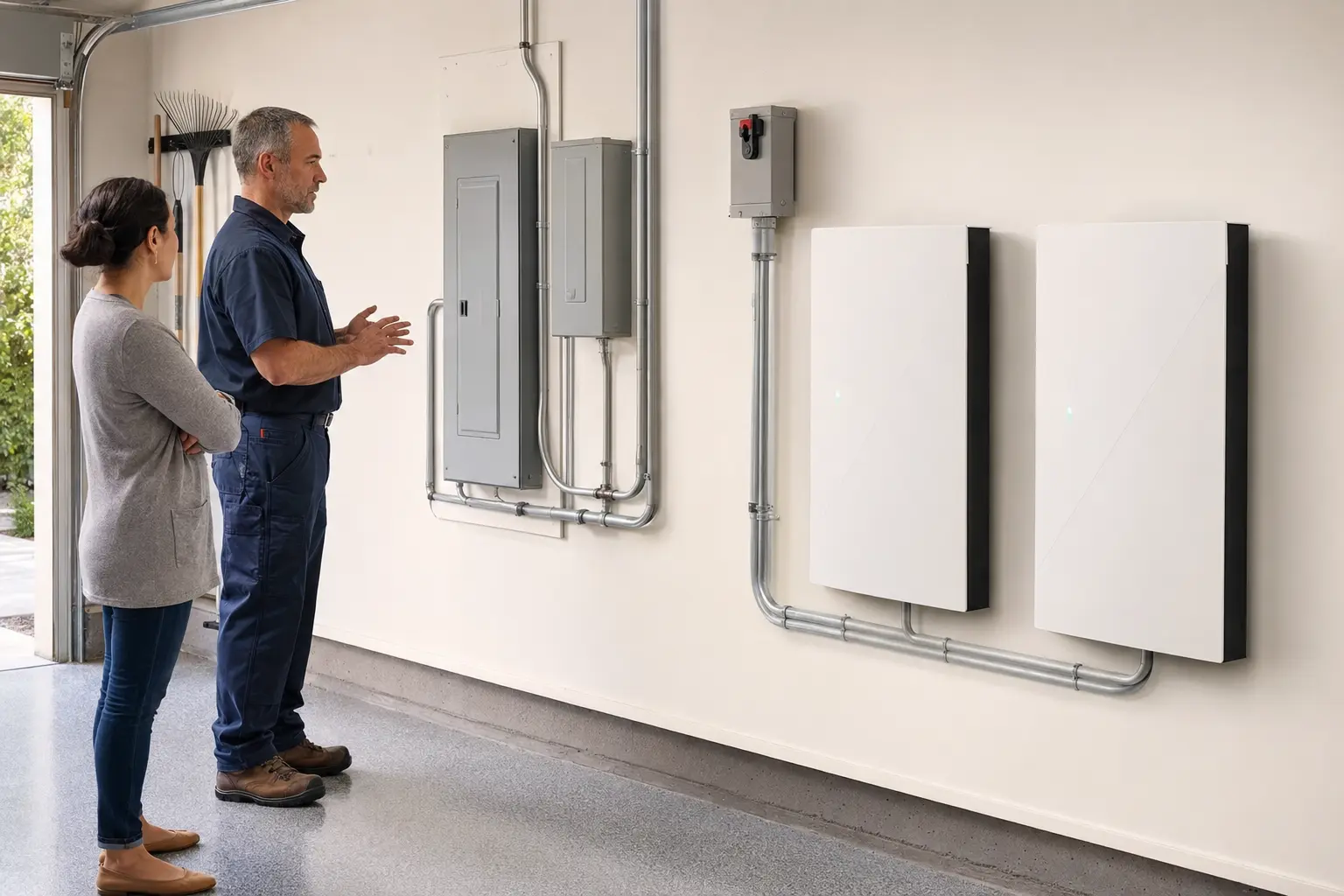
A battery stores electrical energy, then an inverter supplies AC power to connected appliances or circuits. Portable power stations serve plug-in loads and, in some configurations, compatible transfer equipment. Installed home batteries can coordinate with a gateway, backup panel, solar inverter, transfer equipment, or smart load controls.
The main advantage is operational simplicity during discharge. A properly integrated battery can respond without a homeowner going outside, starting an engine, moving fuel, or managing exhaust. The main limitation is that every load draws down a finite reserve. High-power heating, cooling, cooking, water heating, and EV charging can empty that reserve quickly even when the inverter can run them.
Where battery backup is strong
- Silent or very quiet operation during discharge
- No combustion exhaust at the point of use
- Fast response for sensitive or unattended loads
- Practical for defined essential-load plans
- Can recover from outage-capable solar
- Portable versions can support apartments and rentals without permanent wiring
- Installed systems may also support energy management when the grid is available
Where battery backup is limited
- Runtime falls directly as load rises
- Expansion limits and configuration rules can be complex
- Some systems are 120V only or need paired hardware for 240V
- Cold, heat, aging, reserve settings, and conversion losses affect usable energy
- Solar recharge is weather-dependent and input-limited
- Replacement planning matters even when daily maintenance is light
- Heavy resistance heating can overwhelm practical storage quickly
usable kWh / average load kW = idealized runtime hours
Then reduce the idealized result for reserve, inverter loss, standby consumption, temperature, battery age, and uncertainty. Use the Battery Runtime Calculator for a more realistic estimate.
Option 2
A standby generator trades silence for automatic fuel-backed endurance
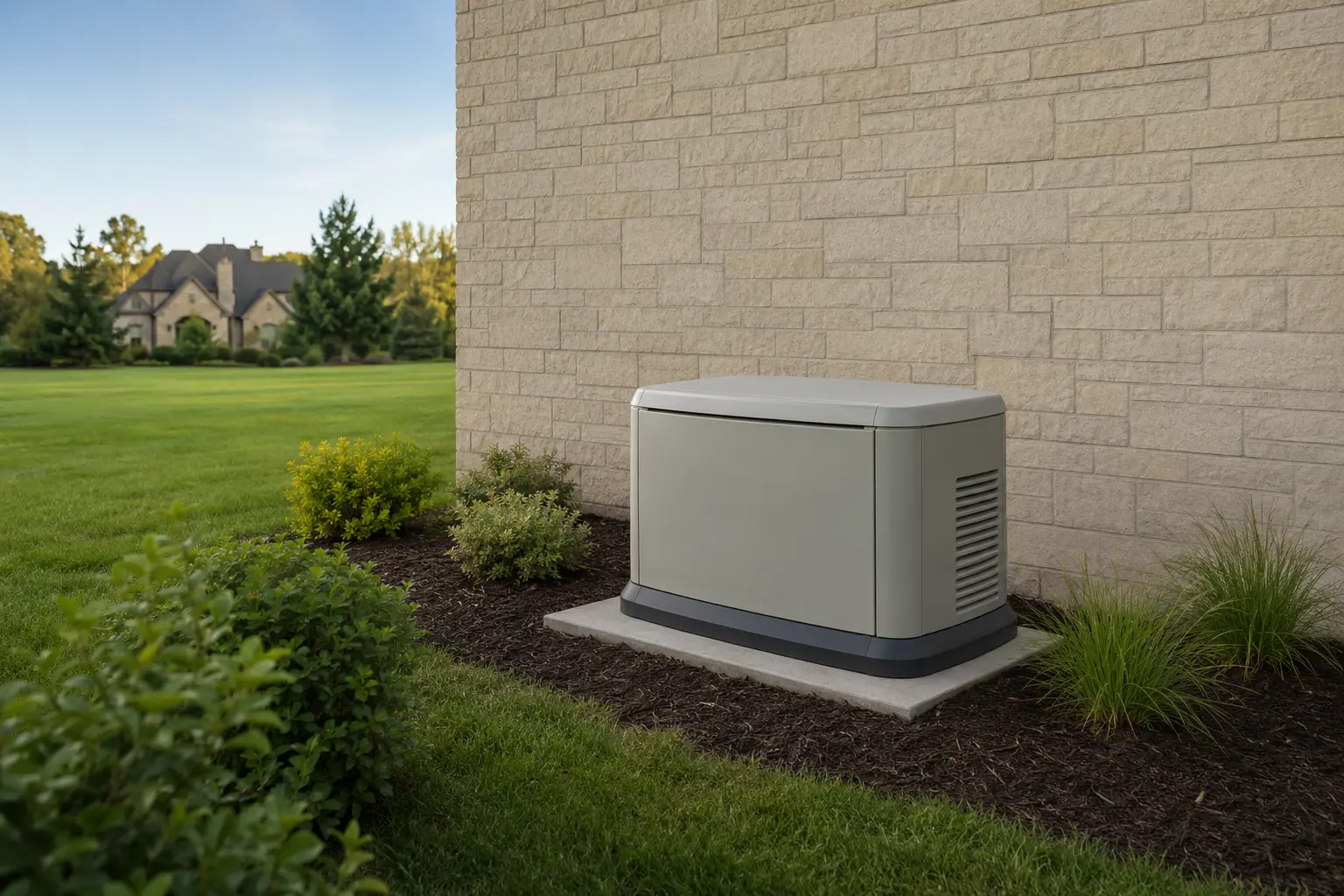
A residential standby generator remains outdoors and usually connects through an automatic transfer switch. When utility power fails, the system starts, stabilizes, and transfers the backed-up circuits or service after a short delay. It can continue operating as long as fuel and operating conditions remain acceptable.
This architecture is strong when the home has large motors, broad circuit needs, 240V loads, or a history of long outages. It is not unlimited power. The generator still has a continuous rating, motor-start limits, fuel demand, environmental derating, maintenance intervals, and a maximum practical load. Automatic load management may be needed to prevent several large appliances from starting together.
Where standby generators are strong
- Automatic operation without manual outdoor deployment
- Strong continuous and motor-start capability when correctly sized
- Common support for 120/240V household circuits
- Longer service during extended outages when fuel remains available
- Suitable for hardwired pumps, heating systems, and broader panel coverage
- Routine exercise can reveal some problems before an outage
Where standby generators are limited
- Combustion exhaust and carbon monoxide require careful placement
- Engine and exhaust noise continue whenever the unit runs
- Fuel pressure, tank capacity, delivery, or regional disruption can limit duration
- Engine service, starting battery, transfer equipment, and fuel system need maintenance
- Permanent installation, permitting, and professional coordination are normally required
- Flood, snow, heat, wind-driven exhaust, and service clearance affect the site plan
Option 3
A portable generator can be capable, but the household becomes part of the safety system
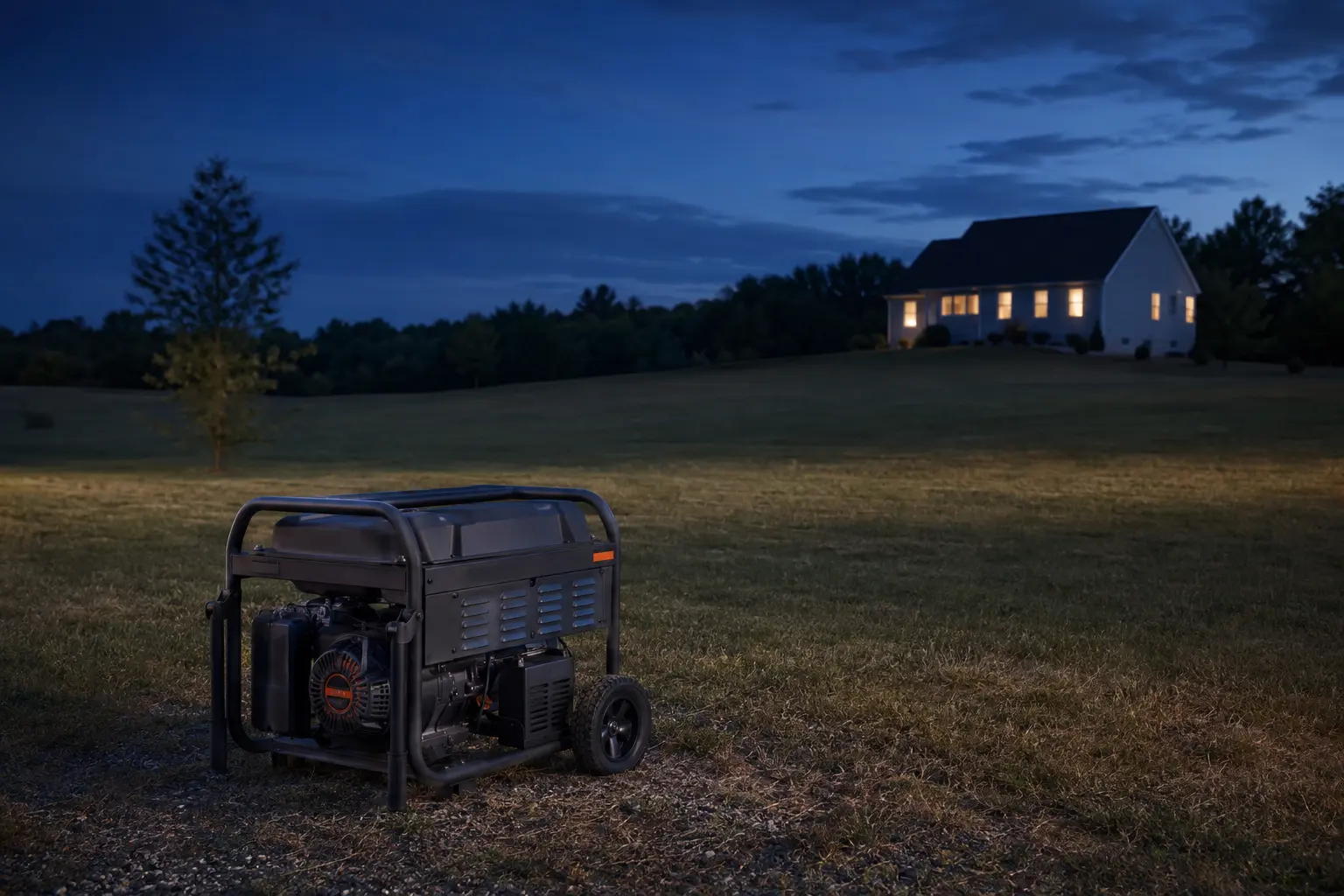
Portable generators can supply selected appliances directly through suitable cords or feed approved household circuits through a properly installed inlet and transfer method. They are flexible and can provide meaningful output, but they require hands-on setup during the exact conditions that caused the outage.
The operator must move the generator to a safe outdoor location, keep it dry according to the manufacturer instructions, direct exhaust away, connect loads correctly, avoid overload, manage fuel, monitor operation, and shut it down before refueling. That workload makes portable generation a poor choice when no capable adult will be present or when an essential load cannot tolerate a delay.
- The property has a dry, stable outdoor operating area with at least 20 feet of separation.
- A trained adult can deploy and monitor it for every outage.
- Fuel can be stored and rotated legally and safely.
- Loads connect through rated cords or a professionally installed transfer method.
- Working carbon monoxide alarms protect every level and sleeping area.
- The home is an apartment, condominium, or dense property without safe separation.
- The only possible location is a garage, porch, carport, shed, or covered opening.
- The critical load must transfer automatically.
- The operator may be absent, physically unable, or unfamiliar with the equipment.
- Fuel storage, noise, weather, or neighborhood rules make routine operation impractical.
Duration
Battery runtime is an energy calculation; generator runtime is a fuel and logistics calculation
A battery gives a relatively direct planning relationship. Divide usable stored energy by average load, then account for losses and reserve. A generator can create electricity for much longer, but its duration depends on fuel consumption at the actual load, usable fuel on site, refueling access, oil and service intervals, ambient conditions, and whether the machine can safely operate through the outage.
Finite but measurable
A 10 kWh nameplate does not mean every 10 kWh reaches appliances. Reserve settings, conversion loss, standby use, temperature, age, and shutdown thresholds reduce delivered energy.
Load control has immediate value. Removing a 1.5 kW heater can save more energy in two hours than an efficient refrigerator may use across much of a day.
Extendable but conditional
A large tank or piped fuel path can support long operation, but consumption changes with load and equipment. Refueling may become difficult during the same storm, flood, or regional emergency that caused the outage.
Continuous operation also accumulates engine hours. Follow the manual for inspection, oil, service, cooldown, and duty-cycle requirements.
Renewable but variable
Solar can turn a battery from a one-charge resource into a daily energy system, but recovery depends on array size, available sun, shading, temperature, conversion loss, and the battery's accepted input.
The array must first cover outage-day loads. Only the remaining production can refill the battery.
Measure the load, model the outage, then choose the architecture
Power delivery
Output, motor surge, voltage, and connection can eliminate an option before runtime matters
A system that stores or generates enough energy can still fail if it cannot start the well pump, furnace blower, sump pump, refrigerator compressor, or air conditioner. Calculate running load and starting demand separately. For each motor, test its starting watts while the other loads expected to remain on are still counted.
Continuous watts
Add the loads likely to overlap. Preserve operating headroom rather than designing for continuous use at the absolute limit.
Starting watts
Test each motor start against the other active loads. The largest nameplate surge by itself is not the complete requirement.
120V or 240V
A watt rating does not create the required voltage. Verify split-phase output, receptacles, current per leg, and transfer compatibility.
Connection
Choose direct outlets, selected circuits, or broader panel integration. Never improvise a cord that energizes household wiring backward.
| Load | Battery question | Generator question | Likely planning issue |
|---|---|---|---|
| Refrigerator or freezer | Can the inverter start the compressor, and how many kWh does cycling use? | Can it start while other loads remain on? | Surge plus daily energy |
| Sump pump | Is automatic transfer available and is surge supported? | Will it start unattended, and is the transfer path reliable? | High consequence, variable cycling |
| Well pump | Does the exact configuration provide required 240V and starting current? | Does generator output and per-leg current support the motor? | Voltage and motor start |
| Furnace blower | Can controls and blower receive stable power through an approved circuit path? | Is neutral, transfer, and motor starting handled correctly? | Hardwired load and winter priority |
| Electric resistance heat | How quickly will the sustained load empty storage? | How much fuel and generator capacity will it consume? | Very high continuous demand |
| Central air conditioner | Does the system support compressor start, 240V, and daily energy? | Is a soft-start device or load management required? | High surge and high energy |
Total ownership
Compare the complete system, not just the battery cabinet or engine
Purchase cost alone is an incomplete comparison, and temporary online prices age quickly. Compare the scope required to make each option safe, usable, maintainable, and ready for the target loads.
Battery cost drivers
- Usable storage and expansion batteries
- Inverter output and 120/240V configuration
- Gateway, transfer, backup panel, or smart panel
- Solar integration or dedicated charging hardware
- Electrical panel, service, conduit, and location work
- Permits, commissioning, monitoring, and eventual replacement
Standby generator cost drivers
- Generator output and transfer equipment
- Fuel line, meter capacity, propane tank, or site work
- Concrete or approved mounting base and placement preparation
- Electrical integration, permits, inspection, and commissioning
- Routine engine service, starting battery, and repairs
- Fuel consumed during exercises and outages
Portable generator cost drivers
- Generator, weather-compliant operating plan, and security
- Rated cords or installed inlet and transfer equipment
- Approved fuel containers, storage, and fuel rotation
- CO alarms, maintenance supplies, and spare consumables
- Manual labor and household training for every outage
- Noise, neighborhood, and storage constraints
Option 4
A hybrid system can use each technology where it is strongest
A hybrid does not simply mean owning both. The sources need a deliberate operating sequence, compatible charging path, safe transfer design, and load priorities. The battery supplies instant, quiet power. Solar or a generator restores energy after the battery has carried the initial outage.
Grid fails
Battery supports critical loads immediately or after the designed transfer interval.
Loads are managed
Heavy discretionary circuits remain off so refrigeration, pumps, heat controls, and communications keep priority.
Recovery starts
Solar contributes when available, or the generator runs in an efficient charging window outdoors.
Quiet reserve returns
The battery resumes silent operation for night, low-load periods, or times when engine use is undesirable.
Hybrid makes sense when
- Critical loads cannot wait for manual generator deployment.
- Outages regularly exceed one practical battery cycle.
- Night noise or neighborhood limits make continuous engine operation undesirable.
- Solar can cover part of the daily energy but not every weather condition.
- The generator can charge the battery through an approved, efficient path.
Hybrid may be unnecessary when
- Outages are brief and a correctly sized battery already covers them.
- A dependable standby generator already meets every priority and noise is acceptable.
- The charging path is inefficient, incompatible, or operationally confusing.
- The household cannot maintain both systems.
- Added complexity creates more failure points than resilience.
Decision method
Choose in seven steps
-
1
Define essential loads
List health, refrigeration, water, heating controls, communications, security, work, and property-protection loads before adding comfort appliances.
-
2
Calculate running power and motor starts
Find the loads that overlap, then test the hardest motor start while the other planned loads remain active.
-
3
Estimate outage-day energy
Multiply each load by realistic operating time. Separate continuous, cycling, scheduled, and brief intermittent loads.
-
4
Check voltage and connection
Identify every 240V or hardwired load and decide whether direct outlets, selected circuits, or broader panel integration is needed.
-
5
Match the outage duration
Use battery autonomy for short outages, a realistic fuel plan for long outages, or daily solar and generator recovery for a hybrid.
-
6
Test the property constraints
Confirm generator placement, exhaust, fuel, noise, weather, storage, battery location, electrical service, permits, and household operating ability.
-
7
Compare complete configurations
Verify exact model documents, included hardware, expansion rules, transfer behavior, warranties, service, installation scope, and maintenance.
Build one household requirement, then compare battery and generator routes against it
The flagship calculator estimates energy, running output, motor-start demand, voltage, and likely system category without forcing a battery or generator answer in advance.
How this guide was built
Comparison method and limitations
HomeBackup.net compares architectures by the outage outcome they can deliver. The core criteria are continuous output, motor-start performance, usable energy or fuel duration, 120/240V support, transfer behavior, automatic response, noise, emissions, installation, maintenance, recovery, and safe operation.
This guide does not rank one technology as universally superior and does not use temporary prices. It also does not replace product manuals, load measurements, electrical design, fuel evaluation, local permits, fire requirements, utility rules, medical contingency planning, or professional installation.
Frequently asked questions
Battery vs generator FAQ
Is a battery better than a generator for home backup?
A battery is better for quiet operation, fast response, defined essential loads, short outages, and solar integration. A generator is often better for long outages, large motors, and broader circuit coverage when fuel and safe outdoor placement are available. Neither is universally better.
How long can a home battery run a house?
Runtime depends on usable battery energy divided by average load, then reduced for reserve, losses, standby use, temperature, and age. A small essential-load plan may last many times longer than broad household operation on the same battery.
Can a battery run a well pump or central air conditioner?
Some configurations can, but the exact system must provide the required 240V output, continuous current, motor-start capability, circuit connection, and enough energy. Do not assume that a high total watt rating guarantees compatibility.
Can I use a portable generator in a garage with the door open?
No. Portable generators produce lethal carbon monoxide. Operate outdoors only, at least 20 feet from homes and buildings, with exhaust directed away from windows, doors, vents, and occupied structures. A garage, porch, carport, basement, crawlspace, or shed is not safe.
Does a standby generator run forever on natural gas?
No. Fuel service can be interrupted, generator output and maintenance limits still apply, and regional emergencies can affect infrastructure. Confirm fuel pressure, generator consumption, service intervals, environmental conditions, and a contingency plan.
Will rooftop solar keep working during an outage?
Not automatically. Many grid-tied systems shut down when the grid fails. Outage operation requires compatible inverters, isolation, controls, and a backup design that can safely form an islanded electrical system.
Is a hybrid battery and generator system worth it?
It can be when outages are long, critical loads need instant response, quiet overnight power matters, and the generator or solar system can recharge the battery through an approved path. It may add unnecessary cost and complexity when one source already meets the full requirement.
Which system needs less maintenance?
A battery normally needs less routine mechanical service because it has no combustion engine. It still needs monitoring, inspections, environmental control, software or communications checks, and eventual capacity or hardware replacement. Generators need engine, fuel, starting, transfer, and exercise maintenance.
Should I choose whole-home or essential-load backup?
Essential-load backup is usually easier to size, sustain, and recover. Whole-home circuit access can be convenient, but it does not remove output or energy limits. Heavy loads may still need active management even with a large battery or generator.
Use the calculator first, then compare complete backup configurations
Your load list should decide whether battery, generator, or hybrid architecture deserves the next round of research.