Every important claim should be traceable, scoped to the correct configuration, and reviewed at a level that matches its risk.
Fact checking is not a final spelling pass. It is the process of identifying checkable claims, locating suitable evidence, preserving conditions and dates, reproducing calculations, and challenging language that extends beyond the source.
Important specifications and safety statements must be linked to suitable evidence.
Region, generation, fuel, firmware, accessory, and system size are checked.
Continuous, surge, maximum, typical, and illustrative do not mean the same thing.
Runtime, capacity, generator, and solar calculations receive unit and assumption checks.
Availability, warranty, compatibility, incentives, and policies are treated as time-sensitive.
Safety, medical, electrical, legal, and financial claims receive the strictest review.
Building a claim map
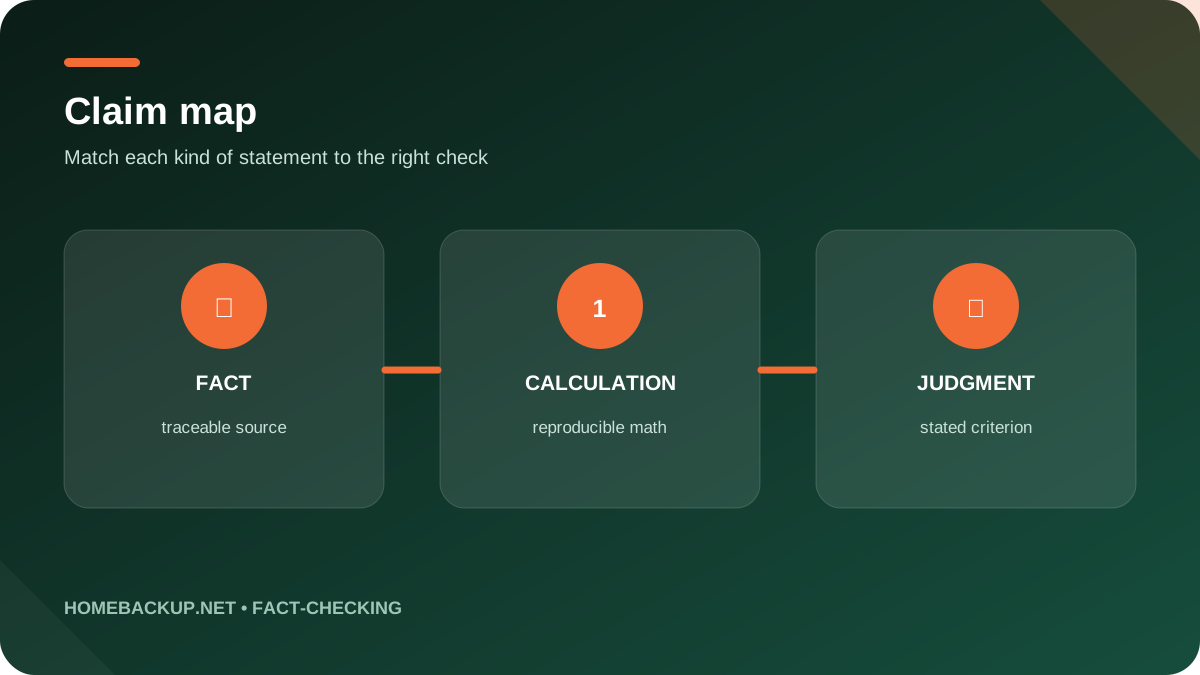
Before publication, the reviewer identifies statements a reader could reasonably act on: power, energy, voltage, runtime, compatibility, price framing, warranty, installation, certification, safety, availability, incentives, and comparative conclusions. Each claim is classified as sourced fact, calculation, estimate, reported experience, or editorial judgment.
This classification determines the check. A sourced fact needs supporting evidence. A calculation needs correct inputs, units, and method. An estimate needs its uncertainty stated. Reported experience needs attribution and cannot be generalized carelessly. Editorial judgment needs a transparent criterion and must not be phrased as a measurable fact.
Selecting evidence
The strongest evidence is normally the current document closest to the claim: a manufacturer data sheet for rated output, an installation manual for electrical and environmental limits, a warranty for coverage, a certification database or laboratory statement for listing, a government agency for safety, a utility for interconnection, and a tax authority for current tax rules.
A retailer table can be convenient but may combine generations or copy an error. Search results can surface a document but are not the document. Community discussions can identify questions but are not sufficient proof of a universal capability. When only weak evidence is available, the claim is narrowed, attributed, or withheld.
Checking specifications and configurations
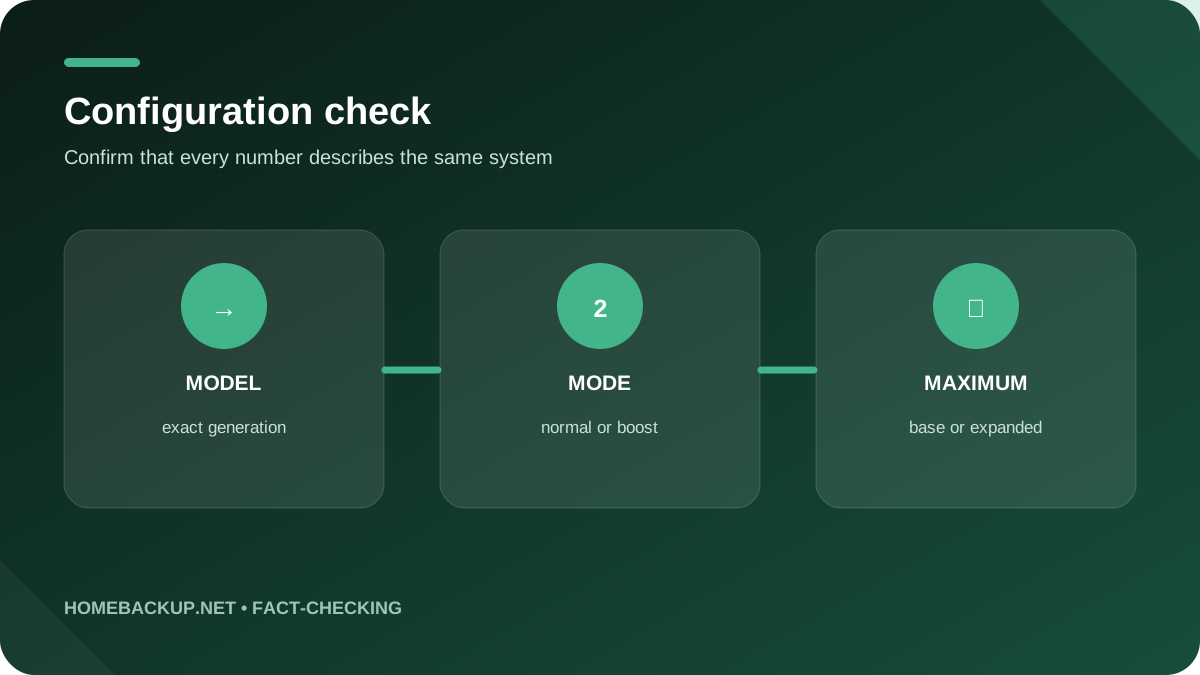
Reviewers record the exact product name, generation, region, model number, base or expanded configuration, battery quantity, output voltage, required accessories, operating mode, and fuel. Continuous power is separated from surge and boost. Nominal capacity is separated from usable delivered energy. A family maximum is separated from a single-unit figure.
Compatibility claims receive special care because a connector or brand name does not guarantee supported operation. The reviewer checks manuals and compatibility lists for panels, expansion batteries, solar inputs, generator charging, transfer devices, apps, communications, and regional electrical variants. If an answer depends on an installer design or firmware, the page says so.
Checking calculations and tables
Every calculator uses explicit units. Watts measure power; watt-hours or kilowatt-hours measure energy. Runtime divides usable delivered energy by average total demand. Generator sizing combines simultaneous running demand with additional motor-start demand and margin. Solar recovery divides the energy requirement by sun hours and net system efficiency, then checks the battery input limit.
A second check uses known inputs, boundary cases, and independent arithmetic. Reviewers test zero or empty selections, unusually large loads, reserve and efficiency limits, 120/240-volt flags, and rounding behavior. Narrative tables must use the same assumptions as the tool. False precision is removed, and the result explains what it does not verify.
Checking safety and installation claims
Generator guidance is checked for carbon monoxide, outdoor placement, ventilation, openings, backfeed, transfer, fuel, conductors, and weather operation. Battery guidance distinguishes cell chemistry from the complete energy-storage system, and it considers listing, mounting, temperature, moisture, flood, vehicle impact, egress, service clearance, manufacturer instructions, and local approval.
Installation language distinguishes model codes and standards from adopted law. The National Electrical Code can inform a design, but the adopted edition and amendments vary. The authority having jurisdiction controls the permit and inspection. A site must not promise that a configuration is legal everywhere because a national document describes it.
Checking commercial and comparison claims
Comparisons normalize configurations before declaring an advantage. If one system includes two inverters and the other is a single unit, the page must show that difference. Prices are avoided when they cannot be maintained reliably, and installed costs are framed as site-specific because service, panel, fuel, trenching, permits, labor, and commissioning vary.
Claims such as best, cheapest, safest, maintenance-free, automatic, or whole-home are challenged. Best requires a category and tradeoff. Cheapest requires a defined configuration and date. Safest requires evidence and scope. Maintenance-free is rarely accurate. Automatic must explain transfer and restart conditions. Whole-home must distinguish circuit coverage from simultaneous operation.
Independent review and publication
The person conducting the final check compares the draft with the source rather than relying only on notes. Links are opened, document dates are checked, key numbers are matched, and nearby language is read for overstatement. The reviewer confirms that sources support the actual claim, not merely the general topic.
A page can publish with an unresolved limitation only when the uncertainty is visible and the remaining guidance is useful. A critical unresolved safety or compatibility issue blocks a recommendation. Publication records the review date, and the page enters a maintenance schedule based on volatility and potential harm.
Monitoring and re-verification
Triggers include a new product generation, revised manual, firmware or compatibility change, safety notice, warranty revision, program termination, changed tax rule, dead official link, reader report, or manufacturer correction. High-risk triggers are reviewed promptly. A routine modified timestamp is not used to imply that every source was rechecked.
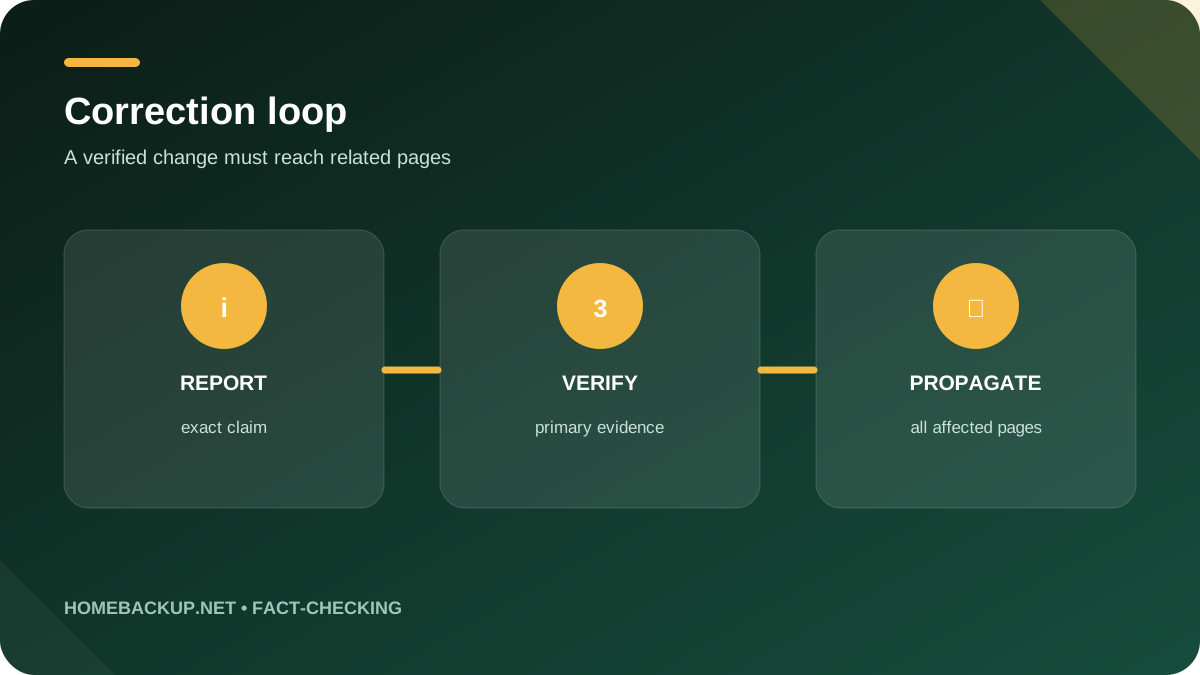
When a claim changes, editors assess downstream pages that repeat it. A capacity or product-name correction may affect a comparison, brand hub, best list, calculator example, and internal link. The correction process therefore includes a search for related content rather than changing one visible sentence and leaving the error elsewhere.
Evidence records and transparency
Research records should retain the source title, URL, access or document date, model and region, relevant section or table, calculation assumptions, and the editorial decision. These records support later updates without encouraging stale copy. Public pages link to useful primary sources when possible, while internal notes may preserve additional detail.
Readers are not expected to trust an invisible process. Pages expose important assumptions, configurations, limitations, review dates, and sources. The Corrections Policy explains how a reader can challenge a claim and what happens when a material error is confirmed.
Language and context checks
Fact checking includes the words around a number. “Up to,” “continuous,” “surge,” “typical,” “nominal,” “usable,” “supported,” and “compatible” each carry conditions. Removing a qualifier can make a copied number false even when the digits are correct. Reviewers compare the draft sentence with the source context, footnotes, table headings, and installation prerequisites.
Units receive special attention. Watts and watt-hours are not interchangeable. AC and DC ratings are not blended. Volts, amps, phases, fuel types, distances, temperatures, and time periods remain attached to their figures. A conversion is shown or reproducible. Regional units can be provided for convenience, but the original rating and model scope remain clear.
Image captions, metadata, alt text, tables, FAQ answers, structured data, and link labels can repeat a claim outside the main paragraph. They are included in the review. A corrected body sentence does not resolve a conflicting search description or graphic. This broader check prevents a reader from encountering two different answers on the same page.
Handling uncertainty and missing evidence
Not every question has a published technical answer. When evidence is incomplete, the site can state what is documented, identify the missing point, and explain how the uncertainty affects the decision. It must not fill the gap with an average from a different product or an assumption presented as fact. A manufacturer support response is attributed and dated when it is the only available source.
Uncertainty can change a verdict. If generator charging is announced but the compatible adapter, charge rate, or operating conditions are not documented, the page cannot value it like a proven feature. If a warranty is unclear about labor, the page should not promise full replacement service. If a battery’s surge duration is unpublished, a difficult motor start remains unverified.
A narrower recommendation is sometimes the most accurate outcome. The page may recommend the system for documented 120-volt essentials while withholding a conclusion about a 240-volt pump. This protects the reader and creates a clear update target when stronger evidence appears. The unresolved item is recorded for the next review.
Frequently asked questions
Are all numbers checked against two sources?
Not mechanically. A current primary document can be stronger than two copied secondary sources. High-impact or conflicting claims receive additional corroboration when available.
How are discontinued products handled?
The page identifies the product as discontinued or older when confirmed, preserves useful owner information, and avoids presenting it as a current default. Redirects are used only when another page fully satisfies the same intent.
What happens if a manual and marketing page disagree?
The dated technical manual normally carries more weight for conditions and installation. The disagreement is investigated by model, region, and revision, and may be disclosed if it remains material.
Are retailer specifications acceptable?
They can help locate a question but are not preferred evidence. Important specifications should be confirmed with the manufacturer or another authoritative primary source.
How are calculations rounded?
Intermediate math keeps sufficient precision, while the displayed result is rounded to a level appropriate for planning. Rounding must not hide a threshold such as voltage, outlet current, or startup capacity.
Can a manufacturer demand removal of criticism?
A manufacturer can submit evidence. Supported factual corrections are made. Valid criticism or scenario-based judgment is not removed solely because it is commercially inconvenient.
How are legal or tax claims checked?
The relevant government authority is preferred, the effective date and jurisdiction are recorded, and the page states that general information is not individualized professional advice.
How do I submit evidence?
Use the Contact page, select Correction, identify the exact URL and statement, and provide a current document or official source. Do not send confidential or restricted material.
Sources and policy review basis
Policy reviewed July 22, 2026. Laws, program rules, search guidance, advertising requirements, product documents, and site practices can change.
- Google Search Central: structured data introduction
- CPSC: carbon monoxide safety center
- UL Solutions: energy storage system testing and certification
- NREL: PVWatts Calculator
- U.S. Department of Energy: permitting and inspection
These pages describe the site’s editorial and operational standards. Privacy and legal pages are general templates for the documented site behavior, not a substitute for advice about the operator’s specific obligations.