Installer request
A useful quote request describes the property, outage priorities, electrical service, fuel, solar, preferred architecture, critical loads, timeline, and location. The form below sends the request to the HomeBackup.net site administrator without storing it in WordPress.
Practical answer
Complete the load plan and project facts before submitting. The form emails your request to the site administrator for review; it does not automatically match you with a contractor or guarantee a response, price, installer availability, or project approval. Do not send medical records, payment information, government identifiers, or other sensitive personal data.
Battery, standby generator, inlet or transfer, hybrid, or an undecided planning request.
ZIP code, home type, electrical service, existing solar, fuel, and likely equipment location help triage.
Refrigeration, pumps, heating, cooling, internet, medical planning, and 240V loads shape the design.
Permit, utility, product availability, fuel, service, trenching, and inspections affect schedule.
Submission requires clear permission for HomeBackup.net to contact you about this request.
The theme emails the administrator and does not save the submission as a WordPress lead record.
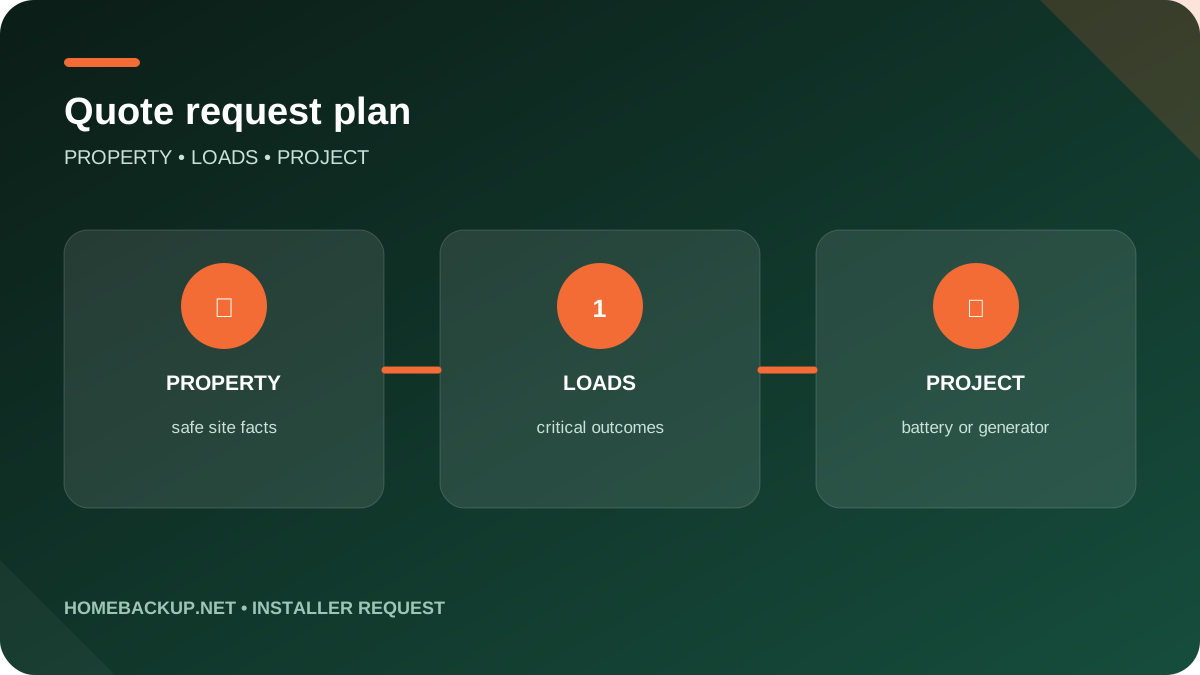
Start with the project boundary
Use the Home Backup Calculator before the form when possible. Write the critical loads, largest 240V equipment, motor starts, target outage duration, and acceptable load shedding. A contractor can refine the numbers, but a clear homeowner scenario produces better first conversations.
Gather property facts without opening electrical equipment. Photograph the exterior of the electrical panel and its visible label only if it is safe, note the main-breaker rating, identify existing solar or generator equipment, record gas or propane availability, and describe possible battery or generator locations. Do not remove a panel cover or access live equipment.
The form is intentionally a first-contact brief, not a binding quote. Installation pricing requires a qualified site survey, design, authority review, and written contract. HomeBackup.net may review or forward a request only with appropriate follow-up and does not approve electrical or fuel work through this form.
An installation should begin with a written operating scenario. Identify the circuits that must work, the largest loads that may overlap, the required outage duration, the desired transfer behavior, and how the system will recover after stored energy or fuel is used. This prevents the project from being reduced to a product name or a headline power rating.
Keep four checks separate. Electrical capability asks whether voltage, continuous output, surge, conductors, breakers, and transfer equipment match the load. Energy or fuel asks how long the plan can operate. Installation compliance asks whether the equipment, location, plans, permit, utility process, and inspections are acceptable. Ownership asks who will operate, maintain, update, and service the system after commissioning.
What the project actually includes
A complete request identifies project type, property type, ZIP code, homeownership or authority to request work, existing solar, preferred backup source, critical loads, 120/240V requirements, electrical service, fuel, desired automatic transfer, possible location, timeframe, contact details, and a concise description of the outage problem.
Do not include sensitive information. A ZIP code is enough for early geographic screening; do not send a full street address until you choose to engage a verified contractor through an appropriate channel. Do not include health diagnoses, medical-device serial numbers, financial account data, tax identifiers, identity documents, utility account credentials, alarm codes, or access instructions.
After contact, verify the identity and credentials of any installer independently. Use the installer selection guide, obtain multiple site-specific written proposals, and do not treat an introduction as an endorsement, warranty, or safety approval.
Information that improves an installation request
| Project decision | What changes | Risk if omitted | Evidence to request |
|---|---|---|---|
| ZIP code | Identifies likely service area, climate, and jurisdiction | Full address is unnecessary for initial screening | Five-digit ZIP only |
| Project type | Routes battery, generator, transfer, or hybrid expertise | The request reaches a firm with the wrong trade capability | Selected architecture or “not sure” |
| Property type | Changes service, ownership, placement, and association rules | Apartment or rental constraints are missed | Single-family, multifamily, rental, or other |
| Electrical service | Helps identify likely panel and voltage questions | The first call assumes unsupported loads | Visible main rating or “unknown” |
| Existing solar | Changes inverter, utility, and outage-mode design | Solar may be assumed to work during outages when it does not | System type or “unknown” |
| Fuel availability | Routes natural gas, propane, or battery planning | Generator feasibility and output assumptions are wrong | Utility gas, propane, neither, or unknown |
| Critical loads | Defines the outcome and sizing conversation | A vague whole-home request hides priorities | Named appliances and consequences |
| 240V loads | Changes source and transfer architecture | Well pumps or HVAC remain unavailable | List pumps, HVAC, range, dryer, water heat, or EV |
| Timeline | Supports realistic scheduling and urgency | A storm deadline is promised without approvals | Flexible, seasonal, or urgent planning |
| Consent and contact | Authorizes a response to this specific request | Unwanted contact or unclear purpose | Email and optional phone with explicit consent |
The decisions in this table interact. Moving a battery may change conductor length, fire review, wall construction, communications quality, and labor. Adding central air may change inverter power, battery count, load management, panel work, and commissioning. A lower equipment quote can become the higher installed price when it omits required electrical or site work.
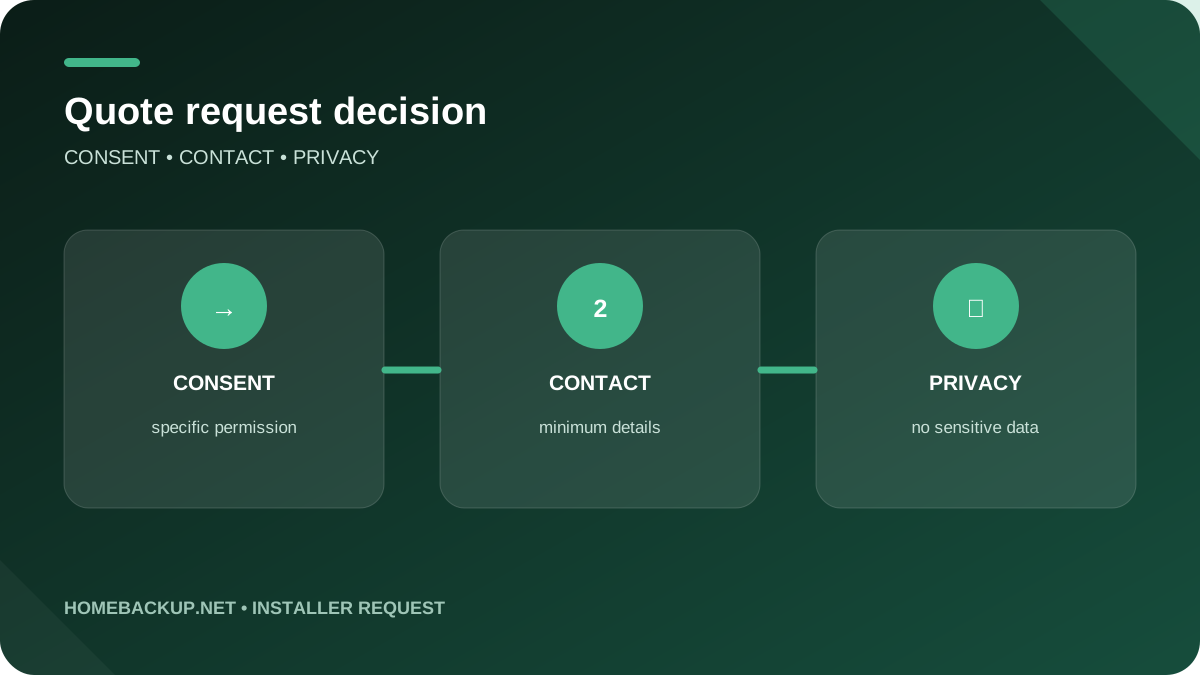
Three strong request examples
“Single-family home, existing 7 kW grid-tied solar, 200A service. Need automatic refrigerator, freezer, internet, furnace blower, sump pump, and selected lights for about 24 hours. Central air can be shed. Interested in an expansion-ready battery.”
“Rural home with propane, 120/240V service, 240V well pump, gas furnace blower, refrigerator, freezer, sump pump, and internet. Need automatic operation and a managed central-air option. Request load and propane assessment.”
“Frequent multi-day outages. Want quiet overnight battery power, solar recovery where practical, and generator charging for bad weather. Critical loads are well, refrigeration, furnace, internet, lighting, and home office. Need site survey and architecture comparison.”
These examples are planning patterns, not universal designs or price promises. The authority having jurisdiction, utility, building type, electrical service, fuel supply, available working space, climate, flood exposure, equipment listing, and manufacturer instructions can change the approved solution. A project should be priced against the actual site after those constraints are known.
How cost and quotes should be structured
The form does not calculate or promise price. A real proposal must normalize equipment, energy, output, transfer, protected loads, panel and service work, fuel, placement, trenching, permits, utility, commissioning, monitoring, taxes, maintenance, allowances, exclusions, and financing. Use the completed battery and generator cost guides before comparing totals.
Ask for a cash proposal before applying financing, incentives, or projected bill savings. Current IRS instructions say residential clean-energy credits cannot be claimed for expenditures made after December 31, 2025. Do not allow an outdated 30 percent federal battery credit to be presented as a guaranteed 2026 net price.
An online introduction should never require immediate payment. Do not pay a lead service, salesperson, or contractor solely to receive a generic estimate. Verify the business, site survey, written scope, permit responsibility, contract, cancellation rights, and payment milestones first.
Compare quotes by normalized scope, not only by the total at the bottom. Separate equipment, design, electrical work, fuel work, concrete or mounting, trenching, communications, permit fees, utility fees, commissioning, taxes, monitoring, maintenance, and optional upgrades. Ask which allowances can change and which items are fixed.
In July 2026, a proposal should not automatically subtract a U.S. federal residential clean-energy tax credit from the price. Current IRS instructions state that residential clean-energy credits cannot be claimed for expenditures made after December 31, 2025. State, local, utility, manufacturer, financing, or resilience programs may still exist, but eligibility and funding must be verified directly before they are included in a net-cost claim.
Permits, inspection, utility, and commissioning
A quote request can identify jurisdiction and likely project type, but only the local authority and utility determine the actual approval path. The installer should confirm adopted code editions, permits, inspections, battery fire review, generator placement, fuel permits, service work, solar interconnection, and homeowner-association requirements.
Ask bidders to include design, permit submission, correction response, fees, inspection scheduling, utility application, and final closeout as specific lines. “Permits by owner” can transfer substantial technical and schedule risk to the homeowner.
Do not accept equipment installation before required approval based on an email lead response. The site survey and contract should name the permit holder and responsible trade professionals. Final payment should be tied to inspection, utility authorization where required, commissioning, and documents.
The National Electrical Code is a benchmark for safe electrical design and installation, but it becomes enforceable through adoption. The locally adopted edition and local amendments matter. The authority having jurisdiction may include electrical, building, zoning, planning, and fire officials. A utility may have a separate review when equipment can operate in parallel with the grid, export energy, change service equipment, or participate in a program.
Keep the approved plans and final records. A complete handoff commonly includes permit closeout, inspection approval, utility authorization where required, equipment serial numbers, warranty registrations, as-built diagrams, settings, shutdown instructions, monitoring access, maintenance schedule, and test results. A system that turns on is not necessarily a closed project.
What changes in a real home?
The administrator email used by the form comes from WordPress Settings. The theme sends the submission through the site email configuration and does not create a lead post, custom database table, or browser-accessible profile. Email servers and site infrastructure can still process and retain messages according to their own settings.
The form uses a WordPress nonce, a hidden honeypot, timing check, and short rate limit to reduce abuse. These controls do not guarantee spam prevention or email delivery. The site owner should configure authenticated transactional email, test delivery, protect the administrator mailbox, and keep WordPress and the theme updated.
Before promoting the form, the site owner should review the published privacy policy, contact identity, consent language, retention practices, response process, any installer-sharing procedure, and applicable privacy and lead-generation requirements. The default form does not automatically share the request with third parties.
Existing conditions frequently control the schedule. Older panels, crowded gutters, obsolete breakers, inadequate working clearance, mixed neutrals and grounds, unpermitted alterations, weak walls, flood-prone locations, long conductor routes, missing gas capacity, and unreliable communications can all require redesign. A site survey should find these before equipment arrives.
Household priorities matter too. A sump pump during a storm, a furnace during extreme cold, refrigeration for medicine, a well pump, and medically necessary equipment need a different reserve strategy than entertainment or convenience loads. The project should document which loads may be shed, which must restart automatically, and which need a second independent contingency.
Common quote-request mistakes
A common thread connects these errors: the buyer is shown a component while the home needs a system. The battery, generator, inlet, panel, transfer device, controls, fuel source, utility service, and selected loads must work together under normal power, outage power, restoration, maintenance, and failure conditions.
What to verify before signing and before final payment
Before submitting, verify that you have authority to request work, the email and phone are correct, the ZIP code and project type are accurate, the critical loads are named, and no sensitive data appears in the notes. Save your own copy of the project brief because the theme does not store it in WordPress.
Before engaging anyone who responds, verify legal business name, location, trade licenses, insurance, manufacturer authorization, subcontractors, comparable experience, references, permit responsibility, written site-specific scope, cash price, financing, contract, commissioning, warranties, service, and closeout. Never grant remote system or utility-account access during an initial sales contact.
Verify business and trade credentials with the issuing authority, not only with a logo on a proposal. Confirm who holds the contract, who pulls the permit, who performs electrical and fuel work, who provides engineering when required, and who will answer warranty calls. If subcontractors are used, ask for their company names and applicable credentials before work begins.
The Federal Trade Commission recommends multiple written estimates, a detailed written contract, contractor identity and license information, start and completion timing, and avoiding full payment upfront. Payment rules vary by state. Keep changes in writing and tie the final payment to the contract milestones, completed inspection, working commissioning test, and receipt of promised documents.
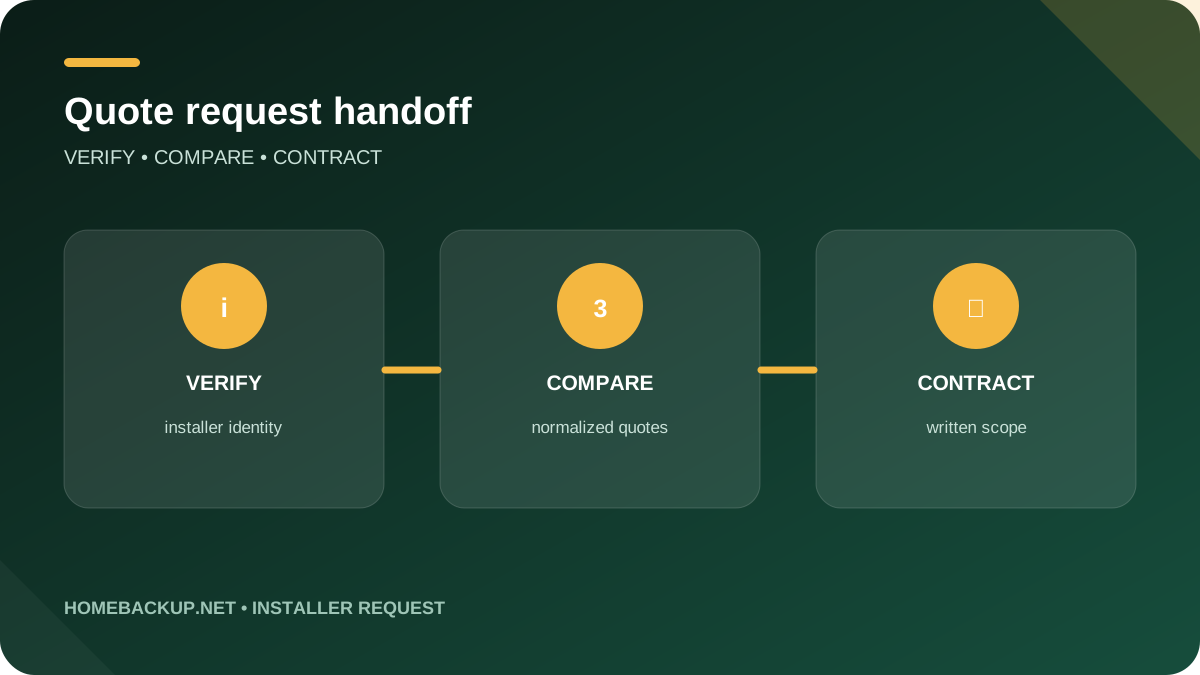
Safety boundaries
Do not use the request form for an electrical, battery, fuel, carbon monoxide, fire, flooding, or medical emergency. Contact emergency services or the relevant utility and follow the equipment emergency instructions. A form submission is not monitored as an emergency channel.
Do not open electrical panels, expose service equipment, enter a flooded area, approach damaged battery equipment, or run a generator indoors to gather information for a quote. A safe exterior photo and written “unknown” are better than hazardous inspection by the homeowner.
Portable generators must operate outdoors and away from the home, doors, windows, vents, garages, crawlspaces, and other enclosed or attached areas, following current CPSC guidance and the manufacturer’s instructions. Use working carbon monoxide alarms. A transfer switch or interlock prevents source overlap; it does not make unsafe generator placement safe.
A quote-request workflow
- 1
Calculate the first load scenario
List critical circuits, voltage, motor starts, duration, reserve, and loads that can be shed.
- 2
Gather safe property facts
Record ZIP, property type, visible service information, solar, fuel, and possible locations.
- 3
Submit only necessary contact details
Use email, optional phone, and a concise project description without sensitive data.
- 4
Review the administrator response
Clarify whether the request can be handled or introduced, without assuming endorsement.
- 5
Verify and compare installers
Use at least three qualified site-specific written proposals when practical.
- 6
Contract only after design review
Resolve equipment, scope, permits, price, financing, commissioning, warranty, and closeout.
Describe the backup project
This form emails the WordPress administration address. It does not save the submission as a lead record or automatically share it with installers.
Related completed guides
Frequently asked questions
Does this form give me an instant quote?
No. It emails a structured request to the HomeBackup.net site administrator. Installed pricing requires a qualified site survey, design, local approval path, exact equipment, and written contractor proposal.
Will my request be saved in WordPress?
The default Theme 1.7.0 handler does not create a WordPress lead record or custom database entry. It emails the administration address. Email and hosting infrastructure may process or retain the message under their own configuration.
Will my information be sent to installers?
Not automatically. The default theme emails only the site administrator. Any later sharing should occur only through a disclosed, consent-based process that the site owner establishes and reflects in the privacy policy.
What information should I avoid?
Do not send full payment or bank information, Social Security or tax numbers, identity documents, utility login credentials, alarm or gate codes, medical records, diagnoses, or other sensitive data. Use only the minimum project and contact information.
Can renters submit a request?
Only if they have authority to request the conversation and understand that permanent electrical, fuel, battery, or generator work requires property-owner approval and any building or association permissions. State your property status clearly.
What if the form says it could not send?
Copy your project summary before retrying. The site owner should verify the WordPress administration email and authenticated mail delivery. Do not submit repeatedly; the form includes a short rate limit.
Can I use this guide as an electrical design?
No. This guide organizes homeowner decisions and quote questions. It does not select conductors, breakers, overcurrent protection, grounding, bonding, transfer configuration, fire separation, or service equipment for a property. Use the current product instructions and appropriately qualified professionals.
Which code edition applies to an installation quote request?
The edition adopted by the state or local authority having jurisdiction, including local amendments, applies. The newest published NEC or NFPA standard is not automatically the enforceable edition. Ask the permit office and installer to identify the adopted requirements used for the plans.
How this guide was prepared
HOMEBACKUP.net separates product capability from site approval and installation design. This guide uses current government, standards-organization, testing, credentialing, and manufacturer material where appropriate. It does not reproduce a local code, approve equipment, provide engineering, create a contractor relationship, or replace the current instructions for the exact system.
Requirements change with the locally adopted code edition, amendments, product listing, site conditions, utility rules, and project scope. Treat dates, incentives, fees, and cost bands as items to recheck. Obtain a site-specific design and written quote from appropriately qualified professionals before purchasing installed equipment.
Sources and review basis
Reviewed July 22, 2026. Installation, cost, permitting, code, and incentive information can change and must be verified for the property.
- Federal Trade Commission: How To Avoid a Home Improvement Scam
- U.S. Department of Energy: Choosing a Solar Installer
- U.S. Department of Energy: Step-by-Step Guide for Consumers Going Solar
- U.S. Department of Energy: Permitting and Inspection for Rooftop Solar
- IRS: Instructions for Form 5695 (2025), termination of residential credits
Product listings, installation instructions, code editions, utility programs, permits, contractor rules, fees, and incentives can change. Use current documents and the authority having jurisdiction for the actual project.
Use the form above to prepare the first conversation
Submitting the form is only the start. Review the installer selection guide and obtain a site-specific written design before signing or paying for installed work.