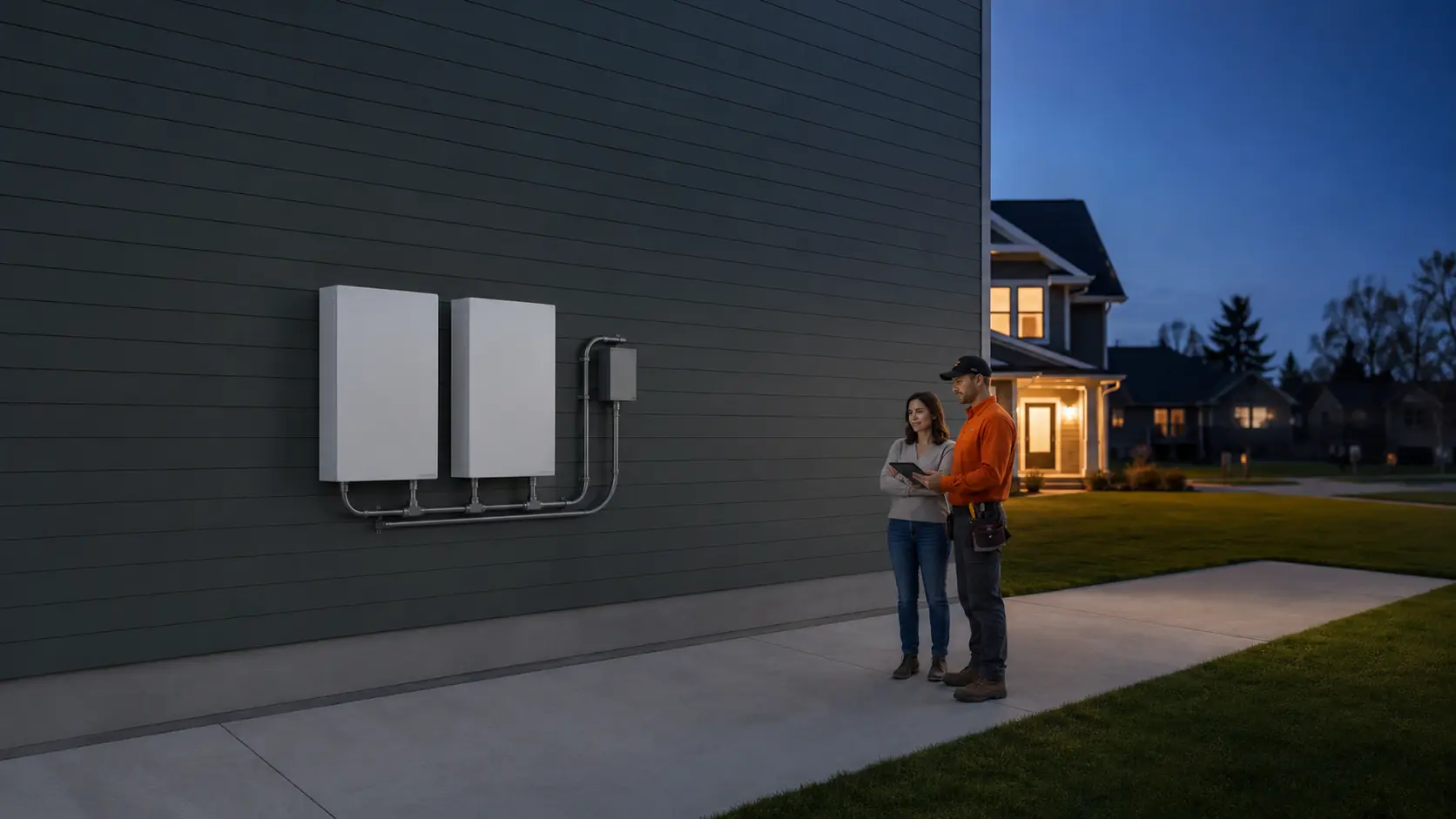
Residential battery planning guide
A home battery can keep selected circuits running quietly and automatically when the grid fails, but the word “battery” hides several separate limits. Storage capacity controls duration. Inverter output controls how much can operate at once. Surge capability controls whether motors can start. Voltage and connection hardware control which circuits the system can serve. A dependable plan has to satisfy all four.

The best home battery is the one that carries your priority loads to the next reliable recharge window
For many homes, the strongest battery plan is not “run everything.” It is a controlled set of circuits for refrigeration, internet, efficient lighting, medical or accessibility needs, heating controls, and one carefully verified pump. Larger systems can support broader circuits and selected 240V loads, but central HVAC, electric resistance heat, water heating, cooking, clothes drying, and EV charging can consume storage very quickly.
Start with the outage service you want, not a battery model. Decide what must remain available, what may run in rotation, and what can stay off. Then calculate simultaneous watts, the hardest motor start, daily kilowatt-hours, required voltage, and the time until grid, solar, or an approved charging source can refill the battery.
Direct-to-device backup
A portable power station supplies selected plug-in loads without permanent panel work. It is the simplest route for renters, apartments, home offices, and a small 120V load list.
Compare portable stationsEssential-circuit battery
An installed battery or panel-connected system protects a defined group of circuits. It preserves runtime and makes household behavior easier to control during an outage.
Plan essential loadsWhole-home capable system
A larger split-phase system can energize much of the panel, but load management is still important. “Whole-home connected” does not mean every large load can run together.
Plan broader coverageBattery plus recovery
Solar or controlled generator charging can extend a battery beyond its initial stored energy. The design must model daily load and realistic daily recovery separately.
Explore hybrid systemsSystem architecture
How home battery backup works during a grid outage
A home battery system is more than a box of battery cells. A complete installed system normally includes stored energy, an inverter or power-conversion system, monitoring and controls, isolation or transfer equipment, overcurrent protection, and a connection to either selected circuits or a broader service panel. Some systems use one integrated enclosure. Others combine several listed components.
When the grid is available, the battery charges according to its controls and reserve setting. When the grid fails, the system must stop exporting power to utility lines and create a protected electrical island for the home. The battery and inverter then establish the voltage and frequency required by the backed-up loads. This transition may feel instant to many appliances, but transfer behavior is configuration-specific and should not be assumed to equal a true uninterruptible power supply for every sensitive device.
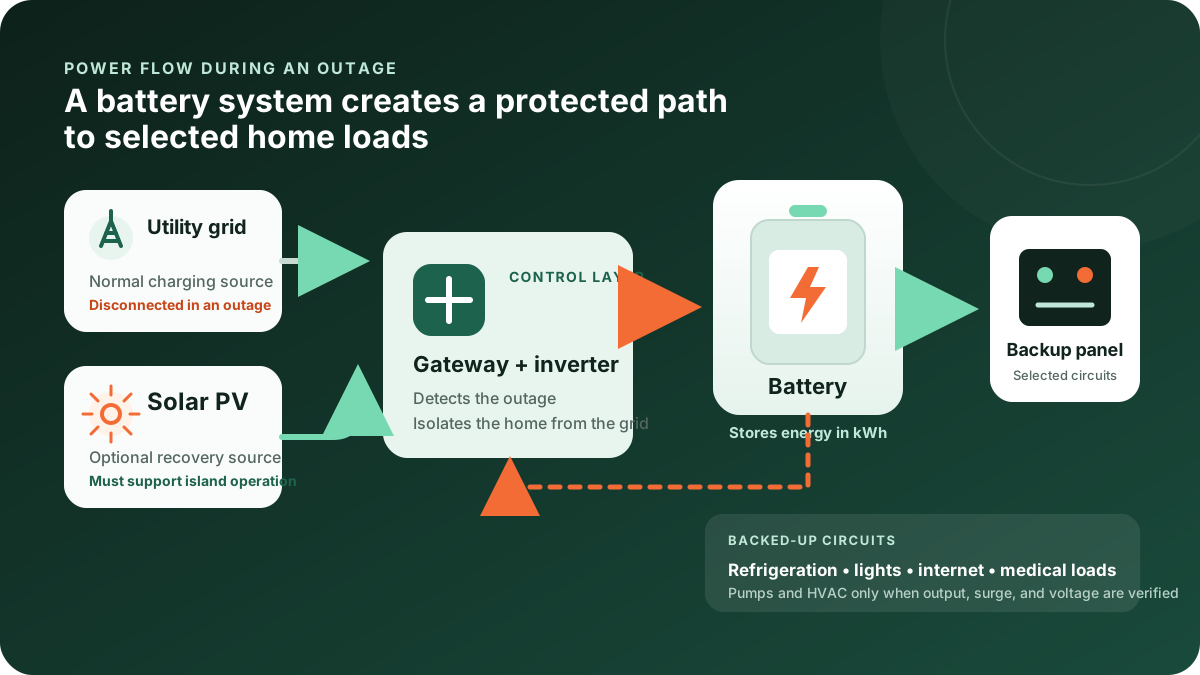
A normal grid-tied solar system is designed to stop energizing the grid when utility power fails. Outage operation requires compatible controls and an inverter architecture that can safely isolate and energize the protected loads. A battery can provide that grid-forming role only when the complete configuration is designed and commissioned for it.
Battery modules
Store energy measured in kilowatt-hours. The usable amount may be lower than the nominal label and changes with reserve settings, temperature, age, and operating limits.
Inverter
Converts battery DC power into household AC power. Its continuous output, short-duration surge, voltage, per-leg limits, and operating temperature matter.
Gateway or transfer equipment
Detects an outage, isolates the protected system from the utility, and coordinates the switch between normal and backup operation.
Load controls
Keep discretionary circuits off, sequence large loads, and prevent the household from asking the battery to start or carry more than it can support.
Sizing foundation
Four numbers determine whether a home battery plan works
Battery marketing often leads with capacity, but capacity is only one part of the requirement. A system can have many kilowatt-hours and still shut down when a pump starts, fail to support a 240V circuit, or deliver less runtime than expected because the household left too many loads on.
The combined demand of loads that may operate at the same time.
The brief higher demand created by compressors, pumps, blowers, and other motors.
The energy available to run the load plan over time.
The voltage, split-phase behavior, and current available to the connected circuits.
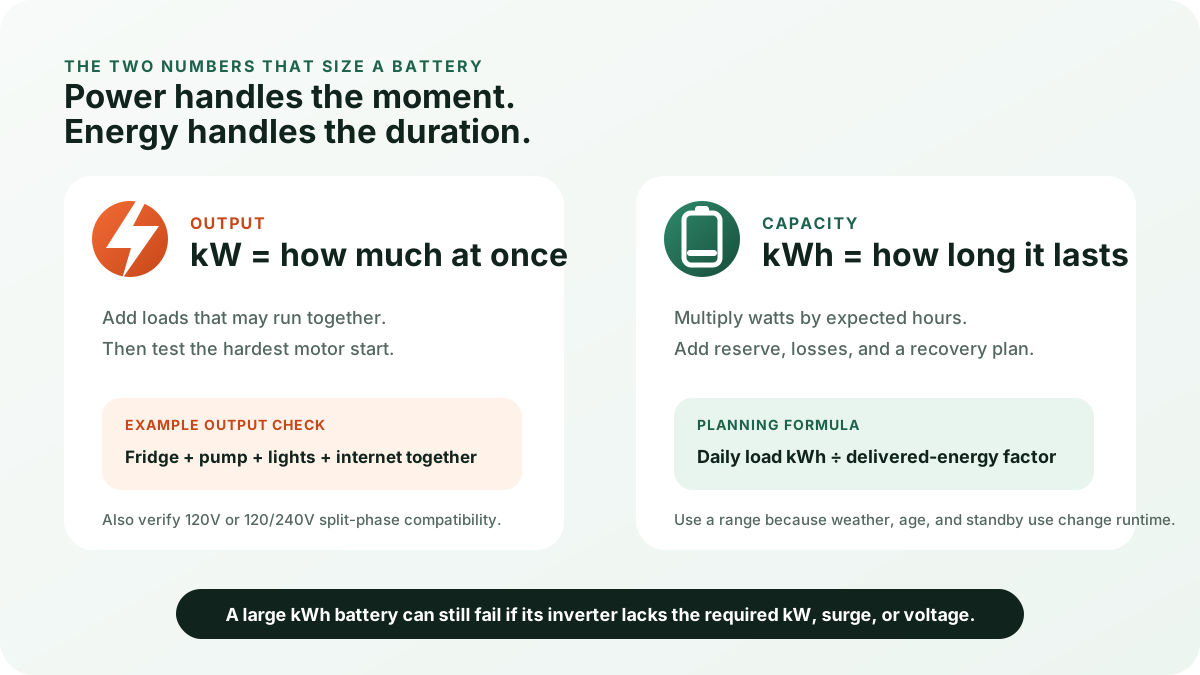
Other active running loads + one motor’s starting watts
Test each important motor start separately while the other loads expected to remain on are still included. This is more useful than comparing the inverter only with the single largest surge number.
Load watts × expected hours ÷ 1,000
Add each load’s kilowatt-hours, then account for conversion losses, reserve, standby consumption, cold or hot conditions, battery aging, and uncertainty in household behavior.
Use the Home Backup Calculator before comparing systems
Build a load list with runtime, voltage, motor surge, outage duration, and recharge assumptions.
Coverage strategy
Choose a backup level before choosing battery capacity
The phrase “home battery backup” can describe anything from a portable unit running a refrigerator and router to a permanently installed split-phase system connected across much of the electrical panel. The right level depends on safety priorities, outage duration, climate, fuel alternatives, and how much load management the household will accept.
| Coverage level | Typical priorities | Main planning constraint | Likely architecture |
|---|---|---|---|
| Device-level | Internet, electronics, CPAP, efficient lights, one refrigerator | Outlets, cords, runtime, manual setup | Portable power station or dedicated UPS |
| Core essentials | Refrigeration, communications, lighting, medical priorities, controls | Daily energy and disciplined circuit selection | Portable or installed essential-load system |
| Essentials plus one motor | Core essentials plus sump pump, well pump, or furnace blower | Motor surge, voltage, and start frequency | Higher-output battery with verified motor support |
| Selected comfort | More circuits, limited cooling or heating, cooking by rotation | Load sequencing and rapid energy use | Expandable split-phase battery with controls |
| Broad home coverage | Most circuits available, with selected large loads controlled | Per-leg current, 240V loads, service integration, recovery | Installed whole-home capable battery or hybrid |
A sensible design can connect broadly while operating selectively. Smart panels, load controllers, or a well-designed backup panel can make more circuits physically available without allowing every heavy load to run at once. That distinction helps a household preserve convenience while protecting the battery from overload and early depletion.
A system may be connected to the main panel and still require the electric range, dryer, water heater, EV charger, resistance heat, or central air conditioner to stay off during an outage. Ask for a written list of loads that may run simultaneously and loads that will be blocked or sequenced.
Load planning
Build the battery around what the household must keep doing
A good load plan uses actual appliance labels, measurements, and expected outage behavior. Generic wattage charts are useful for a first pass, but two homes with similar appliances can have different compressor sizes, pump voltages, heating systems, duty cycles, and weather exposure.
-
1
List safety and continuity loads
Start with medical devices, accessibility equipment, refrigeration, communications, lighting, security, heating controls, sump pumping, well water, and any equipment that protects the structure. Treat medical backup as a separate resilience plan with provider guidance, spare supplies, and a relocation option when needed.
-
2
Separate continuous, cycling, and scheduled use
A router may run continuously. A refrigerator cycles. A CPAP may need a full overnight session. A microwave runs briefly at high power. Do not simply divide every appliance’s daily use evenly across a short outage.
-
3
Identify every motor and 240V circuit
Record running watts, starting watts or motor data, voltage, and whether the load must start automatically. Pumps, compressors, blowers, and central HVAC deserve individual verification.
-
4
Define simultaneous operation
Decide which loads may overlap and which can be rotated. Cooking after the well pump stops is different from demanding both at once. Managed overlap can reduce the required inverter size without reducing essential service.
-
5
Set the autonomy and recovery target
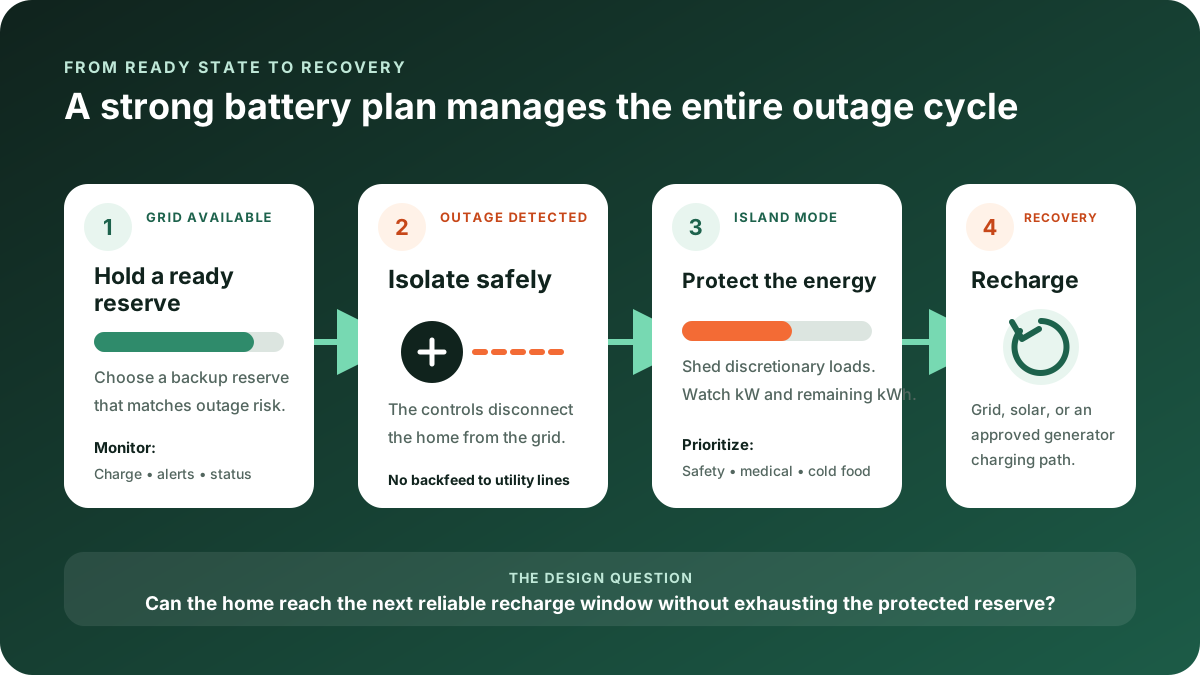
Choose how long the system must operate before dependable recharge. For solar, use realistic weather-adjusted daily production. For grid-only charging, the battery must cover the entire target outage or the household needs another recovery source.
Life, health, and structure
Medical and accessibility needs, alarms, sump protection, heating controls in freezing weather, and other time-critical loads.
Food and communications
Refrigerator, freezer, modem, router, phones, efficient lighting, and limited home-office equipment.
Water and limited comfort
Well pump, furnace blower, fans, room cooling, and short cooking loads when output and remaining energy permit.
High-energy convenience
EV charging, resistance heat, electric water heating, clothes drying, broad central cooling, and unrestricted cooking.
Power quality and compatibility
Continuous output is only the first inverter check
The inverter must carry the steady load, start important motors, deliver the correct voltage, and remain within its per-leg current limits. A headline watt number can hide restrictions that matter in a North American split-phase home.
Compare the normal rating with the loads that may operate together. Check whether the rating changes in backup mode, at low state of charge, or at temperature extremes.
Look for short-duration surge behavior, motor-start ratings, or manufacturer guidance for the exact equipment. A soft starter can help some compatible air-conditioning loads, but it is not a universal fix.
A 240V well pump, heat pump, range, dryer, or central air conditioner needs a configuration that actually supplies the required voltage. A 120V-only battery cannot create split phase through capacity alone.
A split-phase total watt rating can still be limited on one 120V leg. The circuit arrangement and load balance may determine whether the system can support the plan.
Verify transition time and whether sensitive devices require their own UPS. Some equipment resets during even a short interruption.
For solar recovery during an outage, confirm the system can establish the local grid, restart from a depleted state as designed, and coordinate PV without exceeding charging limits.
The safest planning language is configuration-specific. “This model supports 240V” is incomplete if that feature requires paired inverters, a separate hub, a particular panel, or restricted outlet use. Ask the installer to document the exact hardware path, backed-up circuits, maximum simultaneous output, motor-start assumptions, and any automatic load-control rules.
Energy and runtime
Battery capacity should be a planning range, not a single perfect number
Nominal battery capacity is not the same as energy delivered to household loads. The plan should account for the allowed depth of discharge, backup reserve, DC-to-AC conversion, system standby use, wiring and conversion losses, battery temperature, age, and uncertainty in appliance duty cycles.
Use a documented factor or a conservative range. Do not assume every labeled kilowatt-hour reaches the appliances.
| Runtime variable | Why it changes the result | How to plan for it |
|---|---|---|
| Backup reserve | Some capacity may be held for outage readiness or battery protection | Confirm the user-adjustable reserve and the minimum operating floor |
| Conversion and standby loss | The inverter and controls consume energy before it reaches the load | Use delivered AC energy rather than nominal cell capacity |
| Temperature | Cold or hot conditions can affect available power, energy, and charging | Use the approved installation range and an environmental margin |
| Battery aging | Usable capacity declines over years and cycles | Size for end-of-warranty or long-term performance, not only day one |
| Household behavior | Open refrigerator doors, extra cooking, and unplanned loads raise use | Add a behavior margin and publish an outage load rule for the household |
| Weather-driven loads | Pumps, heating, and cooling may run more during the event that causes the outage | Model the stressful outage condition, not a mild average day |
Capacity expansion should solve a defined problem. Adding battery modules extends runtime, but it may not increase inverter output, motor-start capability, solar input, or charging speed. Check which limits expand with each module and which remain fixed at the inverter or gateway.
Outage recovery
Solar can extend a battery only after it covers the day’s active loads
A battery begins an outage with a finite amount of stored energy. Solar can reduce depletion or recharge the battery, but the useful recovery depends on array size, seasonal sun, cloud cover, shading, orientation, inverter behavior, battery state, allowed PV input, and the household load operating while the sun is available.
This is a planning estimate, not a production guarantee.
Those loads are served before surplus energy can refill the battery.
Clouds or a low PV input ceiling may reduce this sharply.
Solar is strongest when
- The array and battery are designed for outage operation together.
- The protected loads stay below realistic poor-weather production.
- The battery has enough overnight capacity to reach the next solar window.
- The PV input and inverter can accept the available array power.
- The system can restart and coordinate safely after a deep discharge.
Solar is not enough when
- Several cloudy days coincide with high heating, pumping, or cooling demand.
- The home expects unrestricted heavy-load operation.
- The battery reaches its lower limit before morning.
- The existing grid-tied solar lacks outage-capable controls.
- Shading, snow, damage, or storm conditions reduce production.
System types
Portable and installed batteries solve different home backup problems
These categories increasingly overlap. Some large portable systems can connect to selected home circuits through approved equipment, while some installed systems are modular. The useful distinction is how the configuration connects, transfers, expands, and operates during an outage.
| System type | Best use | Connection | Main advantage | Main limitation |
|---|---|---|---|---|
| Small portable power station | Electronics, internet, medical support, lighting, limited refrigeration | Direct plug-in loads | Flexible and simple | Limited output, energy, and circuit access |
| Expandable portable system | Larger essential-load plan, RV crossover, temporary or semi-integrated use | Direct outlets or approved home-integration equipment | Mobility plus an expansion path | More modules, cables, floor space, and configuration complexity |
| Installed essential-load battery | Automatic protection for selected circuits | Backup panel or controlled circuit group | Predictable load boundary and longer practical runtime | Circuits outside the protected group remain unavailable |
| Whole-home capable battery | Broad panel access, solar integration, higher output, automation | Service equipment, gateway, or smart panel | Convenient and scalable home operation | Installation complexity and heavy-load energy demand |
| Battery-generator hybrid | Critical continuity plus multi-day recovery | Designed control and charging architecture | Quiet battery operation with fuel-backed endurance | Two systems to integrate, maintain, and operate safely |
Battery chemistry is one selection factor, not a substitute for system-level safety. Lithium iron phosphate is common in modern backup products because of its cycle-life and thermal characteristics. Other lithium-ion chemistries may offer different energy-density and performance tradeoffs. For an installed system, prioritize the certification and compatibility of the complete battery, inverter, controls, and enclosure, along with the approved location and installation instructions.
Installation and safety
A home battery is electrical and life-safety equipment
Permanent battery installation is not a general do-it-yourself project. Location, mounting, clearances, protection, disconnects, wiring, service capacity, panel configuration, permits, utility rules, commissioning, labeling, and emergency access can all matter. Requirements vary by jurisdiction, adopted code edition, battery type, energy capacity, and manufacturer instructions.
Use a listed system in an approved location and preserve emergency information
UL explains that UL 9540 evaluates the energy storage system as a combination of batteries, power conversion, controls, and related equipment. UL 9540A is a test method used to evaluate thermal-runaway fire propagation behavior. A component label or a portable battery claim does not automatically make a field-assembled stationary system suitable for residential installation.
- Confirm the complete system listing and the exact approved configuration.
- Follow manufacturer instructions and the local authority having jurisdiction.
- Keep required clearances, ventilation conditions, working space, and access.
- Protect equipment from impact, water, unsuitable temperatures, and unauthorized access.
- Retain shutdown instructions, installer contacts, permits, diagrams, and warranty records.
- Tell household members what to do if the system reports a fault, odor, heat, damage, smoke, or unusual sound.
Residential battery incidents can involve high energy and evolving fire hazards. The U.S. Fire Administration notes that lithium-ion energy storage incidents may involve thermal runaway, flammable gases, rapid fire growth, and explosion hazards. Do not open, move, spray, or troubleshoot a smoking, hissing, hot, swollen, damaged, or faulted installed battery. Leave the area, call emergency services, and follow the system manufacturer’s emergency guidance from a safe location.
Can the location support the equipment?
Review structure, environmental exposure, access, clearances, vehicle impact, flood risk, heat, cold, drainage, and proximity to openings or ignition sources as required by the approved design.
Can the service and panels support the design?
Document service rating, main panel, subpanels, grounding, neutral arrangement, solar equipment, generators, transfer hardware, and the exact circuits to be backed up.
Has the system been tested as an outage system?
Verify transfer, backed-up circuits, load controls, motor starts, app alerts, shutdown procedures, reserve behavior, solar recovery, and any generator-charging sequence.
Who monitors and maintains it?
Set alert contacts, inspect the site, keep software and communications working, test the household outage procedure, and schedule service according to the manufacturer and installer.
Compare battery, standby generator, portable generator, and hybrid backup
Match quiet operation, fuel-backed duration, automation, property limits, and manual work to your outage pattern.
Worked planning profiles
Three homes can need very different batteries
These profiles show the reasoning process, not equipment prescriptions. Actual appliance labels, motor data, climate, outage duration, reserve, installation, and recharge conditions must replace the illustrative assumptions.
Quiet overnight essentials
Loads: refrigerator, modem and router, several LED lights, phones, and an overnight medical or sleep device.
Design focus: modest continuous output, full scheduled overnight use, enough energy to reach morning, and a separate medical contingency.
Likely route: a portable or installed essential-load battery. A 120V configuration may be enough if every selected device is 120V.
Refrigeration plus a sump pump
Loads: refrigerator, freezer, internet, lights, and a pump that may cycle frequently during the same storm that caused the outage.
Design focus: pump startup with the other loads active, worst-case cycle frequency, automatic operation, flood risk, and a conservative reserve.
Likely route: an installed essential-load system with verified motor support and enough daily energy for storm conditions.
Well water and selected comfort
Loads: core essentials, a 240V well pump, furnace controls or limited cooling, and short cooking periods.
Design focus: split-phase output, per-leg current, motor surge, load sequencing, larger daily energy, and a credible multi-day recovery source.
Likely route: a larger split-phase battery with controls, solar designed for outage recovery, or a battery-generator hybrid.
Selection checklist
Evaluate the complete configuration, not the battery name
Electrical capability
- Usable AC energy at the planned reserve
- Continuous and short-duration output
- 120V or 120/240V split-phase operation
- Per-leg current and load imbalance rules
- Motor-start evidence for critical equipment
Outage behavior
- Transfer behavior and sensitive-load continuity
- Backed-up circuits and automatic load shedding
- Black-start and low-state-of-charge behavior
- Manual controls if internet or cloud service is unavailable
- Cold, heat, and severe-weather operating limits
Recharge and expansion
- Grid charging rate and restoration behavior
- Solar array compatibility and outage operation
- Maximum battery and PV input
- Whether expansion adds energy, output, or both
- Approved generator-charging path, if required
Installation and ownership
- Complete system listing and approved location
- Permits, utility coordination, and inspection
- Warranty terms, service access, and monitoring
- Replacement and expansion compatibility
- Emergency shutdown and household instructions
Buying by kWh alone
The battery may have enough energy but too little inverter output, surge, voltage, or per-leg current for the load plan.
Calling every circuit essential
Uncontrolled electric heat, water heating, cooking, drying, cooling, and EV charging can turn a long-duration battery into a short event.
Counting perfect-weather solar
The outage may occur during clouds, snow, smoke, shade, or storm damage. Use a poor-weather scenario and preserve overnight capacity.
Ignoring the connection path
Outlets, circuits, panels, transfer hardware, solar, and generators must connect through an approved architecture. Never improvise panel backfeed.
Calculate first, then compare complete systems
Use measured or nameplate loads to establish the requirement. Then compare systems by the exact configuration needed to meet it.
Frequently asked questions
Home battery backup questions
How big should a home battery backup be?
There is no dependable size based only on house area. Add the energy used by priority loads over the target outage, then account for reserve, losses, temperature, aging, and uncertainty. Separately verify continuous output, motor-start demand, voltage, and current. The Home Backup Calculator can produce an initial planning range.
Can one battery power an entire house?
It may connect to much of the house, but operating every circuit is a different question. Large electric heating, water heating, cooking, drying, cooling, pumps, and EV charging can exceed the battery’s output or drain its energy quickly. Whole-home capable systems usually work best with load controls and household rules.
How long will a home battery last during an outage?
Runtime depends on delivered battery energy divided by the actual average load. A focused essential-load plan can last many times longer than unrestricted household use on the same battery. Solar or generator charging can extend runtime only when daily recovery exceeds the energy being used and remains within charging limits.
Will rooftop solar work when the grid is down?
Not automatically. Standard grid-tied solar normally stops exporting when the utility grid fails. Outage power requires compatible isolation, inverter controls, and an approved islanded configuration. Confirm the exact existing solar equipment and the proposed battery architecture.
Do I need a 240V home battery?
You need a 120/240V split-phase configuration if the backup plan includes a 240V load such as many well pumps, central air conditioners, heat pumps, electric ranges, dryers, or EV chargers. If the protected loads are all 120V, a 120V system may be enough. Check the equipment label and connection design.
Can I add more battery capacity later?
Only if the selected ecosystem, inverter, controls, software, warranty, and installation support expansion. Confirm the maximum number of modules, whether future modules must match, whether mixed ages are allowed, and whether expansion adds output or only runtime.
Is a home battery safer than a generator?
They have different hazards. A battery avoids combustion exhaust during discharge, while a generator introduces carbon monoxide, fuel, heat, and outdoor operating requirements. Batteries contain significant stored electrical and chemical energy and require listed equipment, an approved location, correct installation, monitoring, and emergency procedures. Safety depends on the complete system and its use.
Should I choose a battery or generator for multi-day outages?
A generator may offer longer fuel-backed operation, while a battery offers quiet, fast response and limited stored energy. A hybrid can use the battery for immediate and overnight coverage, then recharge it from solar or a properly integrated generator. Compare the actual loads, outage length, fuel access, solar conditions, property, and tolerance for manual operation.
Can a home battery replace a UPS?
Do not assume it can. Transfer time and power quality differ by system and configuration. Sensitive medical, networking, computing, or control equipment may still need a dedicated UPS that is compatible with the battery-backed electrical supply.
What should I ask an installer to provide?
Request a one-line diagram, equipment list, backed-up circuit schedule, output and motor-start assumptions, reserve and runtime model, solar or generator recovery model, location plan, permits, commissioning results, warranty terms, emergency shutdown instructions, and a clear explanation of what will not run during an outage.
Turn the battery concept into a verified home backup plan
Primary safety and technical references
- U.S. Department of Energy: Homeowner’s Guide to Solar
- UL Solutions: Energy Storage System Testing and Certification
- UL Solutions: UL 9540A Test Method for Battery Energy Storage Systems
- U.S. Fire Administration: Responding to Fires That Include Energy Storage Systems
- Ready.gov: Power Outages
Technical and safety review completed July 24, 2026. Equipment capability and installation requirements are configuration-specific and must be confirmed with current manufacturer documentation, the installer, the utility, and the local authority having jurisdiction.