
Essential-load planning
Essential-load backup is the most efficient way to make a limited battery, generator, or hybrid system genuinely useful. Instead of trying to preserve normal electricity use, it protects the smaller group of loads whose loss would affect health, food, water, communications, temperature safety, or the home itself.

Back up consequences, not the entire electrical panel
An essential load is not simply an appliance used every day. It is a device or circuit whose loss creates a meaningful problem during the outage you are planning for. That might be a medical device, sump pump, refrigerator, furnace blower, well pump, internet equipment, selected lighting, or a way to charge phones. The correct list changes with the people, property, weather, water source, heating system, and local outage pattern.
A strong plan passes four separate tests: enough continuous output for loads that may run together, enough surge power for motors, enough stored energy or fuel for the intended time, and the correct voltage and connection method. Reducing the list makes every one of those tests easier.
Plug-in battery backup
Best for a few cord-connected loads such as refrigeration, communications, medical equipment, lights, and device charging.
Compare portable systemsSelected-circuit battery
Best when the home needs clean switchover and a controlled group of circuits without energizing the entire panel.
Plan a home batteryGenerator and transfer
Best when outages can outlast practical battery capacity and safe outdoor operation, fuel, and manual work are acceptable.
Size generator outputBattery plus recovery
Best when quiet stored energy should cover routine use while solar or a generator restores energy during a longer event.
Compare all four routesStep 1: define the outcome
What counts as an essential load in your home?
Start with consequences rather than appliances. Ask what happens if a load is unavailable for four hours, overnight, one day, or several days. A refrigerator matters because food eventually becomes unsafe. A sump pump matters because one failed cycle during heavy rain may damage the property. A furnace blower may matter because a gas furnace cannot distribute heat without electricity. Internet equipment may matter for alerts, work, communication, or Wi-Fi calling.
The same appliance can move between priority levels. Air conditioning may be optional in mild weather but important for a person whose health is affected by extreme heat. A well pump may be managed for brief water-use windows rather than powered continuously. A freezer may tolerate a short outage with the door closed, while a medical refrigerator may require a device-specific temperature and power plan.
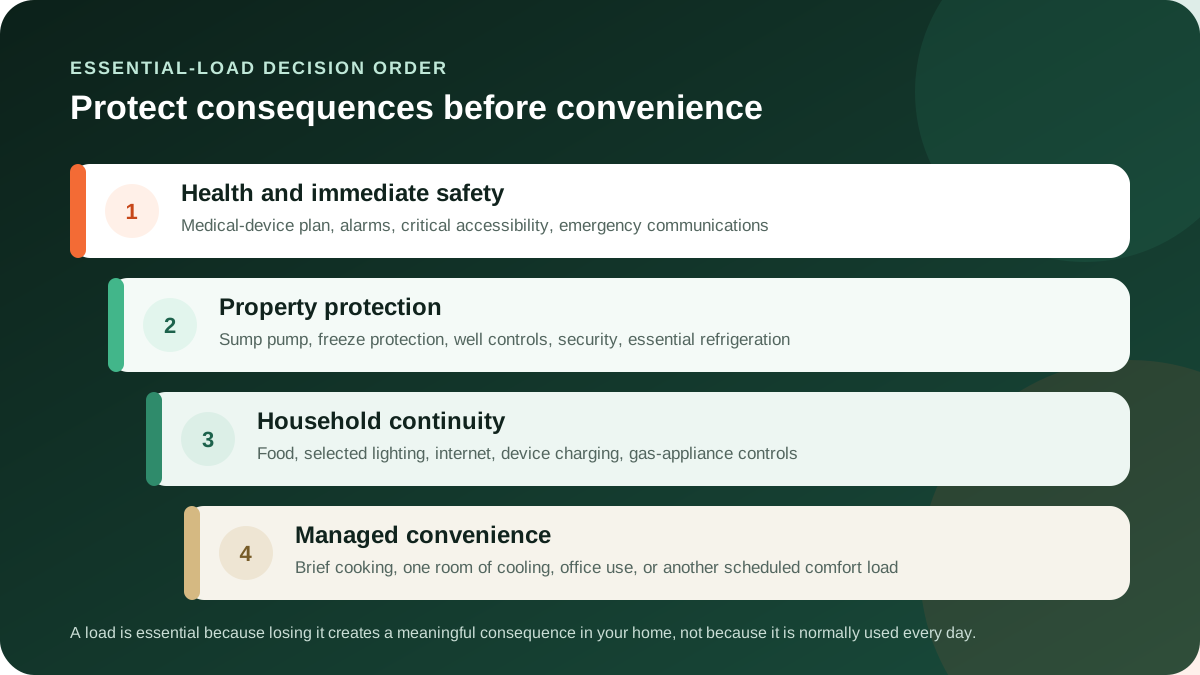
Health and immediate safety
Device-specific medical power, essential accessibility equipment, alarms, and emergency communications belong here. These loads need a written fallback plan, not only a capacity estimate.
Property protection
Sump pumps, freeze protection, critical controls, security, and water-system needs can prevent damage that develops faster than household discomfort.
Household continuity
Refrigeration, internet, efficient lighting, phone charging, and fuel-fired appliance controls help the home remain functional during a routine outage.
Managed convenience
Brief microwave use, a home-office window, or limited room cooling may fit after the first three levels have adequate output and energy.
CDC guidance says an unopened refrigerator keeps food safe for up to four hours, while a full unopened freezer can hold a safe temperature for about 48 hours and a half-full freezer for about 24 hours. Keep doors closed and follow current food-safety guidance. This time buffer may let you delay refrigeration, but it does not remove refrigeration from a longer-outage plan.
Step 2: measure the real loads
Build the appliance and circuit inventory before choosing equipment
Do not begin with a battery capacity, inverter rating, or generator label. Begin with the exact equipment in the home. Record quantity, voltage, running watts, starting watts, expected outage use, and whether the load is continuous, cycling, scheduled, or intermittent. Note which loads can be delayed when another motor starts.
Use appliance nameplates, manuals, manufacturer data, an electrician’s measurements, or an appropriate energy monitor. A plug-in meter can help with cord-connected 120V loads within the meter’s rating. Hardwired equipment, 240V circuits, and motor-start measurements require suitable methods and qualified help. Utility-bill consumption is too broad because it includes normal loads that should be off during backup operation.
| Load | Why it may matter | Record | Behavior to model | Important check |
|---|---|---|---|---|
| Refrigerator or freezer | Food protection | Running watts, compressor start, measured daily energy | Cycling, affected by temperature and door openings | Test the compressor start while other essential loads remain active |
| Modem, router, fiber terminal | Alerts, Wi-Fi calling, work, communication | Combined watts for every required box | Continuous | Confirm whether the provider’s network remains available |
| Furnace blower and controls | Freeze protection and safe indoor temperature | Voltage, running watts, blower start, connection method | Cycling with thermostat demand | Fuel availability does not eliminate the electrical requirement |
| Sump pump | Flood protection | Voltage, run, start, cycle duration, cycles per hour | Intermittent and storm-dependent | Size for the worst credible pumping period, not a dry-day average |
| Well pump | Water supply | 120V or 240V, run, start, pump depth and controls | Intermittent, often managed in batches | Verify split-phase output and per-leg limits when applicable |
| Medical device | Health-specific continuity | Manufacturer requirements, accessories, battery options, hours | Device-specific | Build the plan with the healthcare team and device supplier |
| LED lighting and charging | Safe movement and communication | Total selected watts and expected hours | Scheduled | Use a small intentional lighting plan rather than whole-room habits |
Changing a motor’s running-watt estimate does not automatically make a stored surge value correct. Record starting demand separately and update it when the appliance, measurement, or configuration changes.
Build a categorized appliance list
The flagship calculator accepts quantity, voltage, running watts, starting watts, use pattern, and outage operating time.
Step 3: pass every sizing test
An essential-load plan needs power, surge, energy, and the right electrical path
One number cannot describe a backup system. Kilowatts determine what can operate at once. Surge capability determines whether a compressor, pump, or blower can start. Kilowatt-hours determine how long the plan can run. Voltage and connection determine whether power can reach the load safely and correctly.
Add the loads that may actually run at the same time, then retain practical operating headroom.
Test each important motor start while the other planned loads that stay on are still included.
Add watts multiplied by expected outage hours, then account for reserve, losses, and uncertainty.
Confirm 120V or 120/240V output, current limits, transfer, outlets, and circuit compatibility.
Sum of simultaneous running watts
Do not add every appliance in the inventory if the operating plan deliberately separates them. Do include loads that cannot or should not be interrupted.
Other active loads + one motor’s starting watts
Repeat this calculation for each motor. The limiting event may be a refrigerator starting while a furnace blower is already running, not simply the largest surge value alone.
Watts × outage hours ÷ 1,000
Calculate each appliance independently. Scheduled loads need the hours that occur inside the outage, while cycling equipment needs realistic equivalent run time.
Load energy ÷ delivered-energy factor
The nominal battery target must allow for conversion losses, reserve, standby use, temperature, aging, and uncertainty. Show the assumptions rather than hiding them.
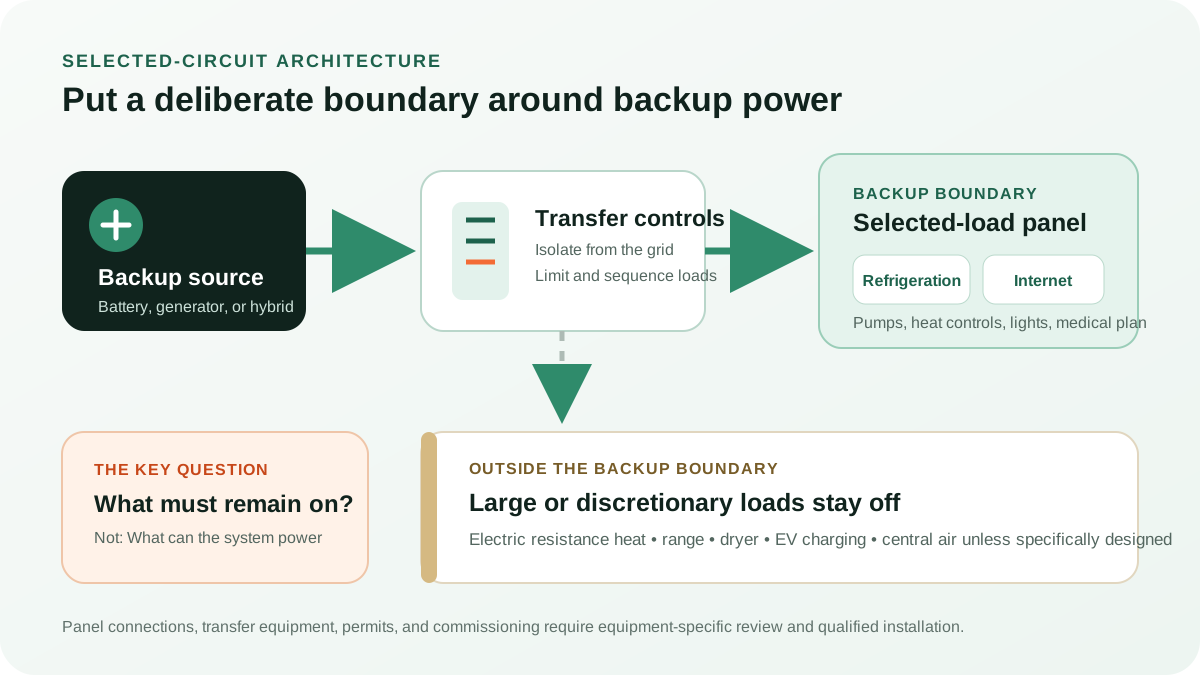
A system may be wired to many circuits while depending on manual or automatic load management. Document which circuits can overlap, which must be staged, and what happens when the household exceeds the limit.
Step 4: use an outage timeline
Model energy according to when each load will operate
A common shortcut multiplies a normal 24-hour appliance estimate by one-half for a 12-hour outage. That can be acceptable for a stable continuous load, but it can badly underestimate a scheduled load. An overnight 12-hour outage may contain the full eight-hour use of a CPAP device. A storm outage may contain more sump-pump cycles than an average day. A short winter outage can include nearly all of the evening heating demand.
Classify every load by behavior. Continuous equipment runs throughout the modeled period. Cycling equipment turns on and off according to conditions. Scheduled equipment runs during a defined window. Intermittent equipment operates in short events whose frequency can change with weather or household behavior.
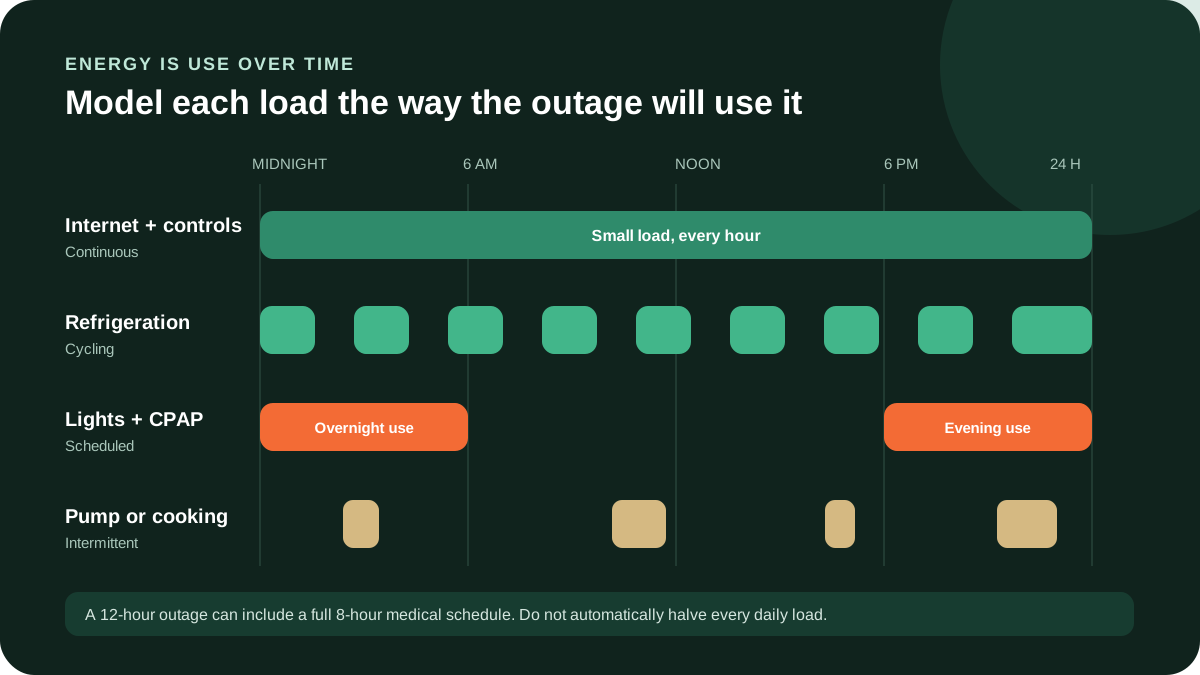
Runs for the full period
Internet equipment, alarm controls, and some medical or monitoring loads may be modeled with the full outage duration.
Runs according to conditions
Refrigeration and heating blowers need equivalent run hours based on temperature, settings, door use, insulation, and duty cycle.
Runs in a defined window
Overnight medical use, evening lights, and a home-office shift may occur in full even when the outage is shorter than one day.
Runs in discrete events
Pumps, microwave cooking, coffee preparation, and garage access are better modeled by event count and minutes per event.
Worked planning examples
Three essential-load profiles show why the household changes the answer
The following numbers are transparent examples, not appliance ratings or purchase recommendations. Replace every value with measurements and documentation for the actual home. The battery ranges assume a conservative delivered-energy allowance for conversion loss, reserve, standby use, and uncertainty. Motor-start capability, waveform, voltage, and connection still require separate checks.
Basic food and communications
- Refrigerator: 150 W running, 1,200 W starting, 8 equivalent hours
- Internet equipment: 25 W for 24 hours
- Selected LEDs: 40 W for 6 hours
- Daily load energy
- 2.04 kWh
- Motor-start event
- about 1.27 kW
- Planning capacity
- about 2.7 to 3.2 kWh nominal
A battery system can be a natural fit because the total energy is modest. Confirm the refrigerator’s actual start behavior and provide an intentional cord or circuit plan.
Winter essentials with gas heat
- Basic profile above: 2.04 kWh per day
- Furnace blower and controls: 600 W running, 1,200 W starting, 8 equivalent hours
- Phone charging and controls: 100 Wh
- Daily load energy
- about 6.94 kWh
- Limiting example start
- about 1.87 kW
- Planning capacity
- about 8.8 to 10.5 kWh nominal
Cold weather can increase furnace run time, so the daily energy target may matter more than the moderate running load. Verify the furnace connection and whether the controls accept the proposed source.
Storm property protection
- Basic profile above: 2.04 kWh per day
- Sump pump: 800 W running for 2 total hours, 1,800 W starting
- Well pump: 1,000 W running for 1 total hour, 3,000 W starting, 240V example
- Daily load energy
- about 4.64 kWh
- Limiting example start
- above 3.2 kW
- Planning capacity
- about 6.0 to 7.5 kWh nominal
This profile can require split-phase output and substantial motor-start performance even though its daily energy is lower than the winter profile. Pump duty can rise sharply during the storm, so include a stress case.
If the appliance hours already reflect a harsh scenario and the capacity range adds another large uncertainty allowance, the result may become needlessly oversized. State where each margin appears and keep a base case, a likely case, and a stress case separate.
Health and accessibility
Medical power needs require a layered plan beyond one backup device
Do not treat medically necessary equipment as an ordinary appliance row. Record the exact device and accessory model, input requirements, power supply, operating mode, required hours, built-in battery behavior, alarm behavior, approved external battery options, and the effect of heated humidifiers or other accessories. Ask the healthcare professional and equipment supplier what to do during an outage and whether the device is compatible with the proposed backup source.
FDA guidance recommends preparing in advance for medical devices that require electricity, following the device instructions, and contacting the manufacturer or distributor about battery or generator use. Ready.gov also advises people who rely on powered medical equipment to discuss outage planning with a healthcare provider. A consumer battery estimate does not replace those instructions.
Defined operating window
Size the primary backup for the required device hours plus the approved accessories that will actually be used.
Second compatible option
Keep a separate charged reserve or approved device battery so one failed inverter, cable, or charging plan is not the only line of protection.
Relocation and contact plan
Know who to call, where powered shelter or care is available, and when to relocate before the remaining runtime becomes critical.
Include emergency contacts, supplier details, charging cables, battery rotation, storage limits, alarm meanings, transport needs, and the threshold for leaving the home. Rehearse it before severe weather.
Choose the architecture
Match the backup system to the loads, connection, and outage length
Essential-load planning works with several system types. The right architecture depends on whether loads are cord-connected or hardwired, whether 240V is required, how automatic the transition should be, how long outages last, and whether safe fuel or solar recovery is available.
| System route | Strong fit | Main advantage | Main limitation | Connection planning |
|---|---|---|---|---|
| Portable power station | A few indoor cord-connected loads | Quiet, portable, no fuel exhaust at the point of use | Capacity, outlet, charging, and hardwired-load limits | Direct cords within ratings, or approved home integration where offered |
| Installed selected-circuit battery | Automatic coverage for a deliberate load group | Controlled switchover and simple household operation | Stored energy is finite without recovery | Gateway, transfer equipment, backup panel, or compatible smart controls |
| Portable generator | Longer outages with safe outdoor space and fuel | Fuel can extend operation and support substantial loads | CO, weather, noise, refueling, maintenance, and manual work | Direct manufacturer-approved loads or proper inlet and transfer equipment |
| Standby generator | Automatic longer-duration service for a suitable property | Automatic start and high sustained output | Permanent installation, fuel dependence, maintenance, and noise | Listed transfer equipment and professional installation |
| Battery plus recovery | Quiet daily operation with a long-outage extension path | Separates household power quality from the recovery source | Compatibility and control design are more involved | Integrated solar or approved charging path with load management |
Battery, generator, or hybrid?
Compare noise, automatic operation, fuel, runtime, output, property fit, and the work required during an outage.
Deliver power correctly
Choose between direct plug-in loads, a backup panel, or managed circuits
Portable plug-in backup is the simplest route when all priority loads use accessible cords and remain within outlet, cable, and system ratings. It becomes less practical when the plan includes a furnace, well pump, hardwired sump pump, multiple rooms, or a 240V circuit. In those cases, a selected-circuit panel, transfer equipment, compatible gateway, or smart load-control system may create a safer and more usable plan.
Few accessible appliances
Use only manufacturer-approved connections and appropriately rated cords. Protect cords from water, damage, pinching, heat, and trip hazards. Do not improvise a connection to household wiring.
Fixed selected circuits
A smaller backup panel creates a clear list of supported circuits. It can simplify operation and prevent large discretionary breakers from consuming the source.
Flexible prioritized circuits
Compatible controls can monitor and shed loads, but the design still needs documented limits, fail behavior, and a manual operating plan.
A source connected to building wiring needs approved transfer or isolation equipment for the exact application. Incorrect connections can energize utility lines, expose workers and neighbors, damage equipment, and create fire or shock hazards.
Runtime is only half the plan
Plan both stored autonomy and daily energy recovery
Battery runtime begins with the usable energy available above the chosen reserve. If the system starts at 80 percent charge and the reserve is 20 percent, only 60 percent of nominal capacity is available before conversion losses and standby use. A battery-runtime estimate that assumes a full charge can overstate what the household will actually receive.
For multi-day planning, calculate daily essential-load energy and realistic daily recovered energy separately. Solar recovery depends on array size, weather, shading, seasonal sun, charge efficiency, and the system’s accepted solar input. Generator charging depends on available charging power, fuel, runtime, environmental derating, and whether household loads continue while charging. Recovery first serves the loads operating during that period. Only the surplus refills the battery.
Survive the no-recharge period
Keep enough stored energy for the expected overnight or poor-weather period even when recharge is part of the design.
Recovery minus daily load
If the source recovers less than the essential loads consume each day, the battery declines even though charging is occurring.
The battery must accept the power
A larger solar array or charger does not shorten recovery after the battery, controller, voltage window, or connection reaches its input limit.
Make the plan usable
An essential-load system works better with a simple outage playbook
A technically adequate system can still disappoint if the household does not know which loads are allowed, how to check remaining energy, or when to start recovery. Put the operating rules near the equipment and keep a copy with the emergency plan.
-
1
Before outage season
Measure loads, label circuits, test transfer behavior, charge portable batteries, maintain generators, inspect cords, test alarms, and confirm that every household member understands the priority list.
-
2
At the start of an outage
Confirm that power is actually out, check for storm or utility hazards, turn off discretionary loads, verify the backup source status, and leave major motor loads off until the system is stable.
-
3
Establish the essential baseline
Start communications, health-specific loads, property protection, refrigeration when needed, selected lighting, and heating controls. Watch the initial running demand.
-
4
Sequence motors and optional tasks
Run a well pump, microwave, office equipment, or another managed load only when the system has enough output and other discretionary loads are off.
-
5
Track remaining hours
Compare actual battery decline or fuel use with the plan. Reduce lighting, cooking, office use, or comfort loads early if the event is lasting longer than expected.
-
6
Recover and document
Recharge or refuel through the approved method, record actual energy use, and update the worksheet after the outage. Real operation is the best input for the next version of the plan.
Protect the energy budget
Exclude high-energy loads unless the system was deliberately designed for them
Essential-load backup becomes expensive and short-lived when normal electric heating, cooking, transportation, and whole-house cooling remain available without management. Some large loads may be important in a specific household, but they need to be treated as major design decisions, not accidental additions.
Space and water heating
Electric resistance heaters can consume several times the power of the entire basic essential-load profile. Prefer an existing safe alternative only when it is appropriate and approved.
Range and oven
A microwave or another short-duration method can preserve the energy budget. Never bring combustion cooking equipment indoors unless it is specifically designed and installed for indoor use.
Central air and auxiliary heat
Compressors and electric heat strips can create high running, starting, and daily energy demand. One managed room may be a more practical resilience target.
EV charging and dryers
Delay them unless the system has excess recovery and the backup design intentionally includes the load. Their normal convenience can consume emergency energy quickly.
Non-negotiable boundaries
Keep electrical, battery, fuel, and medical safety separate from sizing
Operate outdoors only, at least 20 feet from homes and buildings, with exhaust directed away from windows, doors, and vents. Never operate one in a home, garage, basement, crawlspace, shed, porch, or carport.
Maintain working alarms with battery backup according to current safety guidance and the manufacturer’s instructions. Never ignore an alarm.
Do not backfeed home wiring. Use approved transfer, isolation, overcurrent protection, grounding, and connection methods for the equipment and local requirements.
Do not handle wet plugs or energize equipment that has been flooded. Follow manufacturer instructions for shock protection and operation in rain, snow, or damp conditions.
Use listed, compatible equipment as instructed. Respect location, temperature, ventilation, clearance, cable, protection, and commissioning requirements.
Follow the medical device instructions and healthcare plan. Do not rely on a general web calculator as the only continuity plan for life-sustaining equipment.
Final planning worksheet
Write down the plan an installer or equipment seller can verify
A useful project brief is more valuable than a broad request for “whole-home backup.” Complete the following list before comparing systems. It exposes missing measurements and prevents product features from replacing load analysis.
Calculate the selected load plan
Use the full planner for a battery range, inverter target, surge test, voltage warning, generator class, and system route.
Frequently asked questions
Essential-load backup questions
How many circuits should be on an essential-load panel?
There is no universal number. Circuit count does not reveal power or energy. A panel with many low-demand circuits may be easier to support than a panel with one large pump or heating load. Select circuits by consequence, voltage, simultaneous demand, motor start, and outage energy.
Can one battery run a refrigerator, Wi-Fi, and lights?
Often, but the answer depends on the refrigerator’s measured energy and startup behavior, the combined communications equipment, lighting hours, battery state of charge, reserve, output, and losses. The basic worked example on this page uses 2.04 kWh of load energy per day before system allowances.
Is a furnace an essential load?
It can be in cold conditions or when the home risks frozen plumbing. A fuel-fired furnace still needs electricity for controls and the blower. Verify voltage, running watts, starting demand, connection, fuel availability, and realistic run time. Electric resistance or auxiliary heat is a much larger load.
Should I include the sump pump or the refrigerator first?
Prioritize the load with the faster and more serious consequence in the event being planned. During heavy rain, a sump pump may protect the property immediately, while a closed refrigerator provides a short food-safety buffer. During a dry routine outage, the order may change.
Do essential loads need 240V backup?
Only if an essential appliance or circuit requires it. Well pumps, some sump systems, HVAC equipment, and other motors may use 240V. Confirm split-phase capability, per-leg output, surge behavior, neutral and transfer requirements, and the exact connection.
Can solar panels power essential loads when the grid is down?
Only when the complete solar, inverter, storage, controls, and isolation architecture is designed for outage operation. A normal grid-tied solar system generally stops exporting when utility power fails. For multi-day resilience, compare realistic recovered energy with the daily essential-load energy.
Should I size for one day if I expect daily solar charging?
Keep an autonomy floor for the no-recharge period. Overnight, clouds, snow, smoke, shading, and input limits can reduce recovery. A design that works only when the next day produces an optimistic solar estimate is fragile.
Is automatic transfer necessary?
It is valuable when loads cannot tolerate a long interruption, no one may be present to connect equipment, or the household needs a simple response. Transfer time is system-specific, and a backup system should not be assumed to function as a true UPS for every sensitive device.
Can I connect a portable generator directly to the home?
Only through an approved connection and transfer or isolation method for the exact installation. Never improvise a backfeed through a receptacle. Portable generators also require safe outdoor placement, exhaust control, fuel handling, weather protection, and maintenance.
The strongest essential-load plan is small enough to understand
List the consequences, measure the loads, model their real outage schedule, test each motor start with other active loads, confirm voltage and connection, then size stored energy and recovery separately. A deliberate plan can protect more meaningful runtime than a larger system asked to imitate normal household use.
Sources and methodology
Worked numbers are transparent planning examples, not manufacturer ratings. Replace them with data for the actual appliances, site, and system. Safety and resilience guidance was checked against current government sources:
- Ready.gov: Power Outages
- Ready.gov: People with Disabilities
- CDC: Keep Food Safe After a Disaster or Emergency
- FDA: Medical Devices and Natural Disasters
- U.S. Department of Energy: Solar and Resilience Basics
- CPSC: Generator, Carbon Monoxide, and Fire Safety
Editorial and technical review: July 25, 2026. This guide is educational and does not replace appliance instructions, medical advice, an electrical design, permits, inspections, or qualified installation.