Independent, homeowner-first guidance for planning backup power around real loads, real outages, and the limits of each system.
HomeBackup.net helps homeowners understand batteries, generators, portable power stations, solar recovery, transfer equipment, and installation choices. The site is educational. It does not replace appliance documentation, an electrical design, a permit review, emergency planning, medical advice, or a qualified installer.
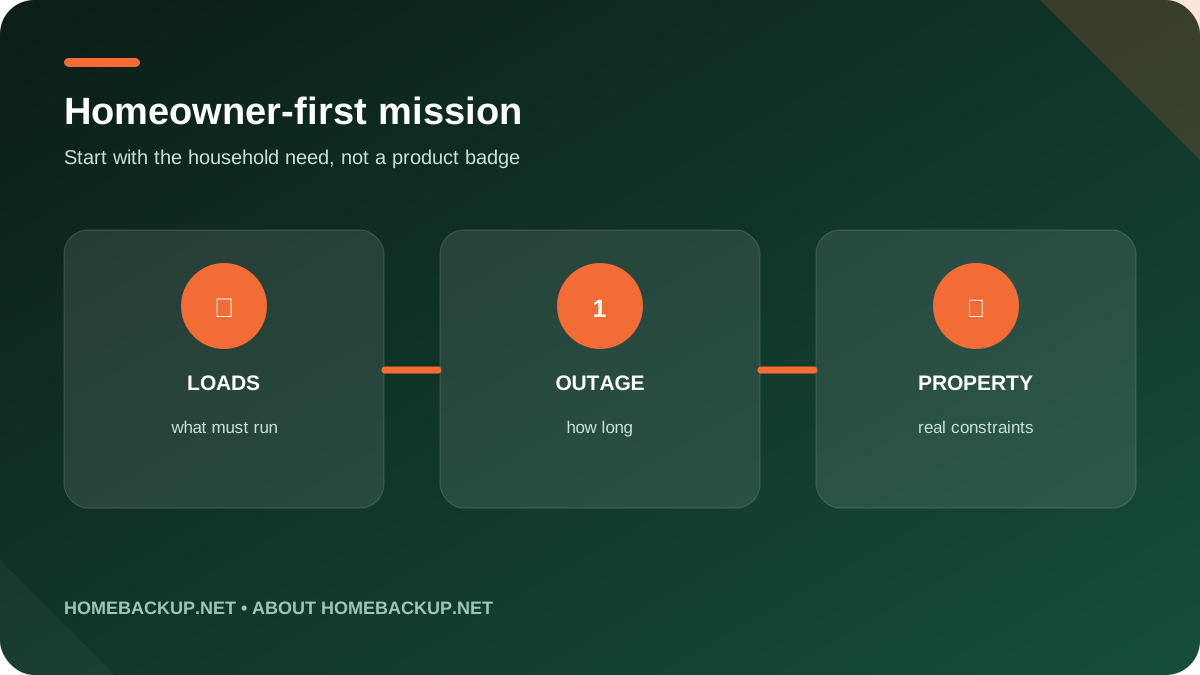
Guidance begins with the loads, outage duration, property constraints, and priorities of a household.
Specifications and safety statements are checked against current primary documents whenever those documents are available.
Commercial relationships do not buy a ranking, a conclusion, or the removal of a material limitation.
Running watts, startup demand, battery energy, voltage, and recharge are treated as different planning questions.
Generator exhaust, electrical transfer, battery placement, permits, and medical-device planning receive conservative treatment.
Material changes are reviewed, dated, corrected, and explained according to the published editorial policies.
Our mission
A power outage turns abstract product specifications into practical household decisions. A refrigerator needs energy over time, a sump pump needs enough startup power at the right moment, a well pump may require 240-volt output, and a central air conditioner can overwhelm a system that looks large when judged only by battery capacity. HomeBackup.net exists to translate those different requirements into a planning process a homeowner can follow.
The site is built around a simple sequence: identify the loads that matter, measure or verify their electrical requirements, decide how long they need to operate, account for losses and starting demand, choose a suitable system architecture, and confirm how that system will connect to the home. That sequence is more useful than beginning with a brand name or a broad promise such as whole-home backup.
Who the site is for
HomeBackup.net serves homeowners, renters, apartment residents, caregivers, remote workers, people with wells or sump pumps, households with solar, and anyone comparing a battery with a generator. Some readers need a small plug-in system for refrigeration and communications. Others are considering a permanently installed battery, an automatic standby generator, a smart panel, or a hybrid design for multi-day outages.
The site assumes readers want a decision they can explain and verify. It does not assume that the largest system is the best one. A carefully designed essential-load solution can be more resilient than an expensive system that lacks sufficient surge output, fuel planning, solar recovery, transfer equipment, or service support. Guides therefore route different homes toward different answers.
What we cover
Core coverage includes home batteries, portable power stations, standby and portable generators, hybrid battery-generator systems, solar recharge, critical-load and smart panels, transfer switches, interlock kits, appliance requirements, runtime calculations, installation planning, permits, and installer selection. Product and brand pages explain how an ecosystem works before comparing its headline maximums.
The calculators are planning tools. They make assumptions visible and separate running load, startup demand, energy consumption, reserve, conversion losses, outage duration, and recharge. Results are not bids, engineering drawings, medical backup plans, or guarantees. Readers are asked to replace examples with appliance labels, measurements, manufacturer instructions, and site-specific professional advice.
- Batteries and generators are compared by scenario rather than declared universal winners.
- Product maximums are separated from one-unit or base-configuration capability.
- Electrical integration is treated as part of the system, not as an accessory afterthought.
- Official safety and installation instructions take priority over general web guidance.
How the guidance is produced
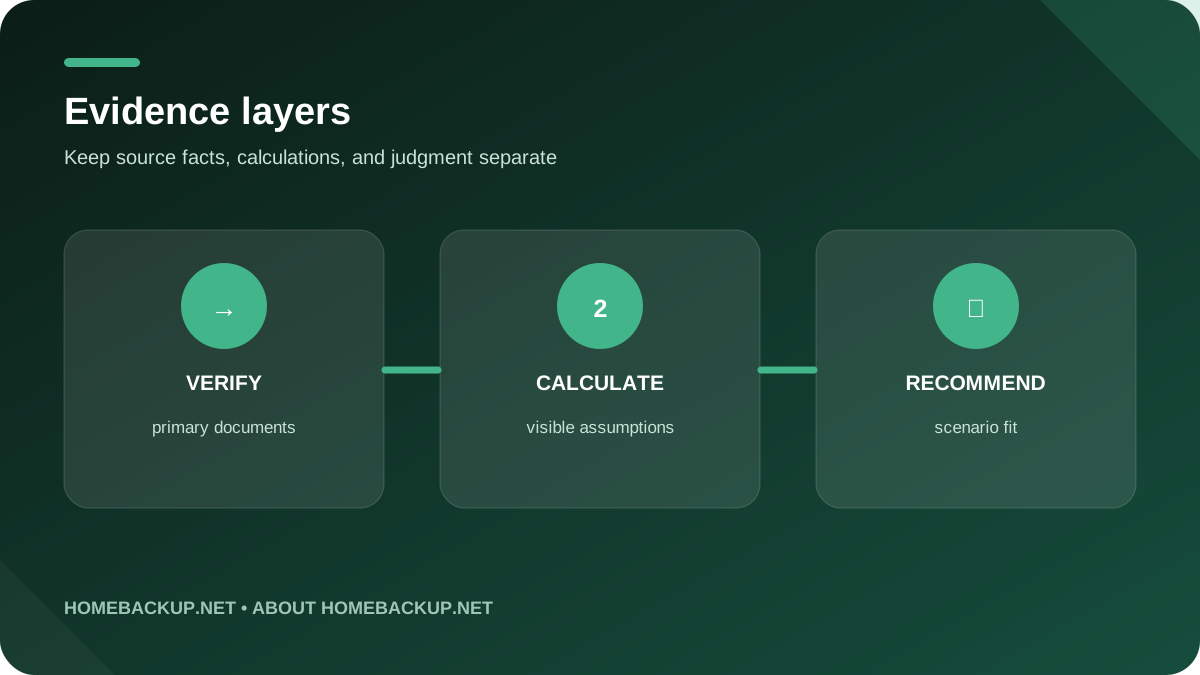
Research normally begins with manufacturer manuals, data sheets, warranty documents, installation instructions, certification information, government safety guidance, national-laboratory tools, and the rules published by utilities or authorities. Secondary reporting may help identify questions, but it is not used to overrule a current primary document without a clear reason.
Writers separate verified facts from calculations and judgment. A stated battery capacity is a manufacturer fact. A runtime range is a calculation based on capacity, reserve, delivery efficiency, standby loss, and load. A recommendation is an editorial judgment about fit. Keeping those layers separate lets a reader challenge an assumption without having to reject the entire guide.
How the site is supported
HomeBackup.net may earn compensation when a reader follows certain links or submits an eligible inquiry. A material relationship is disclosed where it can affect how a reasonable reader interprets a recommendation. The existence or size of a commission does not change the evaluation framework, and a brand cannot purchase a favorable conclusion through an affiliate arrangement.
Commercial pages can still be useful, but their intent should be visible. Readers can review the Affiliate Disclosure for the sitewide policy and the Editorial Policy for the separation between monetization and editorial judgment. Product availability, referral programs, and advertising relationships can change, so the disclosure is maintained as part of the launch review.
Safety and professional boundaries
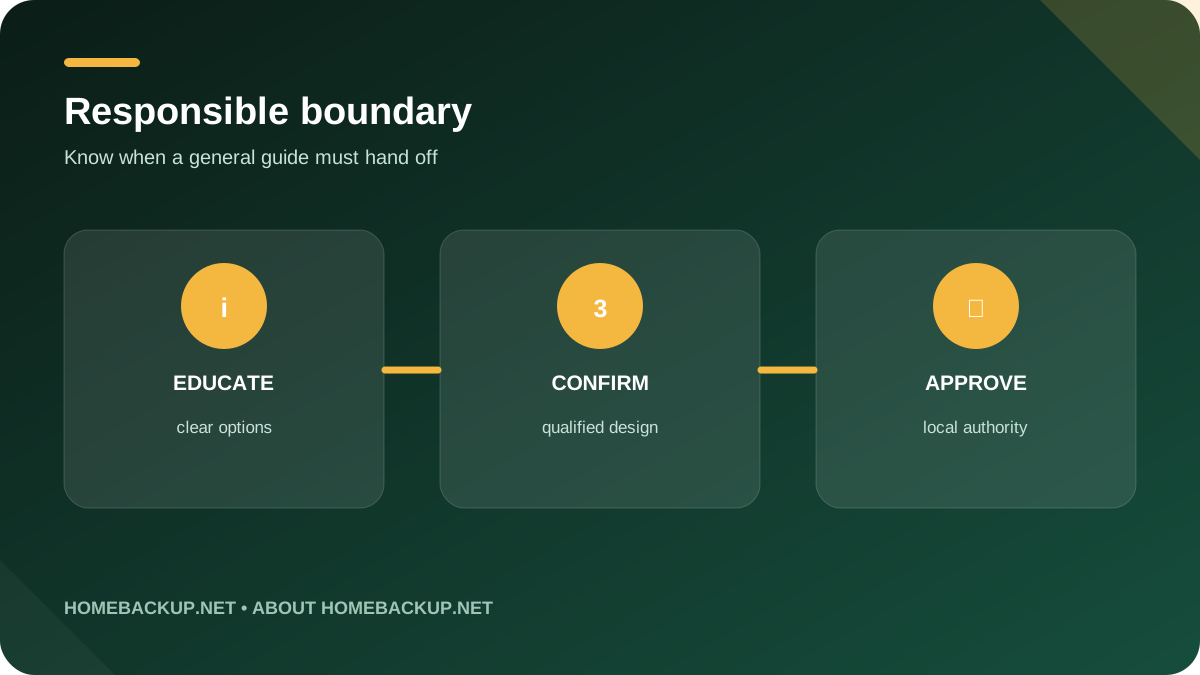
Combustion generators create lethal carbon monoxide and must never be operated in a home, garage, basement, crawlspace, shed attached to occupied space, or near openings where exhaust can enter. A generator must not energize household wiring through an unsafe backfeed. Permanent batteries, transfer equipment, service conductors, fuel systems, and many 120/240-volt connections require qualified work, permits, inspection, or utility coordination.
Medical devices require a device-specific plan created with the manufacturer and care team. A calculator result is not a substitute for an emergency supply plan. Similarly, a discussion of code is not a permit approval. The locally adopted rules and the authority having jurisdiction control an actual project. HomeBackup.net identifies these boundaries because useful guidance includes knowing when general information must stop.
Updates, corrections, and reader participation
Backup-power products and policies change quickly. Manufacturers revise firmware, accessories, warranty terms, compatible panels, generator inputs, and expansion limits. Utilities change interconnection procedures. Tax and incentive rules can end or change. Each substantive guide should show a review date or a reliable modification date, and high-risk claims receive priority when updates are scheduled.
Readers, manufacturers, installers, and subject-matter experts may report a possible error through the Contact page. Reports are evaluated against evidence, not the identity or commercial importance of the sender. Material corrections should change the affected statement promptly and document what changed according to the Corrections Policy.
What readers can expect from us
A HomeBackup.net guide should tell the reader what the system can do, what it cannot do, which configuration a claim describes, what assumptions drive a runtime, which safety limits matter, and what must be verified before purchase or installation. Comparisons should explain who benefits from each option. Best lists should define their categories before naming a candidate.
Readers should also expect the site to acknowledge uncertainty. An illustrative load table is not a promise about a particular appliance. A manufacturer maximum is not necessarily available from one unit. A quoted cost range is not a local bid. When evidence is incomplete or a capability depends on configuration, the page should say so in ordinary language.
Accountability at launch and beyond
Trust pages are useful only when they describe the site that actually exists. At launch, the publisher reviews the navigation, bylines, modified dates, source links, commercial disclosures, privacy language, contact route, email delivery, and correction workflow together. A policy should not promise a test laboratory, installer network, legal department, privacy practice, or response time that the operation cannot support. If the business process changes, the public explanation changes with it.
The launch audit combines automated checks with manual review. Automation can confirm that required pages are published, metadata is present, menus are assigned, image alternatives exist, and starter copy is gone. It cannot decide whether a reviewer has the right expertise, a consent tool is legally adequate, an electrician is licensed, an article is genuinely helpful, or a privacy description matches every vendor. Those questions stay with accountable people.
The site’s authority should grow through useful work rather than invented credentials. Named contributors may be added when their role, experience, and responsibility can be stated accurately. Original measurements may be added when the protocol and equipment are documented. Installer relationships may be added when consent, screening, compensation, and privacy practices are ready. Until then, HomeBackup.net describes its current evidence and boundaries without borrowing claims it has not earned. That standard applies to every new phase.
Frequently asked questions
Is HomeBackup.net a manufacturer or installer?
No. HomeBackup.net is an independent educational publisher. It does not manufacture backup equipment, approve electrical designs, issue permits, or represent that it is the installer for a project unless a separate, explicit agreement says otherwise.
Does the site physically test every product?
No. Evidence levels vary. Many guides are research-based and use current manufacturer and primary-source documentation. A page will not describe research as hands-on testing. The Testing Methodology explains what each evidence level means.
How are products selected for comparisons?
Products are selected because they address a meaningful homeowner scenario, have enough reliable documentation, and can be compared on a consistent configuration basis. Affiliate availability is not a qualification requirement.
Can a brand pay for a better ranking?
No. Advertising, affiliate relationships, samples, access, or sponsorship must not determine a recommendation or suppress a material limitation. Any sponsored content must be labeled as such and kept distinct from independent editorial conclusions.
Are calculator results guaranteed?
No. Calculators expose planning assumptions but cannot see appliance condition, wiring, temperature, altitude, battery behavior, simultaneous loads, motor startup, fuel derating, or installation constraints. Verify results before purchase.
Why are some conclusions conditional?
Home backup is configuration-dependent. A system that is excellent for indoor essentials may be poor for a 240-volt well pump. Conditional conclusions are more accurate than a single universal winner.
How can I report an error?
Use the Contact page, choose the correction topic, identify the exact page and claim, and include a primary source or model number when possible. Reports are reviewed under the Corrections Policy.
Who should make the final installation decision?
The homeowner should work with qualified professionals, manufacturers, utilities, and the local authority having jurisdiction. The final design must reflect the property, loads, service, fuel, equipment instructions, and adopted rules.
Sources and policy review basis
Policy reviewed July 22, 2026. Laws, program rules, search guidance, advertising requirements, product documents, and site practices can change.
- Google Search Central: title link best practices
- Google Search Central: structured data introduction
- FTC: Endorsement Guides questions and answers
- CPSC: carbon monoxide safety center
- UL Solutions: energy storage system testing and certification
These pages describe the site’s editorial and operational standards. Privacy and legal pages are general templates for the documented site behavior, not a substitute for advice about the operator’s specific obligations.