A clear route for reporting, verifying, correcting, and documenting material errors.
Corrections are based on evidence and reader impact. The site does not charge for a correction, does not promise removal of supported criticism, and does not treat a spelling fix the same as an error that could change a purchase, installation, or safety decision.
Readers, manufacturers, installers, agencies, and experts use the same contact route.
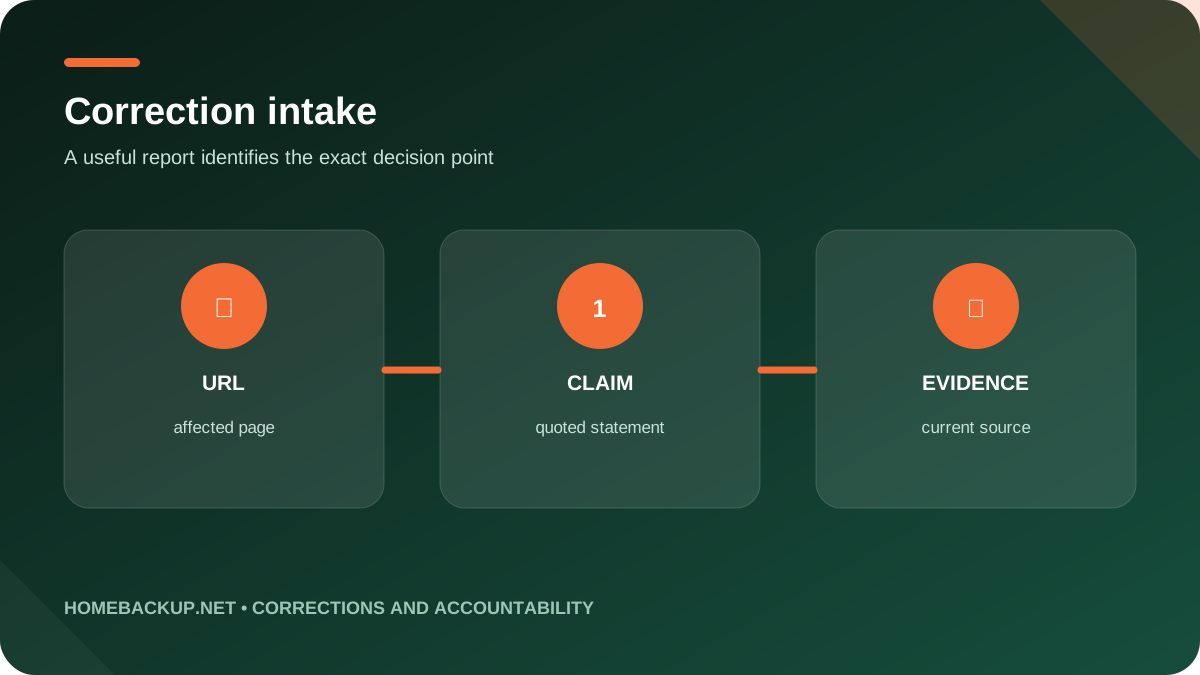
URL, quoted statement, model, date, and evidence make a report reviewable.
Safety, medical, electrical, compatibility, legal, and financial errors are escalated.
Commercial pressure, affiliate status, and advertising relationships do not decide validity.
The page should explain a correction that could alter a reader’s decision.
Repeated specifications and conclusions are searched across the site.
How to report a possible error
Use the Contact page and select Correction or factual issue. Include the exact page URL, the statement in question, why it appears wrong, the product model and region if relevant, and a current primary source. A manual section, data sheet, agency page, utility rule, certification record, or dated manufacturer notice is more useful than a general assertion.
Do not send confidential business information, private customer records, unpublished security details, personal medical data, or documents you are not authorized to share. A correction does not require a threat, invoice, sponsorship, or business relationship. Clear evidence and an exact claim are enough to begin review.
How reports are prioritized
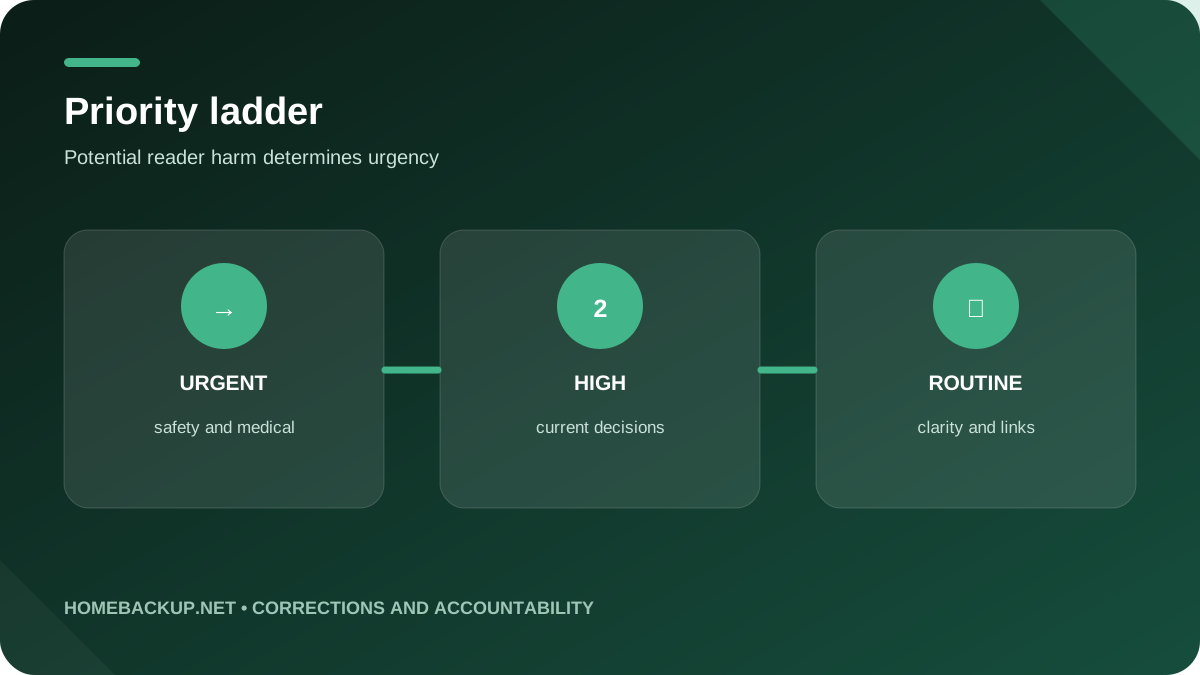
Urgent priority applies when an error could contribute to carbon monoxide exposure, electrical backfeed, fire, medical-device interruption, unsafe installation, equipment damage, or a materially wrong permit or tax decision. High priority also applies to current product compatibility, voltage, transfer, fuel, surge, and warranty claims that could cause a significant purchase error.
Routine priority includes broken links, minor specification differences that do not change the conclusion, wording clarity, formatting, and typographical errors. Lower urgency does not mean ignored. It means the issue can be reviewed without displacing a safety or current-decision correction.
The correction review
An editor opens the affected page, identifies the exact claim type, and checks the cited evidence. The review confirms model, region, generation, configuration, operating mode, document revision, and effective date. If the report concerns a calculation, the inputs, units, formula, and rounding are reproduced.
The editor searches for conflicting primary documents and considers whether the original text was wrong, ambiguous, outdated, or correctly scoped. A manufacturer statement is not rejected because it is commercial, but it is checked against the technical documentation. A reader report is not rejected because it is informal, but a broad factual change requires sufficient evidence.
Possible outcomes
Confirmed material error: the page is corrected, the modified date is updated, and a correction note explains the previous problem and the substantive change. Confirmed minor error: the text is fixed, and a public note may be unnecessary if the meaning and decision did not change. Clarification: accurate text is revised because reasonable readers could misunderstand its scope.
Outdated information: the page is updated to the current generation, rule, or document, while historical context is retained when useful. Unverified report: the page may add uncertainty or request more evidence, but it will not replace a supported claim with an unsupported one. Editorial disagreement: the conclusion remains when the facts and criteria are sound, though the reasoning may be clarified.
What makes a correction material
A correction is material when the original statement could reasonably affect safety, product eligibility, required accessories, capacity, output, voltage, runtime, installation design, legal compliance, cost interpretation, warranty expectations, or the declared winner in a comparison. Materiality depends on reader impact, not the number of words changed.
Changing 7,200 watts to 7,000 watts might be minor in one context and decisive in another. Correcting a product from 120-volt only to supported 120/240-volt operation can change the entire homeowner fit. A material correction note should let a returning reader understand why the conclusion or recommendation changed.
How corrections are displayed
A material note should include the correction date, a concise description of the earlier issue, the corrected information, and whether the conclusion changed. It should not repeat a harmful instruction unnecessarily or hide the correction in a general update log. The affected sentence and any related table are corrected in the body itself.
Minor spelling, punctuation, formatting, and broken-link fixes do not normally receive individual notices. Routine freshness updates can be summarized as a review update when no prior statement was materially wrong. A correction note is not removed merely because time has passed if it remains important to understanding the page history.
Correcting related content
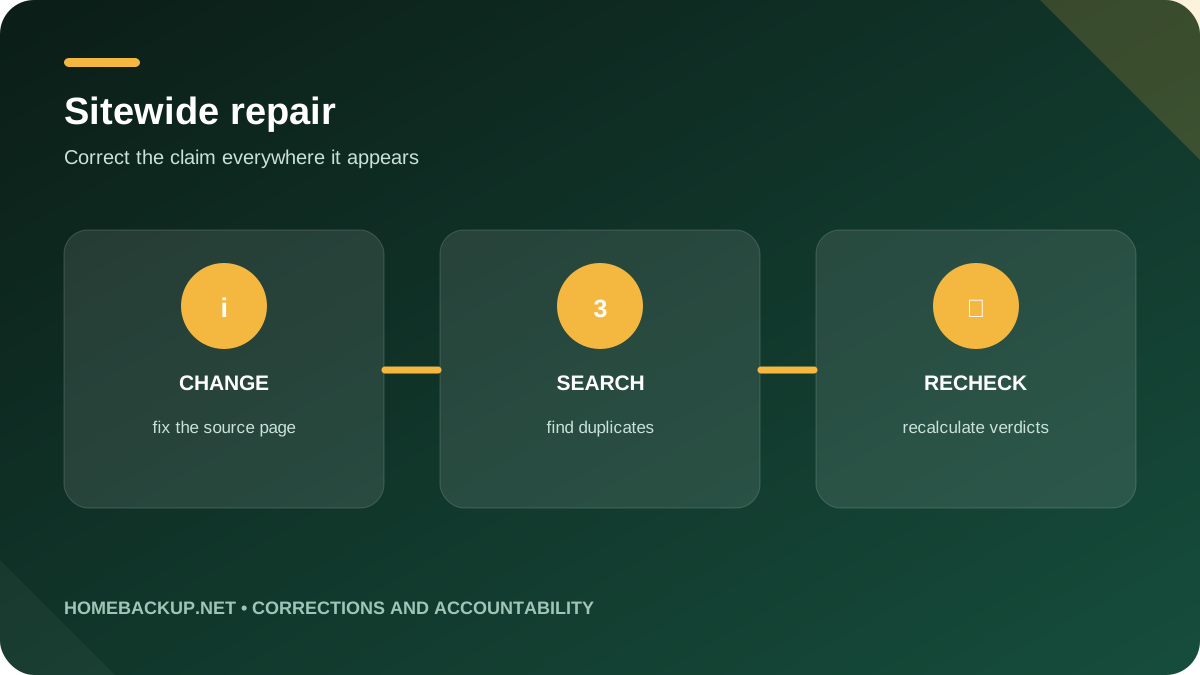
A verified specification can appear in a brand hub, product guide, comparison, best list, runtime example, and installation page. The correction workflow searches titles, body text, tables, metadata, structured data, image captions, and internal links for the same claim. Each occurrence is evaluated in context.
Downstream conclusions are recalculated. If a corrected inverter output changes an appliance recommendation, the appliance discussion and comparison verdict are reviewed. If a product name or URL changes, redirects and navigation are checked. The job is complete when the site no longer presents the known error in another form.
Requests from companies and subjects
Companies receive the same evidence-based process as readers. A commercial relationship does not accelerate a routine correction ahead of a safety report, and the absence of a relationship does not reduce attention. HomeBackup.net can request a manual, revision history, compatibility statement, or written technical response before changing a claim.
A company may disagree with a negative but supported evaluation. The site will correct facts, disclose new evidence, and clarify scope. It will not promise a favorable rating, remove a material limitation, or suppress a documented safety concern in exchange for advertising, affiliate access, samples, or legal pressure.
Follow-up and appeals
A sender may follow up with new evidence or point out that part of the report was overlooked. The request should remain focused on the page and claim. Repeated messages without new information do not require repeated substantive review. Abusive, threatening, spam, or privacy-invasive submissions can be ignored or blocked.
When practical, the editorial team acknowledges a well-formed report and states the outcome after review. Response times are not guaranteed because urgency and research complexity vary. The page itself is the authoritative record of the published correction.
Correction history and version context
A correction note should be understandable without an internal ticket system. It identifies the date, affected claim, corrected fact, source basis, and effect on the conclusion. If the change concerns a new product generation rather than an error, it is described as an update. This distinction prevents routine maintenance from being portrayed as a mistake and prevents a real mistake from being hidden as routine maintenance.
Older information can remain when it helps owners of a discontinued system, but the page must separate historical and current models. A redirect is used only when the replacement page satisfies the same reader intent. Sending every retired product URL to a brand homepage destroys context and makes a previous correction harder to understand.
Internal records can retain research notes and correspondence longer than the public note. Public transparency does not require publishing private email addresses, confidential reports, security details, or unnecessary personal information. The correction record focuses on the content and evidence.
Using corrections to prevent repeat errors
A confirmed error is also a process signal. Editors ask whether the source hierarchy failed, a product family was confused with one configuration, a calculation lacked a unit check, an update changed only one page, or a commercial claim bypassed review. The answer becomes a checklist change, data correction, redirect update, or new audit rule when practical.
Repeated errors often come from centralized facts copied manually into many pages. The site reduces this risk by searching related content and keeping comparison criteria consistent. Automation can identify matching numbers or model names, but a person decides whether each occurrence has the same meaning.
The goal is not a site that never changes. Backup technology changes too quickly for that promise. The goal is a site that makes it easy to report a problem, corrects verified errors at the right priority, explains material changes, and learns enough to reduce the next mistake.
Correction performance is reviewed during the launch audit and later maintenance. The team checks that the contact route works, material notes remain visible, redirects preserve the right intent, and corrected metadata agrees with the page. A policy without a functioning report channel is incomplete.
Frequently asked questions
Will HomeBackup.net pay for error reports?
No standard bounty is offered. Readers may report errors freely, and a correction is not conditioned on payment or a business relationship.
Can I demand deletion of a negative review?
You can submit evidence of factual error. Supported criticism and clearly identified editorial judgment are not removed solely because they are unfavorable.
Are spelling fixes logged publicly?
Usually not. Minor edits that do not change meaning are corrected without a formal note. Material changes that could affect a decision are documented.
How quickly are safety errors corrected?
They receive immediate priority, but the time depends on evidence and scope. A clearly confirmed dangerous instruction should be corrected or temporarily removed as quickly as practical.
What source should I provide?
Use the current document closest to the claim: a manual, data sheet, warranty, agency notice, utility rule, certification record, or official manufacturer statement for the exact model and region.
Will you tell me the outcome?
A well-formed report may receive an acknowledgment and outcome when contact details are provided. The corrected page and any material note remain the authoritative public record.
What if the error appears on several pages?
Mention known examples, but the editorial team also searches related pages, metadata, tables, and links after confirming the underlying correction.
Can I submit a privacy correction request here?
Use the Contact page and choose Privacy request. A personal-data request follows the Privacy Policy, while this Corrections Policy addresses published editorial content.
Sources and policy review basis
Policy reviewed July 22, 2026. Laws, program rules, search guidance, advertising requirements, product documents, and site practices can change.
- Google Search Central: title link best practices
- Google Search Central: snippets and meta descriptions
- FTC: Endorsement Guides questions and answers
- FTC: endorsements, influencers, and reviews
These pages describe the site’s editorial and operational standards. Privacy and legal pages are general templates for the documented site behavior, not a substitute for advice about the operator’s specific obligations.