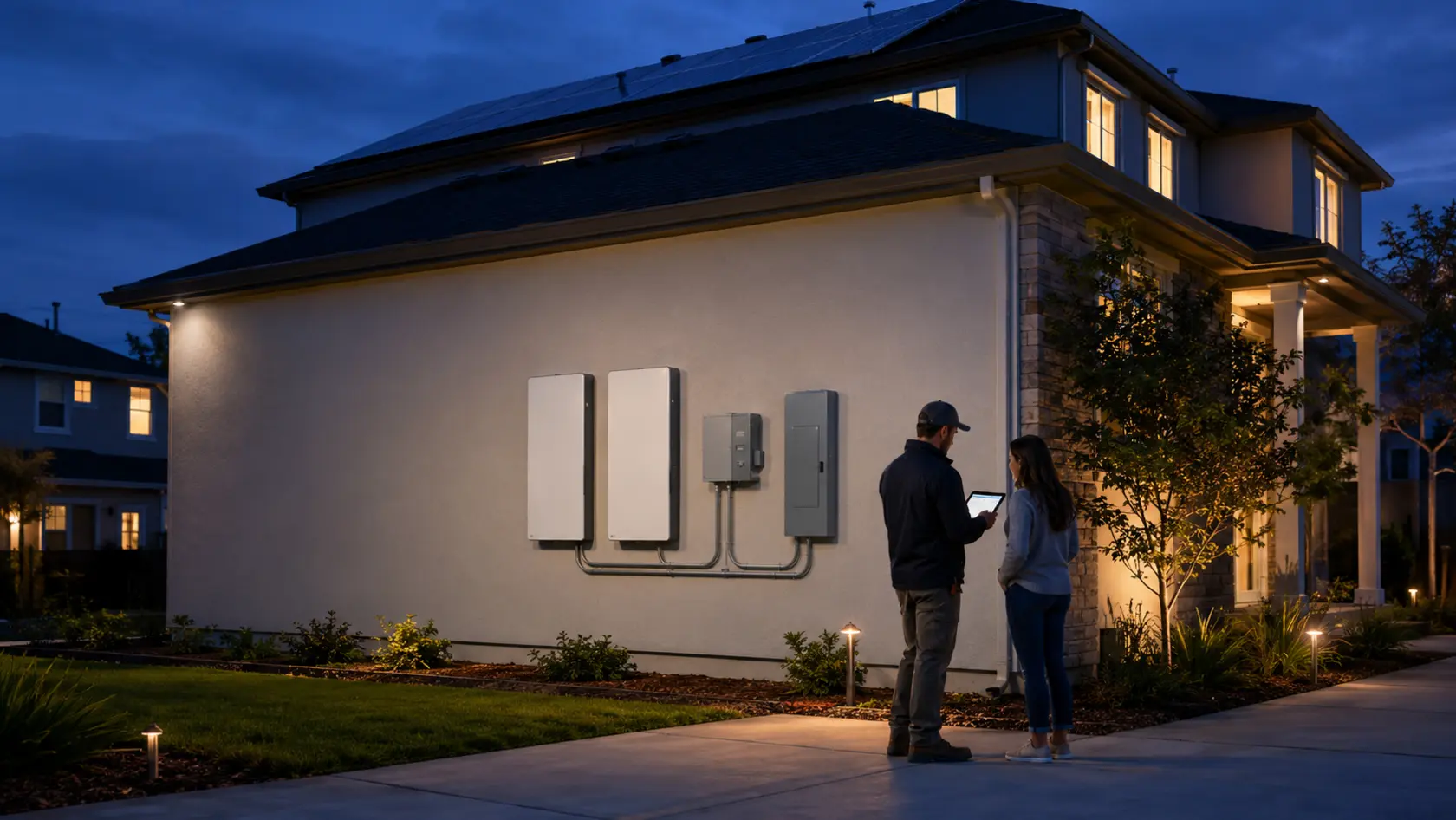
Whole-home system planning
Whole-home backup gives the electrical panel broad access to backup power. It does not automatically mean every breaker can stay on, every large appliance can run together, or the home can operate normally for an unlimited outage. A strong design combines enough power and energy with deliberate load control, safe grid isolation, a realistic recovery plan, and clear operating rules.

Whole-home backup is a control problem as much as a capacity problem
The practical goal is to make most of the home available while preventing the backup source from being overloaded or emptied by a few high-demand circuits. That usually means automatic or manual load shedding, scheduled use of large appliances, priority groups, and an outage mode that is different from normal grid operation.
Start with four numbers: the highest planned simultaneous running load, the hardest motor-start event, the energy the home will use in a day of outage operation, and the recharge or refueling available before the stored energy is exhausted. Then verify voltage, per-leg limits, transfer equipment, installation location, and local requirements with qualified professionals.
Battery with load control
Best when seamless switchover, indoor comfort, low routine maintenance, and managed daily energy matter most.
Plan a home batteryStandby generator
Best when long outages, large loads, automatic starting, a suitable outdoor location, and reliable fuel are the priorities.
Size generator outputBattery plus recovery
Best when quiet battery operation should carry normal outage loads while solar or a generator restores energy.
Compare battery, generator, and hybridEssential circuits instead
Best when broad panel access adds more output, capacity, installation, and complexity than the household needs.
Plan essential loadsStep 1: define the promise
What does whole-home backup actually mean?
There is no single useful meaning of “whole home” without describing the operating rules. One system may energize the main panel but automatically block the electric dryer, resistance heat, pool equipment, and EV charging. Another may support almost every circuit as long as the occupants avoid simultaneous high-demand use. A large standby generator may run more equipment for longer, but it still has output, fuel, maintenance, placement, and connection limits.
The strongest definition is panel-level coverage with a documented load-management plan. The backed-up side of the electrical system can reach most circuits, while controls or household rules keep demand inside the source’s continuous and surge ratings. This approach preserves flexibility. A refrigerator, lights, internet, outlets, pumps, selected heating or cooling, and brief kitchen loads can remain available, even if they cannot all operate at the same moment.
A system should be judged by the outage experience it can repeat, not by the number of breakers technically connected. Ask which rooms and functions remain usable, which loads switch off automatically, how long the plan works without recovery, what happens in poor solar weather, and what the household must do when the outage begins.
Panel access
Most circuits are reachable from the backup source, either through the main panel or a broad backup panel.
Managed normality
The home feels mostly normal because large loads are scheduled, shed, or limited when backup power is active.
High-load coverage
Selected heating, cooling, pumps, cooking, or other 240V equipment can operate after exact output and surge checks.
Multi-day resilience
Stored energy, fuel, solar, or generator recovery can sustain the planned outage load through longer events.
A system can be wired for broad coverage and still rely on load management. In many homes, control is more valuable than simply adding capacity because it prevents a short demand spike or one forgotten appliance from shutting down the entire backup source.
Step 2: understand the home
Audit the panel, service, appliances, and outage conditions
Begin with an electrical inventory, not a product brochure. Record the service size, panel arrangement, subpanels, solar equipment, existing generator inlet or transfer equipment, and every major hardwired load. Identify whether loads use 120V, 240V, or split-phase power, and note any equipment with a compressor, pump, blower, or motor.
The utility bill is useful for understanding monthly and seasonal consumption, but it is not a whole-home backup load calculation. Normal bills include EV charging, laundry, water heating, cooking, cooling, pool equipment, and other loads that may be reduced or moved to specific windows during an outage. Use interval data, panel monitoring, appliance specifications, and professional measurements to build an outage-specific profile.
| Audit item | What to record | Why it changes the design | Who should verify it |
|---|---|---|---|
| Electrical service and panels | Service rating, main disconnect, panel locations, subpanels, breaker spaces, feeder ratings | Determines where transfer, controls, backed-up loads, and new equipment can be integrated | Qualified electrician and system designer |
| Large 240V loads | HVAC, well pump, range, dryer, water heater, EV charging, pool or workshop equipment | Often sets the output, surge, split-phase, and load-shedding requirements | Electrician, HVAC or pump specialist when applicable |
| Motors and compressors | Running current, starting current, controls, soft-start compatibility, cycling behavior | A brief start event can exceed the source even when daily energy use appears reasonable | Qualified installer using appropriate data and measurement |
| Daily outage energy | Watts, hours, duty cycle, weather dependence, occupant behavior, seasonal variation | Sets battery capacity, fuel use, solar recovery, and multi-day strategy | Homeowner with designer review |
| Existing solar | Array size, inverter type, shutdown behavior, storage compatibility, backed-up configuration | Grid-tied solar alone normally does not guarantee usable power during an outage | Qualified solar and storage installer |
| Site and permits | Equipment locations, openings, access, flooding, temperature, fire separation, fuel path, noise, local rules | Can eliminate otherwise attractive equipment or require a different architecture | Installer, authority having jurisdiction, utility, and other local reviewers |
Step 3: pass four independent tests
A credible whole-home plan must fit four limits at the same time
Capacity alone cannot prove whole-home capability. A large battery can still have insufficient inverter output for a heat pump start. A high-output generator can still be the wrong voltage or lack the approved connection equipment. A solar array can produce meaningful energy over a day while delivering little during the cloudy hours when the battery needs recovery.
Loads running together
Add the realistic simultaneous demand, not every breaker rating and not an unrealistically low average.
Hardest start event
Test a motor start while the other loads expected to remain on are still drawing power.
Energy over time
Model the actual outage schedule, cycling loads, weather, reserve, losses, and desired autonomy.
Voltage and connection
Verify split-phase output, per-leg limits, transfer isolation, neutral and grounding design, and circuit compatibility.
These limits interact. If a smart control prevents the water heater from operating while the heat pump compressor starts, the required peak output may fall. If solar or a generator reliably restores the battery each day, the required stored energy may fall. If the home must survive several days with no reliable recovery, energy capacity and load reduction become more important.
Step 4: challenge the difficult circuits
Large 240V loads decide whether the plan is realistic
Electric resistance heating, central air conditioning, heat pumps with auxiliary heat, electric water heaters, ranges, clothes dryers, EV chargers, well pumps, pool equipment, and workshop tools can dominate whole-home backup design. Some have high steady demand. Others have a short but demanding start. Several may create uneven demand between the two 120V legs.
Do not assume that a circuit can be supported simply because the system has a 240V outlet or a whole-home label. Confirm continuous output, surge duration, per-leg output, supported connection method, and any operating restrictions. For HVAC and pumps, use exact equipment data and qualified evaluation. A compatible soft-start device may reduce starting demand for some equipment, but it is not a universal fix and must be approved for the application.
Resistance heat
Electric furnaces, baseboards, heat strips, and space heating can consume stored energy rapidly. Auxiliary heat may need to be disabled or limited.
Cooling and heat pumps
Compressor start, outdoor temperature, defrost, blower demand, and auxiliary heat can make nameplate shortcuts unreliable.
Water heating and cooking
High power may be acceptable for a short controlled window when other large loads are held off.
EV, dryer, pool, and workshop
These circuits may remain connected but blocked during an outage unless the source and recovery plan intentionally include them.
The same system may feel generous in spring and constrained during a winter cold snap or summer heat wave. Model the most important seasonal condition separately, including HVAC behavior and any medical or temperature-safety needs.
Step 5: control the peak
Load management makes whole-home coverage practical
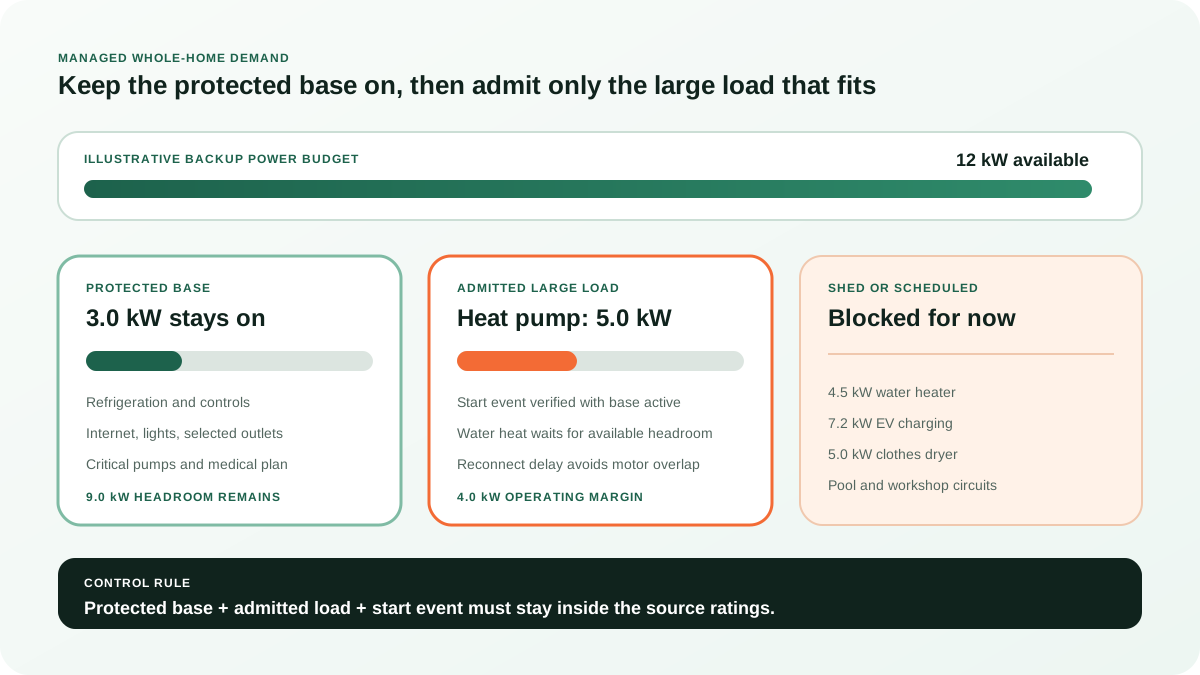
Load management prevents selected circuits from running when the backup source lacks headroom. It may be built into a smart panel, energy gateway, transfer system, generator load-management module, appliance controller, or the operating rules followed by the household. Automatic control is stronger when the system must work while nobody is home.
Use priority groups. Life safety, medical equipment, refrigeration, communications, sump pumping, water, and minimum heating or cooling should outrank discretionary loads. The system can then admit lower-priority circuits only when capacity and energy are available. Some controls shed a circuit immediately when total demand approaches a limit. Others schedule appliances, respond to state of charge, or prevent two large loads from operating together.
Never shed casually
Medical plans, alarms, essential communications, critical controls, and consequence-heavy property protection.
Preserve continuity
Refrigeration, selected lights, internet, outlets, fuel-fired heat controls, and basic water needs.
Admit when headroom exists
Managed HVAC, a well pump, brief cooking, or water heating with interlocks or schedules.
Block during outage mode
EV charging, dryer, pool heater, unnecessary resistance heat, and other discretionary high-energy loads.
Step 6: size instantaneous power
Calculate running demand and motor-start demand separately
Build a planned simultaneous-load case for each important season. Do not add every appliance in the home, but do not hide loads that genuinely overlap. Refrigeration, internet, lights, controls, and pumps may remain on while a heat pump or well pump starts. The source must support that event or the controls must prevent it.
What operates at the same time
Use measured or verified load data and preserve margin for variation, controls, aging, and loads that are easy to overlook.
What happens during the hardest start
Do not compare only the motor’s starting watts with the surge rating. Other planned loads are still operating.
What control can safely avoid
Document which loads are blocked, the order they return, and what happens if a control or communication link fails.
As an illustration, suppose protected base loads total 2.4 kW. A heat-pump compressor draws 4.0 kW while running and needs a verified 7.5 kW during its hardest start. If the base loads remain active, the start event is about 9.9 kW before margin. If a 4.5 kW water heater is also allowed to run, the event becomes about 14.4 kW. Blocking the water heater during compressor starts can change the required system class without reducing daily comfort very much.
Test loads, surge, voltage, and recharge together
The Home Backup Calculator models running demand, motor starts, daily energy, 120/240V needs, and recovery in one plan.
Step 7: size energy over time
Daily kWh determines whether whole-home backup lasts
Instantaneous output answers whether the system can run the home now. Energy answers how long it can continue. Estimate watt-hours for every load from power, operating time, and duty cycle. Add the loads to create a daily outage-energy target, then account for conversion losses, the usable portion of the battery, reserve, temperature, aging, and uncertainty.
For a simple planning estimate, divide required AC load energy by usable fraction and conversion efficiency. If a home needs 30 kWh of AC energy for one outage day, and the planning assumptions are 90 percent usable capacity and 90 percent conversion efficiency, the nominal capacity before additional reserve is about 37 kWh: 30 ÷ (0.90 × 0.90). This is an illustration, not a product recommendation. Use the actual system specifications and installer design.
Build the outage schedule
Model separate schedules for mild weather, the most important winter condition, and the most important summer condition.
Translate AC use into battery size
Keep reserve and long-term aging visible rather than hiding them inside an unexplained percentage.
Do not multiply blindly
Recovery is useful only after it covers the loads operating while charging. Weather and charging limits can reduce the result.
Heating and cooling can overwhelm a battery plan because their energy use changes with weather. For resilience, the home may need a smaller conditioned zone, a temperature setpoint strategy, disabled auxiliary resistance heat, shading, insulation improvements, or an alternate safe location during extreme conditions. Whole-home electrical reach should not replace a broader emergency plan.
Step 8: choose the source strategy
Battery, generator, solar, and hybrid systems solve different problems
A battery is an energy reservoir with fast, quiet electrical output. A generator converts stored fuel into electricity and can continue as long as the machine, fuel supply, maintenance, and operating conditions permit. Solar is a variable energy source that can reduce net battery draw or restore charge when the outage-capable system can accept it. A hybrid design coordinates these resources.
Quiet, automatic, managed
Strong for short and medium outages, overnight operation, seamless transfer, indoor loads, and homes that can reduce or schedule high-energy use.
High output and fuel duration
Strong when long outages and large loads dominate, provided placement, fuel, service, transfer, noise, exhaust, and maintenance are acceptable.
Battery operation plus recovery
Strong when the battery should carry the home quietly and a generator or solar should run efficiently for controlled recovery windows.
The hybrid route can reduce generator run hours and avoid operating a combustion source for every small overnight load. It can also reduce the battery capacity needed for multi-day autonomy. The design is only strong if the charging path, transfer sequence, controls, generator compatibility, fuel plan, and operating instructions are verified as one system.
Choose the architecture before choosing a brand
Compare output, runtime, fuel, noise, automatic operation, maintenance, installation, and outage fit.
Step 9: test realistic household profiles
Three examples show why “whole home” needs context
These simplified profiles demonstrate the method. The numbers are illustrative and deliberately rounded. Actual equipment can differ substantially, especially HVAC, pumps, heating, and motor-start demand. Use exact data and professional design for a real system.
Mixed-fuel suburban home
- Gas furnace controls and blower
- Refrigerator, freezer, internet, lights, outlets
- Brief microwave and coffee-maker windows
- Electric dryer and central cooling held off
- Illustrative daily load
- 14 kWh
- Planned running peak
- 4.8 kW
- Hardest start case
- 8.2 kW
- Management priority
- Kitchen sequencing
Broad coverage may feel close to normal because space heat uses fuel and the largest optional electrical loads remain off.
Managed all-electric home
- Heat pump with exact compressor and auxiliary-heat checks
- Refrigeration, internet, lighting, and normal outlets
- Water heating admitted in a scheduled window
- Dryer, range overlap, and EV charging blocked
- Illustrative daily load
- 32 kWh
- Planned running peak
- 8.5 kW
- Hardest start case
- 13.5 kW
- Management priority
- HVAC and water heat
Weather can change the result sharply. A recovery source or a smaller conditioned zone may be central to multi-day resilience.
Rural pump-heavy home
- 240V well pump and pressure system
- Sump pump, refrigeration, internet, lights, and outlets
- Fuel-fired heat with electric blower and controls
- Water use grouped into managed pumping periods
- Illustrative daily load
- 20 kWh
- Planned running peak
- 6.3 kW
- Hardest start case
- 11.8 kW
- Management priority
- Pump sequencing
Motor start, split-phase output, well access, storm pumping, and the ability to recover energy matter more than average household watts.
Each home can be connected broadly, yet each has a different whole-home promise. Profile A may achieve useful battery autonomy with modest behavioral changes. Profile B needs careful HVAC and energy planning. Profile C may prioritize surge and fuel-backed recovery. The correct system follows the outage profile rather than the floor area of the house.
Step 10: isolate and control correctly
Transfer equipment is part of the system, not an accessory
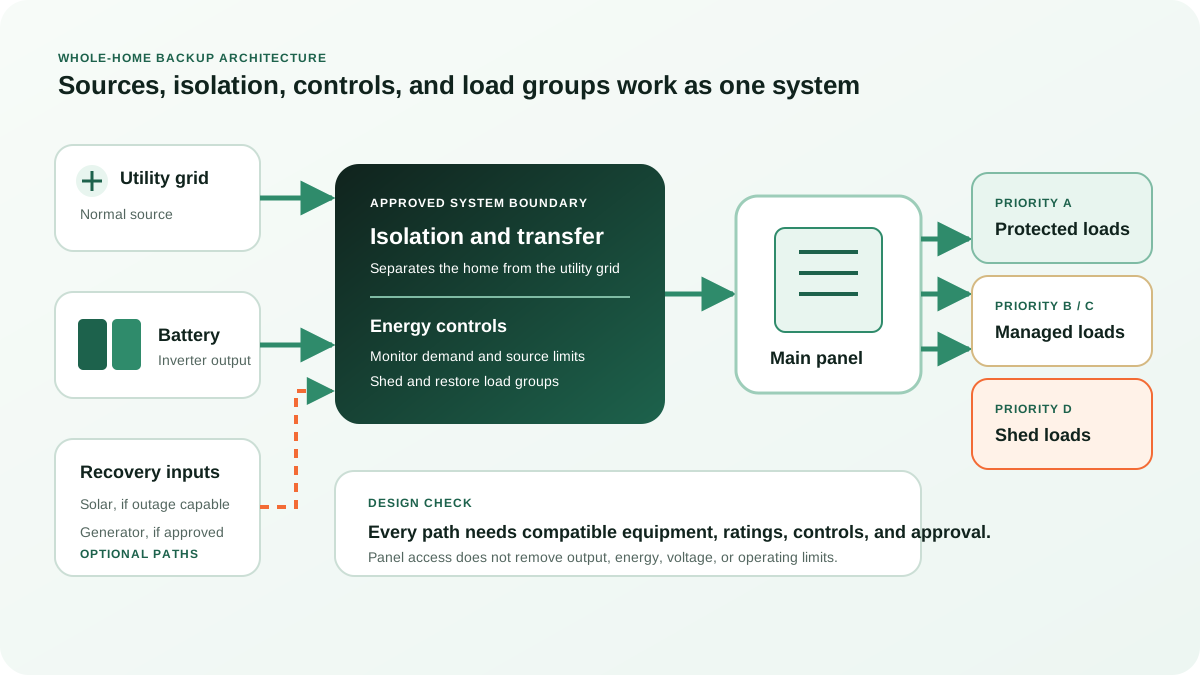
During an outage, the backup source must be isolated from the utility grid unless the complete interconnection system is specifically designed and approved for another operating mode. Proper transfer equipment protects utility workers, occupants, equipment, and the backup source. Never connect a generator or inverter to the home by improvising a backfeed path.
The transfer architecture may use an automatic transfer switch, energy gateway, service-rated equipment, a backed-up loads panel, a smart panel, or another approved arrangement. The correct choice depends on the source, service, utility rules, neutral and grounding design, fault-current requirements, existing solar, generator integration, and local code. The same enclosure that switches sources may also monitor demand or shed circuits, but these are separate functions that both need verification.
Keep backup from energizing the grid
Use listed, approved transfer or isolation equipment installed for the exact source and electrical system.
Decide what stays energized
Choose main-panel reach, a broad backup panel, or selected circuits based on output, energy, and operating needs.
Protect the power budget
Confirm load-shed priorities, reconnect delays, state-of-charge rules, manual overrides, and failure behavior.
Step 11: plan beyond the first battery cycle
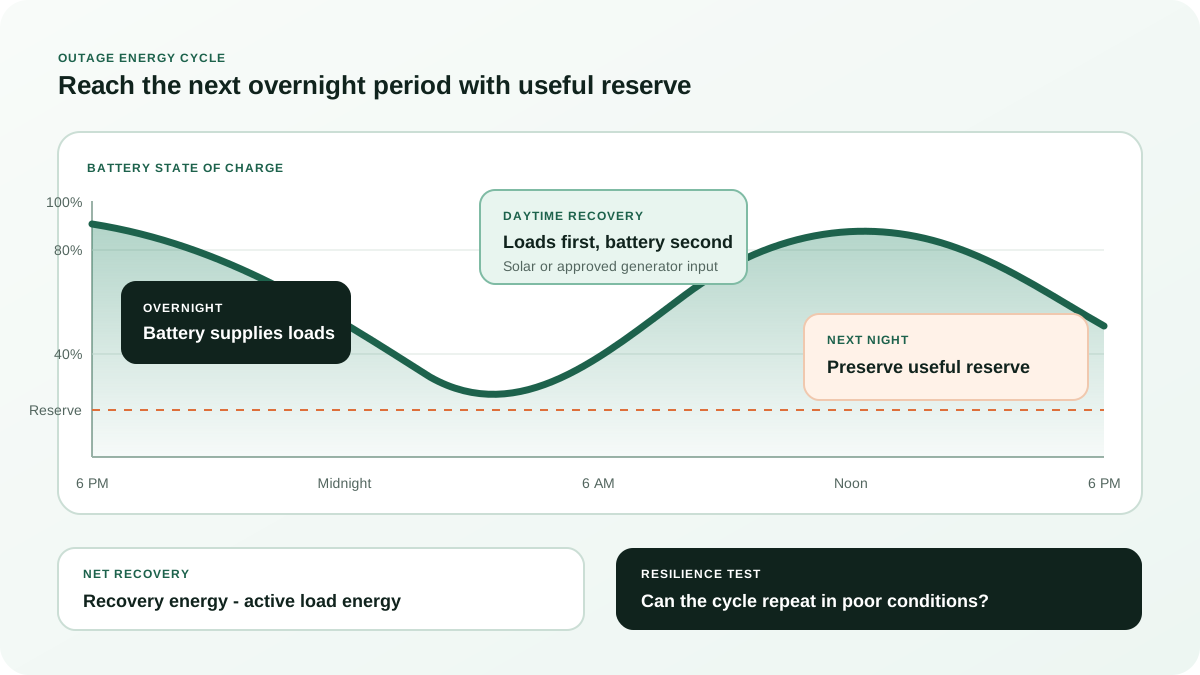
Recovery determines whether the plan survives a long outage
Solar, grid charging before an event, a standby generator, or a portable generator used through approved equipment can restore energy. The useful daily recovery is not simply array rating multiplied by daylight hours or generator nameplate multiplied by runtime. Account for weather, temperature, shading, conversion, battery charge limits, ongoing household loads, fuel, maintenance, and operating windows.
Grid-connected solar without the required outage-capable inverter, controls, isolation, and storage arrangement may shut down when the grid fails. Verify black-start behavior, minimum state of charge, solar curtailment, and what happens when the battery is full or too low to establish the local electrical reference the solar equipment needs.
Variable and weather-dependent
Model a conservative production day, the system’s outage mode, charge acceptance, and the loads operating during daylight.
Controlled high-power windows
Verify charger input, generator compatibility, approved connection, fuel, noise, exhaust, and efficient run periods.
The fastest resilience upgrade
Lower HVAC demand, water-heating frequency, cooking energy, and discretionary loads when recovery falls behind.
Write a state-of-charge response plan. For example, normal outage mode may preserve broad coverage above a defined threshold, block selected large loads below the next threshold, and switch to essential-only operation before reaching the protected reserve. The exact thresholds depend on the system, medical needs, weather, and expected recovery.
Step 12: design the physical project
Equipment location, certification, permitting, and commissioning matter
Whole-home backup is a permanent electrical project. Battery systems, inverters, transfer equipment, generators, fuel systems, solar, panels, and controls must be selected and installed as compatible equipment. Product listing does not eliminate location-specific design, and independently listed parts do not automatically become an approved system when combined in the field.
For stationary residential energy storage in the United States, verify the system certification and the requirements that apply to the intended installation. UL Solutions identifies UL 9540 as the system safety standard used for energy storage systems and UL 9540A as the test method used to evaluate thermal-runaway fire propagation. Local building, electrical, fire, zoning, utility, and manufacturer requirements control the actual project.
Clearances and environment
Check openings, ignition sources, vehicles, flooding, drainage, temperature, sunlight, ventilation, service access, impact protection, and fire separation.
Service and equipment coordination
Verify panels, disconnects, conductors, overcurrent protection, fault ratings, grounding, neutral, transfer, solar, and generator paths.
Prove the outage behavior
Test transfer, motor starts, load shedding, reconnect order, communications, alerts, manual controls, recovery, and shutdown procedures.
Manufacturer instructions, the system listing, site conditions, and local authorities determine where equipment may be installed. Keep the final approved plans, labels, emergency instructions, and contact information accessible.
Step 13: prepare the household
Whole-home backup still needs an outage operating plan
Automatic transfer solves only the first seconds. The household should know which loads are available, which are blocked, how to see state of charge or fuel status, when to reduce demand, and how to respond to an alarm. A simple plan is more reliable than asking people to interpret a complex dashboard during severe weather.
-
1
Confirm the outage and transfer state
Check for electrical damage, flooding, unusual smells, smoke, alarms, or equipment warnings before treating the event as routine.
-
2
Enter the correct load mode
Pause EV charging, laundry, pool equipment, unnecessary resistance heat, and other circuits defined by the plan.
-
3
Protect the next overnight period
Track energy, weather, fuel, and recovery. Reduce lower-priority loads before the reserve becomes urgent.
-
4
Use large loads one at a time
Follow the documented schedule for HVAC, water pumping, cooking, and water heating rather than improvising.
-
5
Record abnormal behavior
Note overloads, nuisance trips, failed starts, unexpected battery draw, alarms, or poor recovery for qualified follow-up.
-
6
Verify normal return
After grid restoration, confirm transfer, charging, controls, fuel status, alerts, and any loads that were intentionally disabled.
Non-negotiable boundaries
Use listed equipment, approved isolation, and safe source operation
Whole-home systems involve utility power, high fault current, large batteries, fuel, exhaust, motors, solar generation, and automatic controls. Design, permits, installation, and commissioning belong with qualified professionals. The household’s role is to understand normal operation, alarms, shutdown instructions, and the emergency plan.
Never energize a home through an improvised cord or connection. OSHA warns that a generator must not be connected directly to a structure unless a qualified electrician has installed transfer equipment that isolates the electrical system.
CPSC says portable generators belong outdoors only, at least 20 feet from homes and buildings, with exhaust directed away from windows, doors, vents, and other openings.
Use working CO alarms with battery backup on every level and outside sleeping areas, following current safety guidance and local requirements.
Follow manufacturer emergency instructions. Smoke, unusual heat, odor, hissing, leaking gas, deformation, or alarms require immediate action and emergency assistance.
Ready.gov advises alternate plans for refrigerating medicines and using power-dependent medical devices. Do not make one home system the only layer.
Do not approach, reset, or operate damaged, flooded, overheated, smoking, or electrically exposed equipment. Follow emergency and professional instructions.
Step 14: prepare a decision-ready scope
Give installers the same load plan and ask for explicit answers
Comparable proposals need a shared scope. Give each installer the panel information, appliance list, measured loads, outage priorities, seasonal cases, desired autonomy, recovery options, site constraints, and the exact large loads you expect to use. Ask the proposal to state what is included, what is blocked, and under what conditions.
Ask what happens if communications fail, a battery reaches reserve, solar cannot start, the generator does not start, a large motor fails to start, or the home exceeds the power budget. A strong proposal explains the degraded mode rather than describing only normal operation.
Frequently asked questions
Whole-home backup questions homeowners ask
Can a battery run my entire house?
It can provide panel-level coverage when the system has the required voltage, continuous output, surge capability, stored energy, transfer equipment, and controls. Many designs still manage or block high-demand circuits. “Entire house” should be defined by the actual outage operating plan.
How many kWh does a whole-home battery need?
There is no reliable answer from house size alone. Build a daily outage load from exact appliances, hours, duty cycles, weather, and behavior. Then account for usable capacity, conversion losses, reserve, aging, desired autonomy, and dependable recovery.
Do I need to back up every breaker?
No. A selected-circuit design may be simpler and more resilient. Broad panel access is useful when priorities change, but it creates more need for load control. Compare the benefit with the added output, energy, installation, and operating complexity.
Can solar panels power the home when the grid is down?
Only if the system is designed for outage operation with the required inverter, controls, isolation, and usually storage or another grid-forming source. Conventional grid-tied solar commonly shuts down during an outage. Verify the exact architecture and black-start behavior.
Is a standby generator whole-home backup?
It can support broad coverage when correctly sized and connected, but it still has output, fuel, placement, noise, maintenance, and operating limits. Large electrical loads may need load management even with a substantial generator.
Is a hybrid battery and generator system better?
It can be stronger for long outages because the battery carries quiet routine loads and the generator restores energy in controlled windows. The benefit depends on compatible equipment, approved connections, charging power, controls, fuel, maintenance, and a documented operating sequence.
Can I keep central air conditioning running?
Possibly, but use the exact HVAC data. Verify running demand, compressor start, auxiliary heat, defrost behavior, per-leg output, outdoor temperature, soft-start compatibility, daily energy, and what other loads remain active. Cooling one zone may provide better resilience than treating the full normal HVAC load as fixed.
How much reserve should I keep?
The reserve should reflect the consequences of losing power, uncertainty in recovery, weather, medical needs, and the system’s minimum operating limits. Keep it visible in the plan and define the lower-priority loads that switch off before the reserve is reached.
Build the outage version of your home before comparing systems
List the circuits, define simultaneous use, test motor starts, calculate daily energy, decide which loads can be shed, and document how the system recovers. That turns “whole home” from a marketing phrase into a repeatable operating plan.
Primary safety and technical references
- U.S. Department of Energy: Solar Energy Guide for Homebuilders
- U.S. Department of Energy: Guide to Fire Safety with Solar Systems
- UL Solutions: Energy Storage System Testing and Certification
- UL Solutions: Installation Codes and Requirements for Energy Storage Systems
- U.S. Consumer Product Safety Commission: Generator Carbon Monoxide and Fire Safety
- Occupational Safety and Health Administration: Electrical Safety after Hurricanes
- Ready.gov: Power Outages
Final system design, equipment selection, location, permits, installation, and inspection depend on the property, utility, manufacturer instructions, product listing, and authorities having jurisdiction.
Editorial review: July 25, 2026. This guide provides planning education and does not replace electrical, engineering, medical, fire-safety, utility, or code advice.