Battery plus generator planning
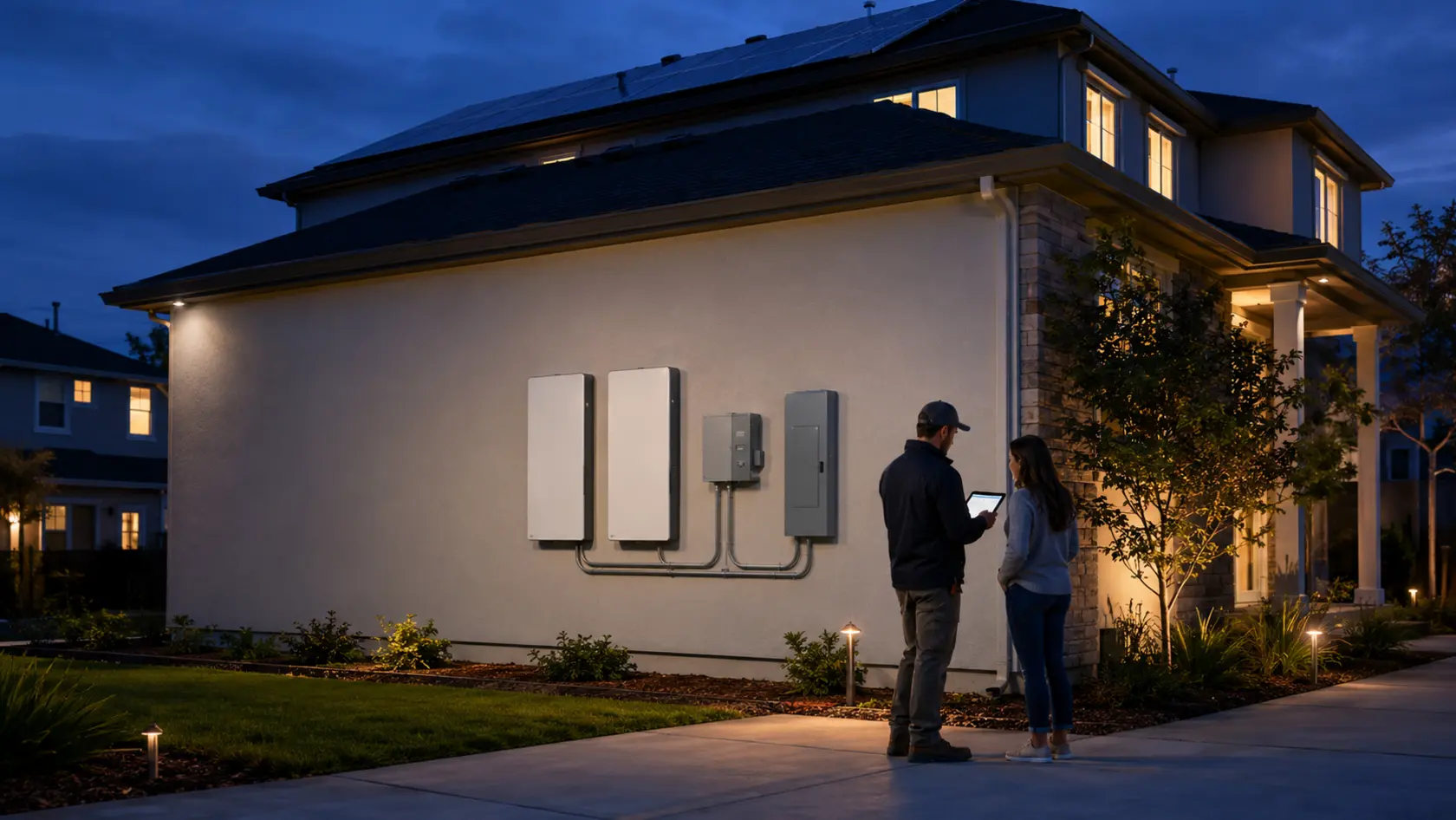
A hybrid backup system uses stored energy for quiet, immediate power and a generator for controlled recovery during a long outage. The concept is simple. The implementation is not. The battery, inverter, generator, charger, transfer equipment, solar, controls, grounding, neutral arrangement, and household loads must work as one approved system.

A good hybrid system separates load support from energy recovery
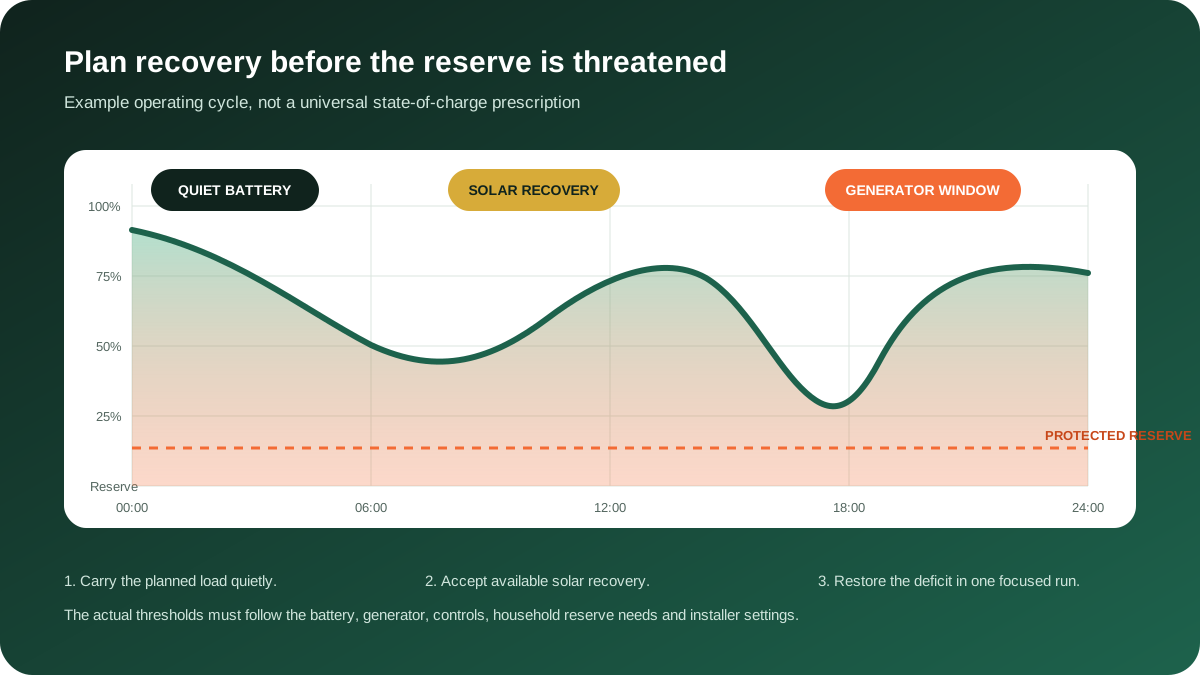
The battery should carry normal outage loads, absorb brief surges, and keep the home quiet when demand is modest. The generator should start or be deployed only when stored energy reaches a planned threshold, when a major load needs support, or when poor solar conditions make recovery uncertain.
This can reduce generator runtime, fuel use, noise, and light-load operation. It also creates more ways for the system to fail if components are selected independently. Confirm the charging path, accepted generator input, voltage and frequency requirements, maximum charge rate, transfer behavior, neutral and grounding design, automatic-start interface, and failure response before purchasing equipment.
Integrated hybrid system
Battery, generator, controls, and transfer equipment are designed and commissioned to operate together.
Plan whole-home coverageBattery with generator charging
A compatible generator recharges a portable or modular battery through an approved input and operating procedure.
Compare portable systemsBattery, solar, generator fallback
Solar handles routine recovery when conditions allow, while the generator covers the remaining energy deficit.
Model solar recoveryOne source may be enough
Short outages or a small essential-load plan may not justify hybrid controls, fuel, maintenance, and commissioning.
Compare the simpler optionsStep 1: choose the control model
Three hybrid architectures can work, but they are not interchangeable
The word hybrid often hides the most important question: exactly how does generator power reach the battery and the loads? An integrated system may accept generator input through listed control equipment and automatically coordinate charging. A portable arrangement may use the generator only to power the battery’s AC charger. A whole-home design may let a generator support the backed-up bus while also restoring battery energy. Each route has different limits and installation requirements.
Battery carries loads, generator charges battery
The inverter remains the load source. Generator output feeds only an approved charging input. This creates a clear operating model and can keep sensitive loads isolated from generator variation.
Generator supports loads and charges
Approved controls transfer or coordinate the backed-up bus so the generator can carry household demand while surplus output restores the battery.
Solar and battery lead, generator fills the deficit
Solar provides the first recovery path. The generator operates only when state of charge, weather, or forecast demand shows that solar will not maintain reserve.
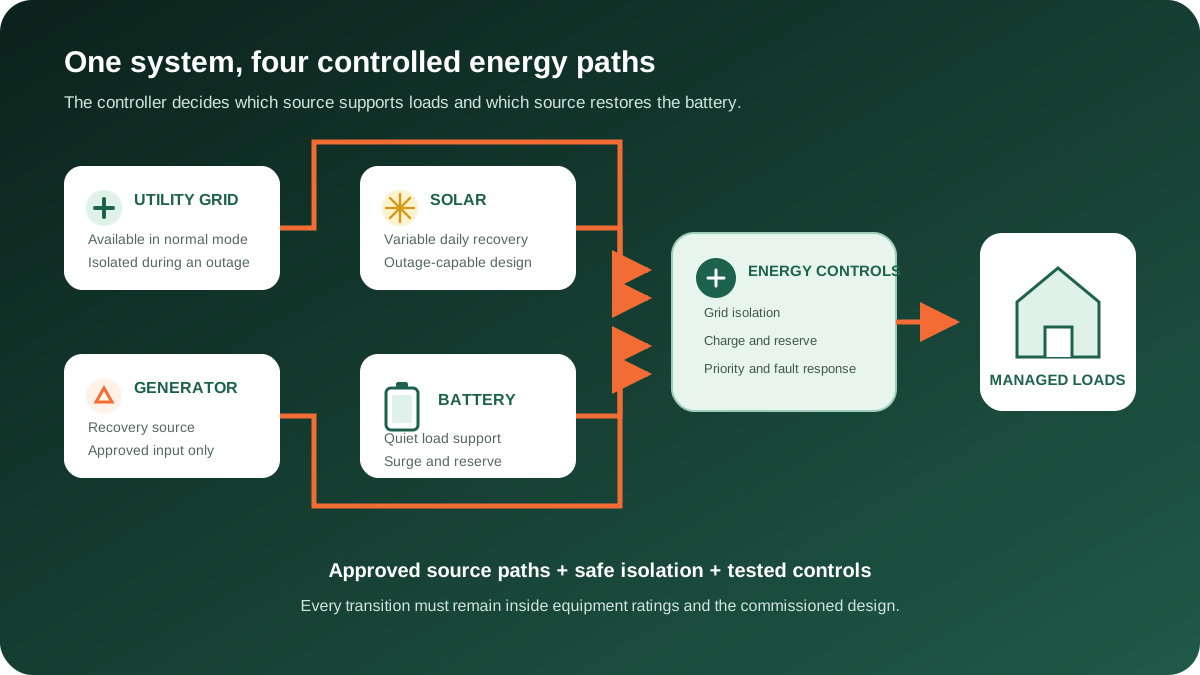
A plug may physically fit while voltage, frequency, waveform, grounding, neutral, current, charging profile, or control behavior remains incompatible. Use only the connection methods and equipment approved by the manufacturers and the system designer.
Step 2: define what must work
Write the outage promise before sizing equipment
Begin with the home’s essential and managed loads. List refrigeration, communications, medical devices, lighting, pumps, heating controls, selected outlets, and any carefully managed comfort load. Record running power, the hardest start event, daily energy, voltage, and whether a load can be delayed while the generator charges.
Then define the reserve rule. A household with medical equipment, a well pump, or winter heating controls may need a larger protected battery reserve than a home using backup mainly for convenience. Decide how much energy must remain if the generator fails to start, fuel runs out, solar production falls, or a storm prevents safe outdoor deployment.
Continuous load
The realistic watts expected to run together during battery operation.
Hardest start
The largest motor or compressor surge while other priority loads remain active.
Energy between runs
The watt-hours consumed from one generator or solar recovery window to the next.
Protected reserve
The battery energy that normal operation should not consume before the fallback is proven.
The system boundary also includes the transfer equipment, backed-up panel or managed main panel, battery enclosure, generator location, fuel supply, solar controls, communications, and manual override. Treating the battery and generator as separate purchases often misses the equipment that makes them operate safely as one system.
Step 3: pass the power tests
Size the inverter for loads and the generator for recovery plus load support
The battery inverter must support the continuous outage load and the hardest expected surge. A generator used only for charging must support the charger input with appropriate headroom and site derating. A generator expected to carry loads while charging must support both at the same time, including motor starts and control-system requirements.
Continuous output
Add the loads that can realistically overlap during battery operation.
Surge output
Test the hardest motor start while all loads that must stay on continue running.
Recovery output
Include charger input, loads carried during charging, elevation, temperature, fuel, and a practical operating margin.
A larger generator does not automatically produce faster battery recovery. Charge rate can be limited by the battery, charger, inlet, controls, temperature, state of charge, or system settings. Oversizing the generator without increasing the accepted charge rate can create inefficient light-load operation with little resilience benefit.
Size home loads and generator output independently
Use the home calculator for the outage load, then confirm the generator against the actual charging configuration.
Step 4: size the interval
Battery capacity should cover the quiet interval and the fallback reserve
A hybrid battery does not necessarily need to hold several days of energy. It needs enough usable energy to carry the planned loads between reliable recovery windows, absorb uncertainty, and preserve the reserve. Nighttime quiet operation is a common design target, but the right interval depends on fuel availability, generator restrictions, solar conditions, weather, medical needs, and how quickly the household can respond.
Daily outage use
Multiply each load’s watts by its actual hours or duty cycle, then add the results.
Energy between runs
Calculate only the portion of the day the battery must cover without generator or sufficient solar.
Losses and reserve
Account for usable depth, inverter loss, temperature, aging allowance, and protected reserve.
For example, a managed home using 9 kWh across a full outage day might consume 4.5 kWh during a 12-hour quiet window. If the planning assumption reserves 20 percent and allows 10 percent for conversion and other losses, the installed target is larger than 4.5 kWh. The exact model should use the equipment’s specified usable energy and operating conditions rather than a universal loss factor.
Step 5: verify the charging path
Generator charging is the heart of the hybrid design
Record the generator’s rated continuous output for the intended fuel, the output available at the site’s elevation and temperature, the battery charger’s maximum input, the approved voltage and frequency range, and whether charging power can be limited. If household loads share generator output, the controller must prevent the charger from consuming the headroom needed for a motor start or essential circuit.
| Check | What to confirm | Why it matters | Failure symptom |
|---|---|---|---|
| Accepted input | Voltage, frequency, current, waveform, grounding and neutral requirements | Determines whether the charger will accept and safely use generator power | Charging refuses to start, cycles, or trips |
| Charge rate | Maximum and adjustable AC charging watts at different battery states and temperatures | Sets recovery time and generator loading | Long run time or repeated overload |
| Shared loads | Whether household loads remain on the generator while charging | Changes the required generator headroom | Voltage sag or shutdown during a motor start |
| Automatic start | Approved dry contact, communications, warm-up, cooldown and stop logic | Prevents unsafe or unreliable automatic behavior | Generator starts but power is not accepted, or stops too early |
| Transfer behavior | Grid isolation, source selection, interlocking, neutral and grounding design | Protects occupants, equipment and utility workers | Unsafe backfeed, nuisance trips or incorrect bonding |
Estimate recovery time by dividing the energy to restore by the net charging power that actually reaches the battery. Net charging power is not the generator nameplate rating. It is the accepted charger input after concurrent loads and charging losses. A battery needing 6 kWh of restored energy at 2.4 kW net charging requires about 2.5 hours in ideal steady conditions, plus practical allowance for tapering and changing loads.
Step 6: write the operating rules
Good thresholds protect reserve without running the generator constantly
Automatic systems need a start threshold, stop threshold, minimum run time, warm-up and cooldown behavior, quiet-hour logic, exercise schedule, fault handling, and a manual override. Manual systems need the same decisions written as a household procedure. The generator should not wait until the battery is nearly empty if weather, fuel, or equipment uncertainty could leave critical loads without a fallback.
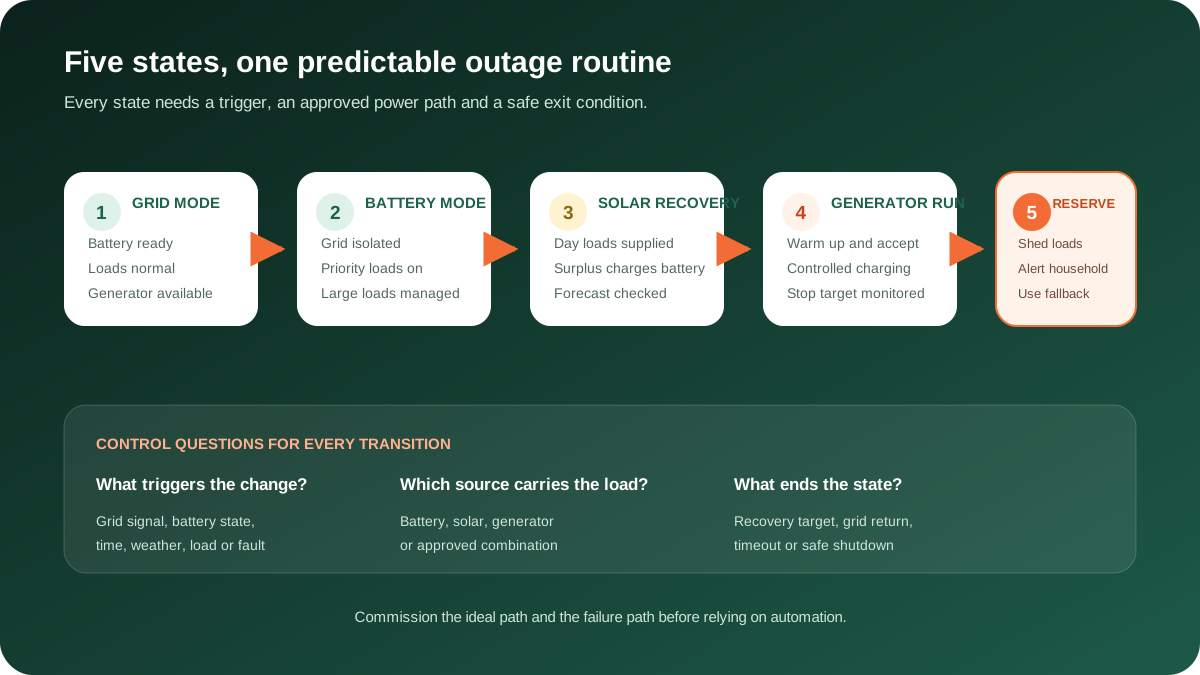
- 1Grid fails
Transfer equipment isolates the home and the battery immediately supports the approved load group.
- 2Loads are reduced
Controls or household rules block nonessential heating, charging, cooking, or comfort loads.
- 3Recovery is evaluated
The system checks battery state, solar forecast, current load, quiet hours, fuel and generator availability.
- 4Generator recovery begins
The generator warms up, approved transfer or charging controls accept power, and charging uses a controlled rate.
- 5Battery returns to target
The system reaches the planned stop threshold, removes charging load, cools down the generator, and returns to quiet operation.
Step 7: use solar as variable recovery
Solar can reduce generator runtime, but weather sets the daily result
Solar production during an outage depends on array size, season, orientation, shade, temperature, weather, inverter limits, battery state, and whether the installed system is designed to operate when the grid is down. A grid-tied solar array without the required islanding and storage architecture should not be counted as outage power.
Build the operating plan around a conservative solar day, not the array’s ideal rating. If expected solar energy exceeds daytime loads and the required battery recovery, the generator may stay off. If solar only offsets part of the deficit, run the generator in a focused charging window rather than waiting for an emergency reserve condition.
Compare outage use with realistic solar recovery
Test seasonal sun hours, system losses, array limits, battery capacity, and the energy deficit.
Step 8: test complete scenarios
Three profiles show how the hybrid balance changes
Compact essential-load home
- Refrigerator, Wi-Fi, lights and device charging
- Gas furnace blower or a small heating control load
- No large electric cooking or resistance heat
- Managed running load
- about 500 W average
- Daily energy
- about 12 kWh
- Hybrid goal
- quiet overnight interval
A moderate battery can cover quiet hours. A focused generator run restores the daily deficit when solar is weak.
Well pump and broader circuits
- Refrigeration, communications and lighting
- 240V well pump with verified starting demand
- Brief microwave and selected outlet use
- Managed running load
- about 900 W average
- Daily energy
- about 22 kWh
- Hybrid goal
- surge support and recovery
The inverter must pass the pump-start test. Generator charging needs headroom so a pump cycle does not collapse the recovery session.
Managed whole-home operation
- Most circuits available through load controls
- Selected HVAC or other high-demand equipment
- Solar and generator recovery with protected reserve
- Managed running load
- about 1.5 kW average
- Daily energy
- about 36 kWh
- Hybrid goal
- multi-day resilience
Automatic shedding and source coordination matter as much as capacity. Major loads should be scheduled around recovery and reserve.
These are planning examples, not appliance ratings. Replace every assumption with the home’s measured load data, equipment specifications, seasonal conditions, and approved system limits.
Step 9: plan the consumable side
Fuel and maintenance determine whether the second source is real
A generator is only a recovery source when it can start, produce acceptable power, and continue operating. Record the intended fuel, usable on-site supply, expected consumption at the planned charging load, storage or utility constraints, refueling procedure, maintenance intervals, exercise schedule, oil and service requirements, and who can operate it if the primary household planner is unavailable.
Do not calculate duration from tank volume alone. Generator fuel consumption changes with load, fuel type, environmental conditions, equipment condition, and manufacturer specifications. A hybrid plan can improve fuel efficiency by creating fewer, more purposeful run windows, but only if the charger accepts enough power and the battery can store the recovered energy.
Step 10: remove single points of confusion
Plan what happens when one source, control, or assumption fails
| Failure | Required response | Plan before the outage |
|---|---|---|
| Generator will not start | Preserve battery reserve and shed loads immediately | Manual start procedure, service contact, alternate charging or relocation plan |
| Battery will not accept charge | Stop repeated transfer attempts and protect essential loads | Approved troubleshooting sequence and direct-load fallback only if the design allows it |
| Solar underperforms | Move the recovery window earlier | Conservative weather trigger and fuel reserve |
| Communications fail | Use local controls and manual operating rules | Printed instructions, labeled disconnects and known default behavior |
| Major load overloads source | Remove or block the load before restart | Priority list, load-shedding settings and verified motor-start data |
Step 11: prove the operating sequence
Commission the whole system under realistic load
A commissioning test should simulate grid loss, verify isolation, confirm battery takeover, start the hardest planned motor, initiate generator recovery, confirm accepted charge power, test concurrent loads, verify stop and cooldown behavior, and prove that the system returns to the correct state. Test manual controls and failure notifications as well as the ideal automatic sequence.
- Transfer: grid isolation and source changes behave as designed.
- Power: continuous and surge loads stay inside ratings and per-leg limits.
- Charging: generator power is accepted at the intended stable rate.
- Controls: start, stop, reserve and load-shedding thresholds work.
- Solar: outage-mode production reaches the battery and approved loads.
- Fallback: manual operation remains possible when communications fail.
- Safety: alarms, shutdowns, labels, clearances and access are verified.
- Household handoff: more than one adult can follow the outage procedure.
Non-negotiable boundaries
Never trade generator safety for a shorter cable or easier charging route
Portable generators produce carbon monoxide and must remain outdoors. Current CPSC guidance says to operate them at least 20 feet from homes and buildings, with exhaust directed away from windows, doors, vents, and other openings. Never operate one in a home, garage, basement, crawlspace, shed, porch, or carport. Use working CO alarms on every level and outside sleeping areas.
Distance, exhaust direction and closed nearby openings remain essential even when a generator has a CO shutoff feature.
Never energize home wiring through an improvised connection. Structure connections require approved transfer and isolation equipment installed for the design.
Use listed equipment, approved locations, specified clearances, environmental limits and professional installation where required.
Common questions
Hybrid battery and generator FAQ
Can a portable generator recharge a home battery?
Only when the battery system provides an approved generator or AC charging path and the generator meets its electrical requirements. Permanent systems may require specific controls and professional integration. Never improvise a panel or inlet connection.
Should the generator charge the battery to 100 percent?
Not always. A lower stop threshold can shorten run time and preserve room for expected solar production. The correct setting depends on reserve needs, forecast loads, battery guidance and the reliability of the next recovery source.
Is a hybrid system always better than a larger battery?
No. A larger battery may be simpler for short outages and reliable solar conditions. A hybrid becomes stronger when outages outlast practical stored energy and a safe, maintainable fuel source is available.
Can the generator and solar charge at the same time?
Some integrated systems can coordinate multiple inputs, while others limit or prohibit simultaneous charging. Confirm the exact system architecture and input limits rather than assuming the sources will combine.
Build the hybrid around one tested outage routine
Calculate the load, define the quiet interval, preserve reserve, verify the charging path, and commission every source transition. A hybrid system earns its complexity only when the household can predict what it will do before the grid fails.
Sources and review basis
- U.S. Consumer Product Safety Commission: generator carbon monoxide and fire safety
- OSHA: portable generator grounding and transfer guidance
- U.S. Department of Energy: solar energy and storage basics
- UL Solutions: portable power pack safety and code considerations
Editorial and technical review: July 26, 2026. Product instructions, listed configurations, local rules and qualified professional design control the final installation.