Load planning guide
Generic wattage tables are useful for orientation. A purchase decision should use the actual appliance nameplate, manual, measured energy, and severe-weather operating scenario.
Practical answer
Record voltage, running watts or amps, starting watts or LRA, hours or duty cycle, and outage priority for every load. Use watts for simultaneous inverter or generator demand and watt-hours for battery capacity. Treat the ranges in this guide as planning placeholders until the actual equipment is verified.
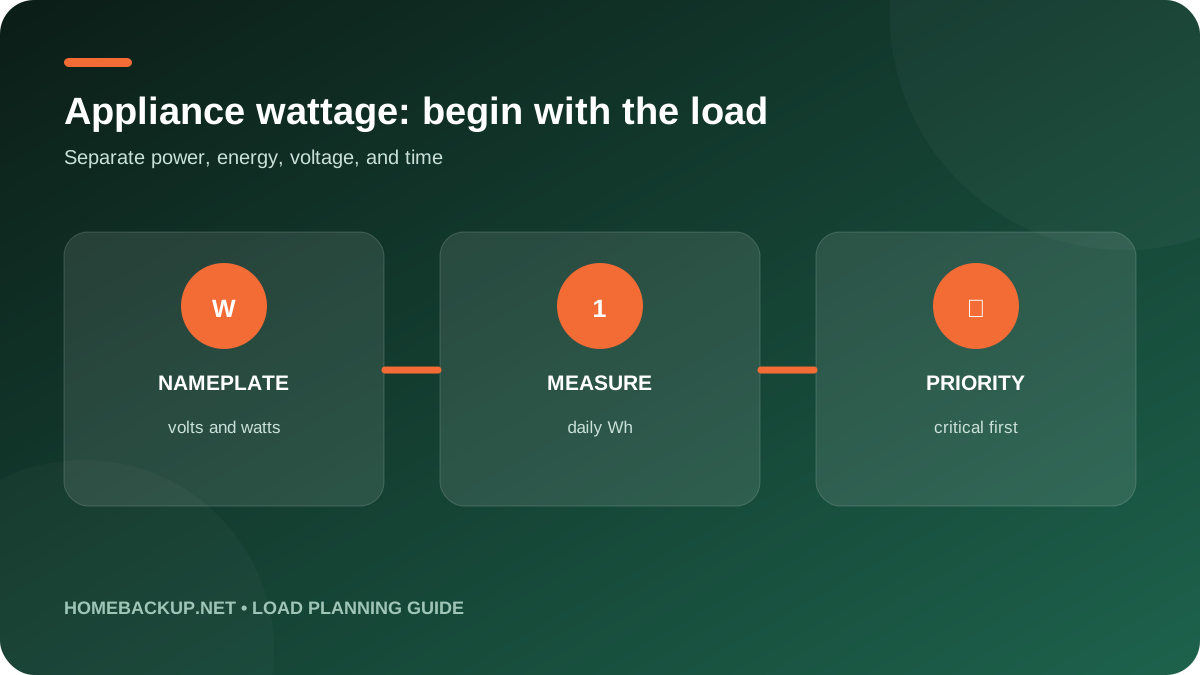
Record voltage and watts or amps from the actual appliance.
An energy meter can reveal daily Wh and cycling behavior.
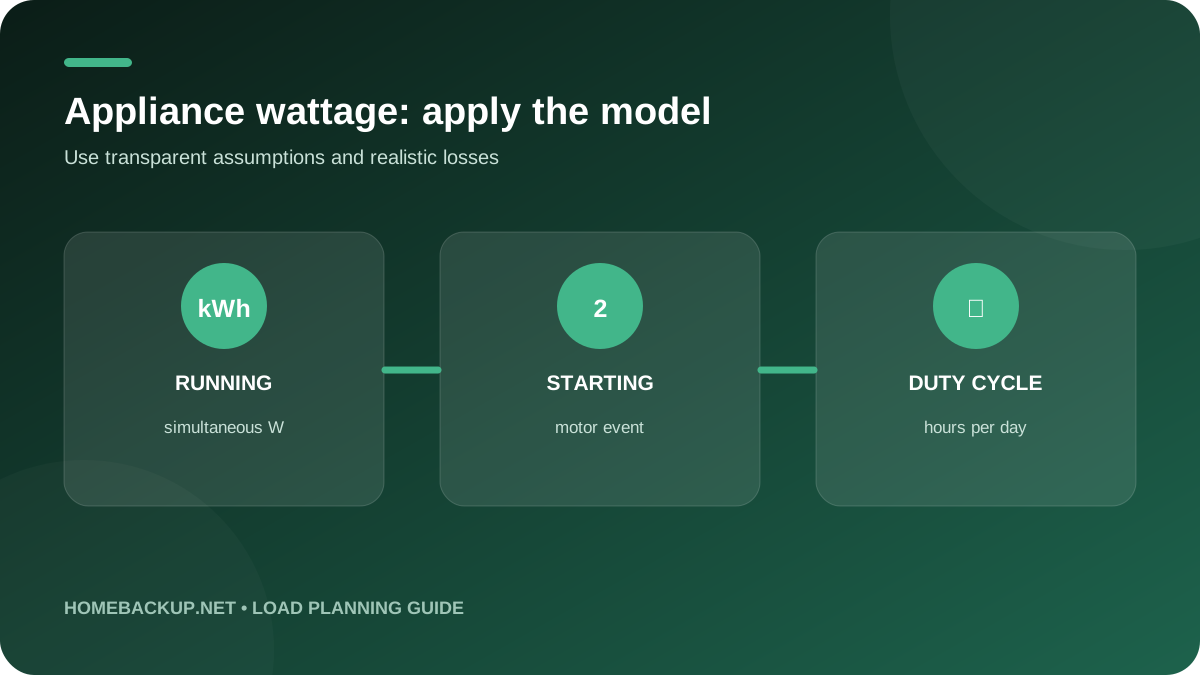
Refrigeration, pumps, furnaces, and cooling need time-based scenarios.
A short compressor or pump start can shape inverter size.
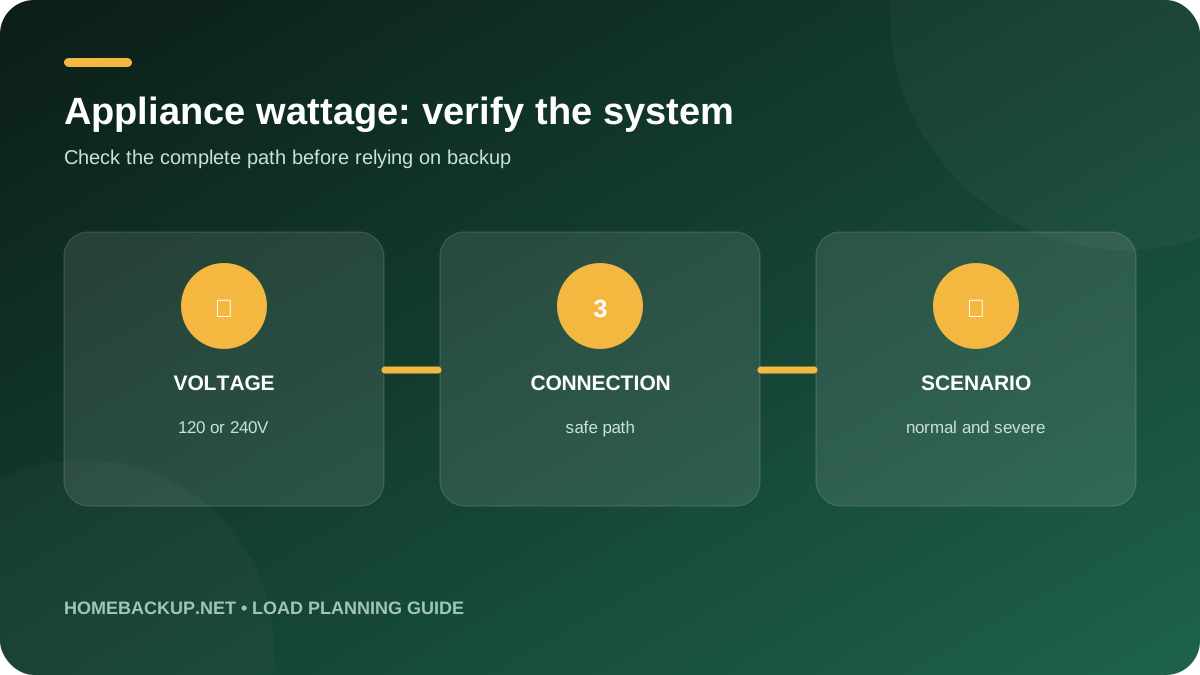
Well pumps, HVAC, heating, dryers, ranges, and EV charging often need split phase.
A smaller managed plan can provide longer, more reliable backup.
Calculator or quick planning method
Running power: when real watts are not listed, volts × amps provides volt-amperes. For resistive loads, VA and W are close; motors and electronic equipment can have power factor, so use manufacturer real-watt data when available.
Energy: watt-hours = average watts × hours. For cycling loads, daily Wh from a meter is usually stronger than label watts × 24. Motor sizing: total simultaneous running watts + the largest additional starting demand is a useful first estimate for sequential starts.
The core idea
An appliance wattage chart cannot know the exact refrigerator, pump, furnace, or air conditioner in the home. Model year, size, efficiency, motor type, thermostat, condition, and environment can create large differences. The chart’s purpose is to identify which loads deserve measurement and which categories are likely to dominate power or energy.
A good inventory has separate columns for voltage, running power, starting power, operating time, daily energy, priority, and connection method. That prevents a 1,500 W space heater from looking similar to a 1,500 W microwave. Their power is similar, but the heater may run for hours while the microwave runs for minutes.
Home backup planning works best when power, energy, voltage, transfer behavior, and recovery are kept separate. Power determines whether equipment can run or start. Energy determines duration. Voltage determines whether the source is electrically compatible. Transfer determines how loads move from grid power to backup. Recovery determines whether the system can support a long outage instead of only consuming a finite reserve.
A useful estimate is transparent about its assumptions. It should show which numbers came from an appliance label, meter, manual, or homeowner scenario. It should also leave room for conversion losses, standby demand, weather, temperature, battery reserve, fuel performance, and changes in household behavior. A result with more decimal places is not necessarily more accurate.
Formula and planning method
Walk through the home and photograph each critical nameplate. Begin with refrigerator, freezer, sump pump, well pump, furnace or boiler controls, heat pump, air conditioner, CPAP or other health-related equipment, modem and router, home office, lighting, cooking, water heating, garage access, and any sanitation or communication load.
For plug-connected 120V equipment within the meter’s rating, measure watts and accumulated Wh. Refrigerators and freezers need at least a representative full day. Networking and office loads should include every power adapter, switch, monitor, and UPS. A furnace, well pump, central air conditioner, or hardwired appliance needs manufacturer data or qualified measurement.
Create at least two scenarios. The essentials scenario protects safety, food, communications, health planning, water, and basic heating controls. The comfort scenario adds selected cooking, cooling, entertainment, or office loads. Extreme-weather scenarios should increase furnace, pump, or cooling duty cycle as appropriate.
Illustrative appliance planning ranges
| Input or condition | Planning treatment | Why it matters | What to verify |
|---|---|---|---|
| Refrigerator or freezer | Often 80 to 250 W while compressor runs; start can be several times higher | Daily energy and compressor surge both matter | Measure 24-hour Wh and check startup |
| Internet equipment | Often 15 to 60 W for modem, router, and network devices | Low power but continuous daily energy | Measure the complete stack and UPS losses |
| LED lighting | Often 5 to 15 W per lamp | Efficient and easy to schedule | Count only outage lamps and actual dimmer behavior |
| Furnace blower | Often several hundred watts; start is higher | Cold-weather duty cycle can dominate | Nameplate, motor type, controls, and thermostat scenario |
| Sump pump | Often several hundred to more than 1,000 W with a larger start | Storm cycling and consequence matter | Pump nameplate, start data, and cycles per hour |
| Well pump | Often 240V with substantial starting demand | Voltage and surge can set source size | Horsepower, depth, controller, LRA, and pressure cycles |
| Window air conditioner | Often 500 to 1,500 W plus compressor start | Room cooling can be manageable with planning | Exact model, thermostat, room, and outdoor temperature |
| Central air or heat pump | Often several kW with major startup and seasonal energy | Can dominate both inverter and capacity | Outdoor and indoor units, LRA, auxiliary heat, soft-start compatibility |
| Microwave or coffee maker | Often 800 to 1,500 W for a short time | High power but limited daily energy | Input watts, not only cooking output |
| Resistance heater or water heater | Often 1.5 to 5.5 kW and continuous while heating | Rapidly consumes battery energy | Element rating, voltage, and load priority |
| Home office | Often 60 to 500 W depending on computer and monitors | Can be measured and reduced easily | Desktop, monitors, dock, network, printer, and UPS |
| CPAP | Often tens of watts, higher with humidifier or heated hose | Health-related planning needs exact device data | Manufacturer power supply, settings, battery guidance, and care plan |
The rows above should be read as a checklist, not as independent answers. A battery may have enough energy but too little inverter output. A generator may have enough running watts but fail to start a pump. A solar array may be large enough on a clear summer day but inadequate during the season when outages are most likely. Test the complete chain against the same operating scenario.
Three appliance inventory examples
The simultaneous load may be modest, but continuous networking and daily refrigeration drive energy. Direct plug-in backup can avoid permanent electrical work.
The pump’s start and storm cycle rate shape the system. Preserve reserve, add a high-water alarm, and avoid using battery energy for discretionary heating or cooking.
The 240V pump can shape inverter or generator power, while furnace duty cycle shapes daily kWh. Load sequencing and a supported long-outage recharge path are valuable.
These examples are deliberately illustrative. Appliance cycling, thermostat settings, motor condition, power factor, cable length, fuel type, elevation, panel configuration, weather, and user behavior can move the result. Build a conservative plan for critical loads, then decide which conveniences can be added only when spare capacity is available.
What changes the result in a real home?
The nameplate can overstate average energy because it identifies electrical rating, not duty cycle. It can also understate source difficulty when it omits a short startup event. Use the label to establish voltage and safe limits, then use energy measurement and motor data to model behavior.
Weather can change several loads together. A winter storm increases furnace runtime and may reduce battery charging in cold conditions. A tropical storm increases sump-pump cycling while reducing solar production. A heat wave increases refrigeration and cooling. One moderate-day measurement should not be the only design case.
Household actions create controllable demand. Avoiding simultaneous microwave, coffee maker, toaster, hair dryer, pump, and air conditioner operation can reduce inverter size. Turning off printers, gaming systems, extra monitors, and standby electronics can extend energy. Labeling the plan makes those savings repeatable.
Outages also change normal behavior. Refrigerator doors open more often, a sump pump may cycle more during the same storm that caused the outage, a furnace may run longer in extreme cold, and a well pump may serve a household that is home all day. At the same time, occupants may turn off discretionary loads. A good model uses an outage scenario rather than an average utility bill alone.
Common appliance wattage mistakes
Most sizing errors are category errors. Watts are treated as watt-hours, a short surge rating is treated as continuous output, a battery nameplate is treated as delivered AC energy, or solar panel watts are treated as guaranteed daily production. Correcting the category usually matters more than changing a safety factor from 20 percent to 25 percent.
How to verify the inputs
OSHA requirements state that appliances are marked with voltage and amperes or voltage and watts. Photograph the label and keep the model number. Search the current manufacturer manual for electrical data, startup information, approved power sources, and any warning about generators, inverters, GFCI, neutral, or waveform.
Use an appropriately rated plug-in meter for ordinary 120V loads. Do not place a consumer meter on equipment beyond its voltage or current rating. For central HVAC, well pumps, electric water heating, ranges, dryers, EV chargers, and panel circuits, use qualified measurement or installer calculations.
Record both a normal day and a severe-condition estimate. For a sump pump, count cycles during heavy inflow. For a furnace, use a design-cold scenario. For an air conditioner, use peak heat. For a refrigerator and freezer, include door openings and room temperature. Update the inventory when appliances are replaced.
Start with the appliance nameplate and current manual. OSHA requirements reflect why the nameplate is important: electrical appliances are marked with voltage and amperes or voltage and watts. For a cycling appliance, a plug-in energy meter can reveal daily watt-hours when the equipment uses a normal 120V plug and the meter is appropriately rated. Permanently wired, 240V, or high-current equipment should be evaluated through manufacturer data or qualified measurement.
Record the date, temperature, operating mode, and duration of any measurement. One calm day may not represent a storm, heat wave, or cold snap. For critical equipment, compare more than one scenario and preserve reserve. If a result depends on a specific surge value, transfer time, solar input, or generator charging feature, confirm it in the current manual for the exact model and configuration.
How this affects the backup system
Once the inventory is complete, the Home Backup Calculator converts selected loads into daily energy, simultaneous power, surge, and a 240V flag. The Battery Runtime Calculator estimates duration for a known battery.
Use the Generator Size Calculator when fuel-based backup is under consideration. Use the Inverter Size Guide for batteries. Both need the same appliance data, which makes one careful inventory reusable across system types.
Appliance priorities should reflect consequence, not convenience alone. A sump pump, medical plan, refrigeration of medicine, well-water controls, or furnace in severe cold may deserve reserve and a secondary backup. Entertainment and high-energy resistance loads can remain off.
The system should be checked in both directions. First, can the source support the largest instantaneous combination of running and starting loads at the required voltage? Second, is enough usable energy or fuel available for the intended duration? Then check whether the proposed solar or generator recovery can replace the daily energy used. Passing only one of these tests is not enough.
Load management can reduce system size without sacrificing the most important outcomes. Refrigeration, communications, medical planning, water management, and basic heating controls may receive priority. Electric water heating, resistance space heating, clothes drying, EV charging, and central cooling may be delayed or tightly controlled. The correct priority list depends on climate, health, water source, flood exposure, and household needs.
Safety, electrical limits, and local requirements
Never open an appliance panel or household electrical panel to obtain measurements unless qualified and authorized. Nameplates, manuals, plug-in meters within ratings, and professional measurements provide safer routes. De-energized equipment can still contain capacitors or stored energy.
Cords and power strips must match load, voltage, environment, and manufacturer instructions. Do not run high-power heating or cooking appliances from an undersized extension cord. Never use a generator or inverter to backfeed a wall receptacle. Combustion generators remain outdoors with carbon monoxide alarms and current safety guidance.
Do not treat a consumer power station or a calculator result as guaranteed medical-grade backup. Follow the medical-device manufacturer’s power instructions and the emergency plan agreed with the care team. For flood protection, heating in severe cold, well water, refrigeration of medicines, or other high-consequence loads, use layered contingency planning and alarms where appropriate.
A practical appliance inventory workflow
- 1
Choose outage priorities
Mark critical, useful, and discretionary loads.
- 2
Photograph nameplates
Record model, voltage, watts or amps, and motor data.
- 3
Measure plug-load energy
Capture daily Wh for cycling and continuous equipment.
- 4
Build normal and extreme scenarios
Change duty cycles for heat, cold, rain, and household occupancy.
- 5
Calculate power and energy separately
Use simultaneous W, starting W, and daily Wh.
- 6
Review and test
Update after equipment changes and conduct a safe controlled outage exercise.
Related completed guides
Frequently asked questions
How accurate are appliance wattage charts?
They are useful for orientation and early comparisons, but actual models vary. A chart should route you to the nameplate, manual, energy meter, and motor data rather than replace them.
Should I use volts times amps?
Volts × amps gives volt-amperes. It closely matches watts for resistive loads, while motors and electronics can have power factor. Use real-watt or manufacturer data when available and retain VA for source-current checks.
How do I measure a refrigerator?
Use an appropriately rated energy meter for at least 24 hours in representative conditions. Record kWh and, if the meter supports it, maximum watts. Verify compressor startup separately because some meters miss fast peaks.
Why is my microwave wattage higher than the front label?
The prominent number can describe cooking output rather than electrical input. Use the electrical nameplate or manual input rating for backup sizing.
Which appliances use 240V?
Central HVAC, many well pumps, electric ranges, dryers, water heaters, resistance heating, and EV chargers commonly use 240V in North American homes. Exact equipment and some multifamily services differ, so check the nameplate.
What loads should I exclude first?
Electric resistance space and water heating, clothes drying, EV charging, large ranges, and central cooling often consume substantial power and energy. Exclude or manage them unless the system is deliberately designed for those loads.
Is the appliance wattage guide result exact?
No. It is a planning estimate based on the values entered and the assumptions shown. Actual performance changes with appliance behavior, temperature, battery condition, power factor, wiring, configuration, and operating mode. Use current manuals and measured inputs where practical.
How much safety margin should I add?
There is no universal percentage. Twenty percent can be a useful first allowance for ordinary noncritical planning, but motor starting, uncertain duty cycles, severe weather, fuel derating, and high-consequence loads can justify more. Margin does not correct a voltage mismatch or an unsupported connection method.
How this guide was prepared
HOMEBACKUP.net separates verified specifications from planning estimates. The calculation methods show their assumptions, and product-independent guidance is based on current government, laboratory, standards, utility, and manufacturer documentation where appropriate. Illustrative runtimes and appliance values are not presented as measured promises for a particular home.
Before buying equipment, repeat the estimate with current nameplates, manuals, measured energy where practical, and a realistic outage scenario. Installed systems need a qualified professional to confirm service compatibility, conductor and breaker limits, transfer method, grounding and bonding, location, permits, inspections, and the current locally adopted rules.
Sources and review basis
Reviewed July 22, 2026. Calculations are planning estimates, not measured performance or an electrical design.
- OSHA 1910.305 appliance nameplate and wiring requirements
- OSHA electrical glossary
- Generac home generator sizing guidance
- Generac explanation of surge and starting wattage
- Generac explanation of running and rated wattage
Equipment specifications, electrical rules, safety instructions, and available accessories can change. Use the current appliance nameplate, product manual, local requirements, and qualified professional review for the actual installation.
Turn the appliance list into a system target
Enter the verified loads in the Home Backup Calculator and keep the original nameplate notes with the result.