A repeatable framework that distinguishes physical testing, document research, calculations, and editorial judgment.
Not every system is physically tested. HomeBackup.net identifies the evidence available, checks configuration-specific claims, and applies the same homeowner criteria. Research-based evaluation is not called hands-on testing, and laboratory certification is not described as proof of every real-world outcome.
Hands-on use, document review, calculation, and third-party certification are different evidence.
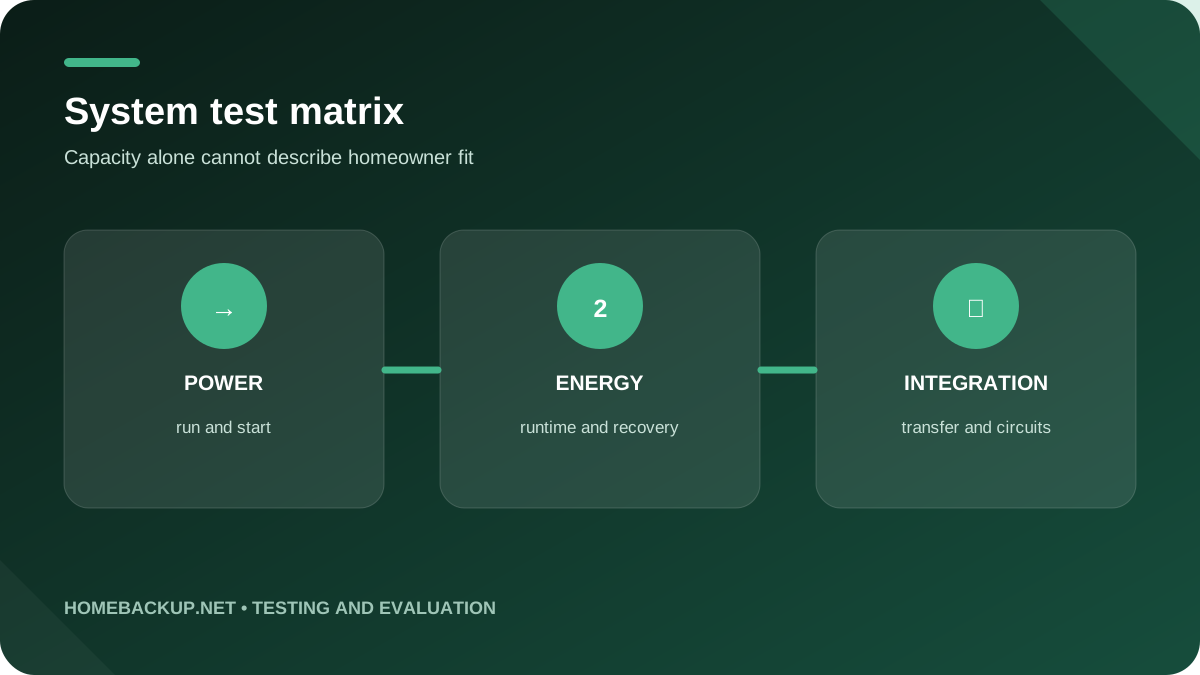
One unit, expansion batteries, hubs, panels, fuel, and firmware can change capability.
Normal output is separated from surge, boost, bypass, or load-management modes.
Reserve, conversion loss, standby draw, cycling, and conditions affect usable runtime.
Transfer, voltage, circuits, solar, generator input, and service equipment determine usefulness.
A useful evaluation states missing tests, assumptions, and unresolved compatibility questions.
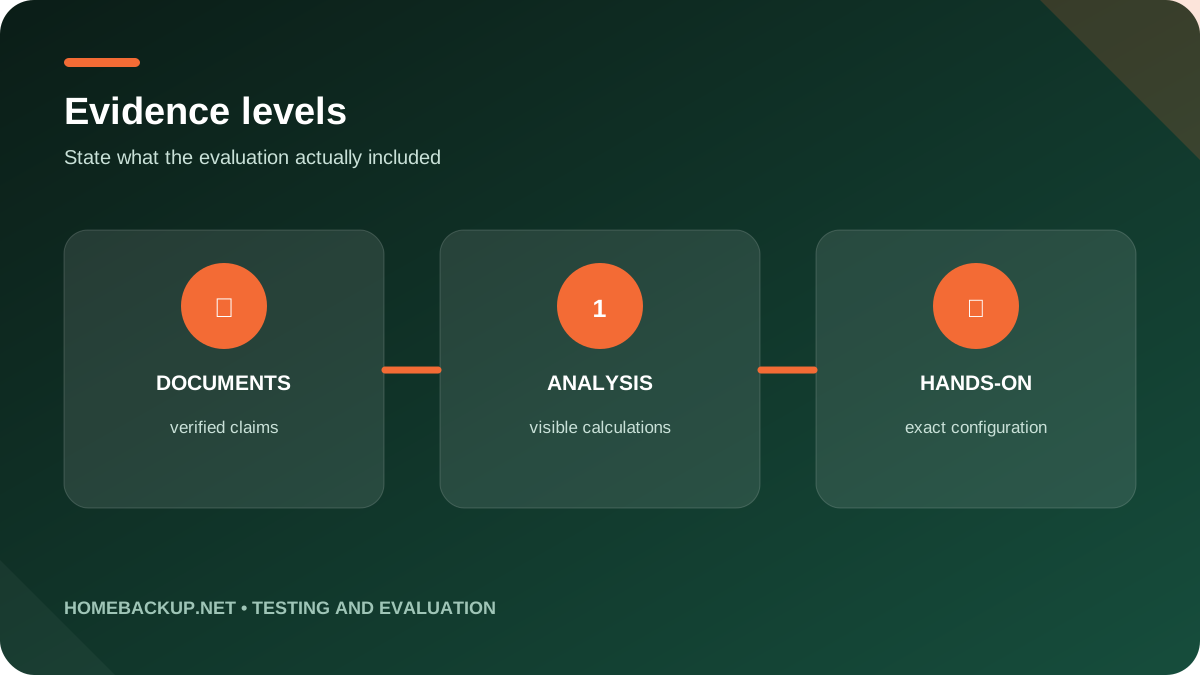
Evidence levels used on the site
Level one is primary-document evaluation. Editors examine official data sheets, manuals, installation instructions, compatibility lists, warranty documents, certification information, support material, and dated manufacturer announcements. This level can establish documented capability but cannot prove noise, ergonomics, thermal behavior, service quality, or long-term reliability beyond the evidence.
Level two adds analytical evaluation. Documented inputs are placed into runtime, recharge, generator-sizing, or load scenarios with visible assumptions. Level three adds hands-on use of the exact named configuration. Level four may include controlled instrumented testing. A page should state the highest level actually completed and must not borrow credibility from a certification or another reviewer’s test.
Configuration control
Before comparing numbers, the evaluation defines the configuration: main unit, battery count, output voltage, required hub or combiner, transfer or smart panel, solar controller, generator accessory, firmware, regional model, and fuel. A product family can contain equipment with similar names but different output, connectors, warranties, or certifications.
Maximum ecosystem claims are recorded separately from base-unit behavior. If two inverters are required for 240-volt split-phase output, that is not presented as a one-unit feature. If capacity expansion adds energy but not inverter output, the distinction is preserved. If a boost mode supports a resistive load by reducing voltage, it is not reported as ordinary continuous output.
Power, surge, and voltage evaluation
Continuous output is compared at the relevant voltage and configuration. Surge is evaluated by magnitude, allowed duration, waveform, and the type of load it can start. Motor and compressor labels, locked-rotor current, manufacturer guidance, and measured startup data are more useful than a generic multiplier when available. Receptacle and circuit current can limit a system even when the headline inverter wattage is larger.
Voltage is a gate, not a preference. A 240-volt well pump, central HVAC unit, range, dryer, or heat-pump component cannot be assumed to work from a 120-volt source. Split-phase support, neutral arrangement, grounding, transfer equipment, supported breakers, and load management must match the home and appliance.
Battery capacity and runtime method
Runtime begins with nominal or stated usable energy, then applies protected reserve, conversion efficiency, system standby consumption, average load, and operating pattern. A simplified delivered-energy estimate is battery kWh multiplied by the usable fraction and delivery efficiency. Estimated hours then divide that energy by average appliance load plus system standby. Cycling appliances require average energy or a duty-cycle assumption, not continuous nameplate watts for every hour.
Examples are presented as ranges because temperature, battery age, firmware, inverter efficiency, reactive loads, surge events, defrost cycles, thermostat settings, door openings, and standby behavior vary. A runtime table never verifies voltage, outlet current, transfer compatibility, or motor startup. Those are separate checks.
- Record battery capacity and whether it is nominal or usable.
- Protect an explicit reserve rather than assuming full discharge.
- Include AC conversion and system standby losses.
- Use measured average power or daily energy for cycling loads when possible.
- Run a separate startup and voltage check before trusting the energy result.
Generator sizing and operating evaluation
Generator evaluation separates rated running watts from starting watts and identifies the rating for the selected fuel. Natural gas, propane, and gasoline output may differ. Temperature, elevation, engine condition, fuel pressure, extension conductors, and power quality can affect real operation. The load calculation combines simultaneous running loads with the largest likely added motor-start demand, then applies operating margin.
A generator is also evaluated as a system: carbon monoxide risk, outdoor placement, weather protection that preserves ventilation, transfer equipment, inlet and conductor ratings, neutral treatment, fuel storage, exercise, maintenance, noise, and emergency refueling. A large generator without safe connection and adequate fuel is not a complete backup solution.
Solar recharge evaluation
Solar recovery uses location and season, peak sun hours, array orientation, shading, temperature, wiring, controller efficiency, and the battery’s accepted photovoltaic voltage, current, and power. Theoretical panel wattage is not treated as daily energy. NREL PVWatts can support a planning estimate for grid-connected arrays, but portable panel conditions and outage operation still need system-specific judgment.
For a battery to recover during an outage, the system must accept solar while isolated from the grid and the array must be connected to the supported path. A grid-tied solar array may shut down without an outage-capable inverter or storage controller. The evaluation therefore asks whether solar operates when the grid is down, not merely whether solar is installed.
Electrical integration and installation review
Installed systems are evaluated by transfer behavior, service rating, backed-up circuits, gateway or automatic transfer equipment, load controls, critical-load panels, monitoring, placement, communications, and commissioning. Product certification is checked for the exact system combination where possible. UL 9540 system certification and UL 9540A fire-propagation testing are related but not interchangeable claims.
Code and permits are treated as location-specific. A national model code can guide a design, but the adopted edition, amendments, fire review, utility process, and authority having jurisdiction determine approval. Cost comparisons normalize equipment, site work, permits, commissioning, warranty labor, and exclusions instead of comparing battery or generator hardware alone.
When hands-on testing is performed
A hands-on protocol records acquisition, exact model, serial or hardware revision when relevant, firmware, accessories, ambient conditions, test instruments, loads, test duration, and anomalies. Possible checks include charge and discharge energy, no-load consumption, AC output, voltage stability, startup behavior, charging input, noise at a defined distance, thermal observations, portability, controls, app behavior, and recovery after overload.
Physical testing has limits. A short test cannot establish multi-year battery degradation, rare reliability events, regional installer quality, warranty response across all owners, or performance in every climate. Installed systems cannot be generalized from one property. These limits are documented rather than hidden behind a score.
How conclusions are reached
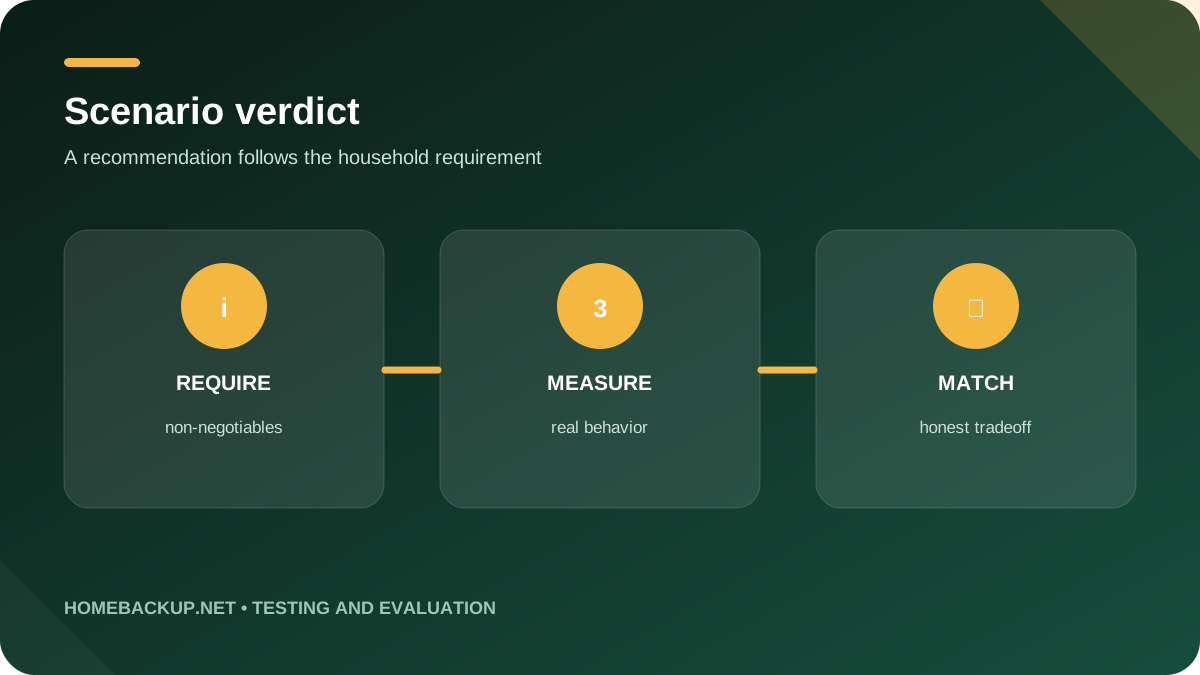
HomeBackup.net does not use one permanent score that pretends every homeowner values the same outcome. The conclusion is scenario-based. Essential-load users may prioritize efficiency, quiet operation, indoor compatibility, and modest output. Whole-home users may prioritize 120/240-volt capability, transfer, load management, expansion, solar, generator integration, and installer support.
A recommended system must meet the category’s non-negotiable requirements and disclose the main compromise. A high-capacity battery can lose a category if its output, voltage, or transfer path does not fit. A generator can lose an apartment category regardless of runtime because combustion operation is incompatible with indoor or balcony use. The scenario defines the decision.
Repeatability, records, and retesting
A useful method lets another reviewer understand how the result was produced. Test notes therefore record the equipment, configuration, firmware, ambient conditions, instruments, loads, timing, settings, and calculation sheet. Screenshots or app exports can support a record, but they do not replace a description of the procedure. When a result is unusual, the test is repeated and obvious connection, calibration, temperature, and state-of-charge issues are checked.
Retesting is appropriate when firmware changes power behavior, a new accessory enables 240-volt output, an updated controller changes generator support, a manufacturer revises usable capacity, or readers report a reproducible discrepancy. The new result does not silently overwrite the old one when the difference matters. The page explains which configuration and date the current conclusion represents.
Comparative tests use the same loads, settings, environmental range, measurement points, and stopping criteria as far as the products allow. When the architectures require different procedures, the difference becomes part of the result rather than being hidden. A fair comparison is not always an identical test, but it is always a transparent one.
Raw readings are retained when practical so rounding, unit conversion, and summary tables can be checked later. A chart or score should be reproducible from the underlying record. If the source data cannot be preserved or shared, the page states the limitation and avoids false precision.
Frequently asked questions
Does HomeBackup.net test every product in a laboratory?
No. Most coverage begins with primary-document and analytical evaluation. Laboratory or hands-on claims are made only when that work was actually performed and documented.
What is the difference between nominal and usable capacity?
Nominal capacity describes stored energy under specified conditions. Usable or delivered energy can be lower because of reserve, battery-management limits, conversion losses, standby draw, temperature, aging, and load behavior.
Why not compare only inverter watts?
Inverter watts do not establish voltage, outlet current, surge duration, energy, transfer, solar recovery, or whether a motor can start. All of those can change homeowner fit.
Are manufacturer specifications trusted automatically?
They are primary evidence for documented capability, but conditions and configuration are checked. Technical manuals and data sheets generally carry more weight than undated marketing summaries.
How are runtime tables verified?
The calculation method and assumptions are reviewed, and results are checked for unit consistency and reasonable ranges. They remain illustrations until replaced by measurements from the actual appliance and system.
Does UL certification mean a battery is safe anywhere?
No. Certification applies to a defined product or system and does not replace compliant placement, installation, environmental limits, instructions, permits, fire review, or maintenance.
Can a short physical test prove reliability?
No. It can reveal behavior in the tested conditions, but it cannot prove multi-year durability, every firmware state, all climates, or universal service quality.
How can a manufacturer correct a specification?
Send the exact page, model, disputed statement, and a current primary document through the Contact page. The correction is reviewed independently and recorded when material.
Sources and policy review basis
Policy reviewed July 22, 2026. Laws, program rules, search guidance, advertising requirements, product documents, and site practices can change.
- UL Solutions: energy storage system testing and certification
- NREL: PVWatts Calculator
- CPSC: carbon monoxide safety center
- Ready.gov: generator safety
- U.S. Department of Energy: permitting and inspection
These pages describe the site’s editorial and operational standards. Privacy and legal pages are general templates for the documented site behavior, not a substitute for advice about the operator’s specific obligations.