Freezer backup power
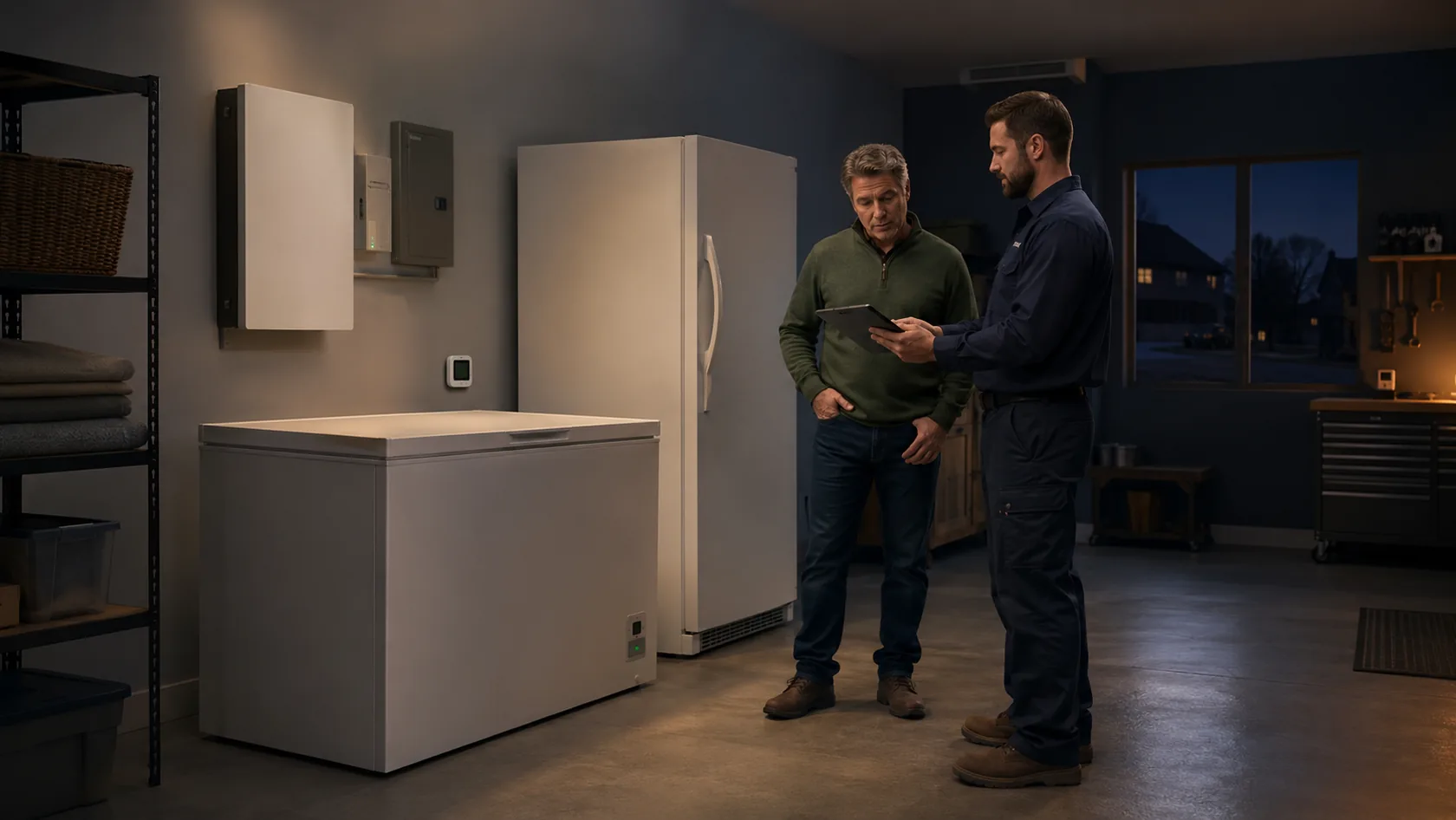
A freezer can preserve a high-value food supply through an outage, but only when the backup plan passes two separate tests. The source must start the compressor and any defrost load, while the stored energy or fuel must cover realistic cycling until the grid returns or another cold-storage option takes over. Freezer type, fullness, room temperature, door use, seals, and food temperature all change the outcome.

Size freezer backup from compressor start, measured daily energy, and the time to recovery
The inverter or generator must support the freezer’s highest starting demand while all other loads sharing the source are active. Battery capacity must cover measured watt-hours over the intended powered interval, conversion losses, difficult room conditions, and a reserve. A generator must meet the same electrical demand from a safe outdoor location and remain supportable with fuel and maintenance.
A closed freezer also provides passive cold storage. FoodSafety.gov states that a full freezer may hold a safe temperature for approximately 48 hours, or about 24 hours when half full, if the door remains closed. Those figures are emergency estimates, not guaranteed runtime. They do not replace an appliance thermometer, a power plan, or the item-by-item safety check required after thawing.
Portable power station
A practical quiet option when its inverter starts the compressor and its battery covers measured freezer energy.
Compare portable stationsInstalled battery
Useful when the freezer should transfer with the refrigerator, communications, pumps, lights, and other priorities.
Plan a home batteryGenerator
Useful for longer outages after outdoor placement, carbon monoxide safety, weather protection, fuel, and connection are solved.
Size generator outputBattery plus recovery
Run quietly from stored energy, then recharge in planned solar or generator windows before reserve becomes critical.
Plan a hybrid systemStep 1: collect useful evidence
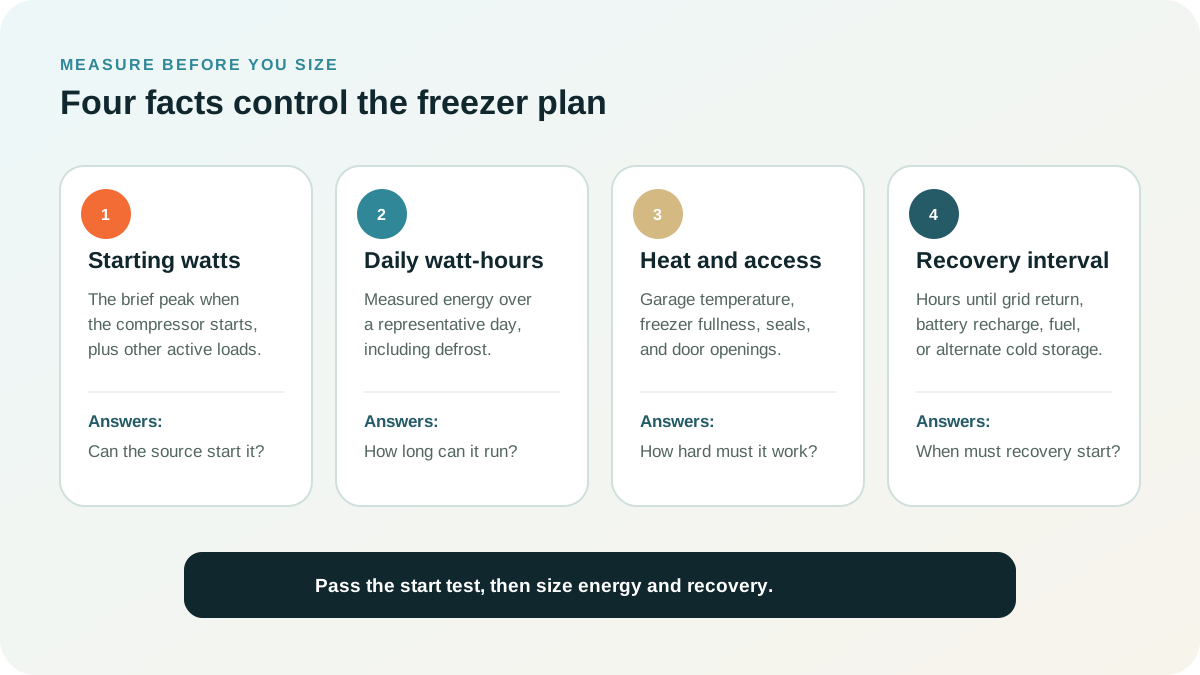
Four facts control almost every freezer backup decision
Freezers are cycling motor loads. They do not draw one fixed wattage all day. The compressor may be off for part of the hour, run steadily during another part, and demand a brief peak when it starts. A frost-free model may add fans and an electric defrost heater. The same freezer can consume very different daily energy in a cool basement and a hot garage.
Starting watts
The highest brief compressor-start demand, tested with the other loads that will remain active.
Daily watt-hours
Measured energy over representative days, long enough to include normal cycles and defrost behavior.
Operating conditions
Room temperature, fullness, door use, seals, frost, ventilation, and the model’s approved ambient range.
Recovery interval
Hours until grid return, battery recharge, generator support, ice, or safe transfer to other storage.
A lightly stocked freezer with replaceable food may justify a different resilience level from a full freezer holding bulk meat, prepared meals, breast milk, or food needed for a medical diet. Backup value is household-specific even when electrical demand is identical.
Step 2: identify the appliance
Chest and upright freezers create different outage conditions
Both designs use a compressor to move heat out of the cabinet, but shape, insulation, defrost method, door behavior, and installation location affect energy use and cold retention. Do not transfer a runtime estimate from one freezer to another merely because their internal volume looks similar.
| Characteristic | Chest freezer | Upright freezer | Backup implication |
|---|---|---|---|
| Opening | Top lid; dense cold air tends to remain low when opened briefly | Front door; cold air can spill out more readily | Frequent access usually penalizes an upright more |
| Organization | Deep storage can require longer searching unless baskets and a map are used | Shelves make items easier to find quickly | Organization can matter as much as cabinet shape during an outage |
| Defrost | Many models use manual defrost, but verify the exact unit | Many models are frost-free with fans and a defrost heater | Automatic defrost may add a distinct sustained electrical event |
| Typical location | Often basement, garage, utility room, or pantry | Often garage, utility room, or kitchen-adjacent area | Hot or very cold rooms may change consumption or violate the approved ambient range |
| Passive holdover | Can be favorable when full, well insulated, and unopened | Highly dependent on insulation, fullness, seals, and door discipline | Use official general guidance only as a planning buffer, not a model guarantee |
Convertible refrigerator-freezer units add another variable because mode selection changes the target temperature and duty cycle. Combination refrigerator-freezers also share a sealed system or controls in model-specific ways. If the household depends on both compartments, measure and back up the complete appliance rather than treating the freezer section as an independent load.
Step 3: understand the waveform
The highest wattage and the largest daily energy event are not necessarily the same
Compressor start is normally brief and can challenge an inverter even when daily energy is modest. Steady cooling creates the main running draw. The thermostat then stops the compressor while controls may remain energized. In frost-free models, a heater and fan sequence can create another load that lasts longer than a motor start. Each event answers a different sizing question.
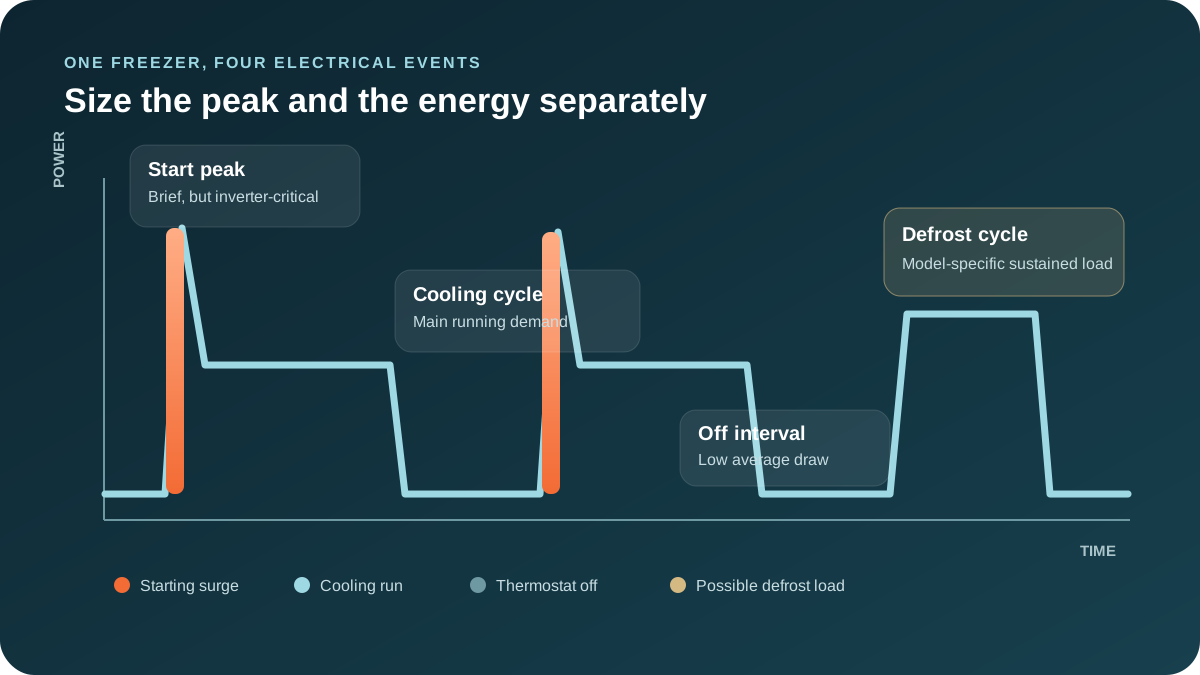
| Electrical event | What it tells you | What can go wrong | Best evidence |
|---|---|---|---|
| Compressor start | Required surge capability | The source trips even though its average load estimate looked adequate | Peak-capable meter, manufacturer data, or professional measurement |
| Steady cooling | Continuous load while the compressor is active | Other loads push combined output above the source rating | Power meter or specified electrical input |
| Thermostat off | Why average watts are below running watts | A running-watt-times-24 estimate greatly overstates energy | Accumulated kilowatt-hours over time |
| Defrost cycle | Possible higher sustained demand and extra energy | A short measurement misses the event | Multi-day measurement and model documentation |
| Restart after warming | Performance after a long off period or door opening | The freezer runs much longer than during a normal cool day | Controlled test without risking stored food |
Variable-speed compressors may ramp differently from traditional single-speed motors, but that does not remove the need for verification. Output waveform, protective electronics, low-temperature controls, defrost, and the source’s surge duration remain model-specific.
Step 4: replace assumptions with data
Measure for several representative days, not only one cooling cycle
For a plug-connected household freezer within the meter’s rating, a quality energy meter can record current watts, peak demand, and accumulated kilowatt-hours. Follow the meter and appliance instructions. Do not use a damaged receptacle, undersized adapter, light-duty extension cord, loose plug, or equipment not rated for the load. Hardwired, commercial, or unusual equipment deserves professional evaluation.
- 1Record the exact appliance
Photograph the model, voltage, current, frequency, and certification label. Find the manual and EnergyGuide information.
- 2Measure accumulated energy
Monitor for at least 24 hours and preferably 48 to 72 hours so normal cycling and a possible defrost event are represented.
- 3Capture the brief peak
Use equipment fast enough to record compressor start. A slow display may show only steady running demand.
- 4Note the room and food load
Record ambient temperature, freezer fullness, door openings, setpoint, frost condition, and whether warm food was recently added.
- 5Test the complete backup case
Confirm startup while every other load intended to remain on is operating, then watch for alarms or source derating.
If measurement is not yet possible, divide the labeled annual kilowatt-hours by 365 for an average daily starting point. That estimate does not reveal starting surge and may not reflect a hot garage, damaged gasket, heavy frost, unusual access, aging components, or outage recovery after warming. Use a conservative allowance and verify before depending on it.
Step 5: pass the power test
Size output for the freezer’s hardest start with the rest of the plan still running
Continuous output must exceed all loads that can operate together. Surge output must support the freezer’s starting peak while the refrigerator, Wi-Fi, lights, furnace controls, or another selected load remains active. Review surge duration, waveform, receptacle and branch limits, temperature derating, and the manufacturer’s guidance for compressor loads.
Add active loads
Combine freezer running watts with every load that will remain on at the same time.
Substitute the peak
Replace freezer running watts with its measured starting demand.
Avoid edge operation
Allow for measurement uncertainty, hot conditions, aging, and one reasonable extra load.
A source may advertise a short peak that is unavailable from every receptacle or mode. Confirm duration, voltage, waveform, shared limits, and low-battery behavior. Test the actual freezer after the source is fully charged and again with the planned companion loads.
Check the freezer beside the refrigerator, pumps, lights, and internet
The main calculator separates continuous demand, motor start, voltage, daily energy, and recovery.
Step 6: pass the energy test
Battery capacity should cover measured freezer energy plus losses and reserve
Begin with the freezer’s measured watt-hours for the desired powered interval. Add every other load sharing the battery. Then account for the fraction of nameplate capacity the system makes usable, conversion and standby losses, temperature, age, and the reserve needed for uncertainty or the next compressor start.
Convert battery rating to AC energy
Use documented system behavior where available and show assumptions.
Scale measured daily use
Include the complete powered interval and every companion load.
Compare usable energy with average load
This estimates duration only after the inverter passes the start test.
A passive holdover period can reduce the number of powered hours, but cycling the freezer manually without temperature evidence can create unsafe uncertainty. If you plan scheduled battery or generator windows, use an appliance thermometer or remote temperature alarm, verify that the appliance maintains the intended temperature, and set a clear restart threshold. Let the freezer’s thermostat control its normal cycles while power is available.
Step 7: calculate transparent examples
Measured daily energy changes runtime more than cabinet size alone suggests
These examples illustrate the method and are not promises for a particular freezer or battery. Each assumes 85 percent usable battery capacity and 90 percent AC conversion efficiency, producing a combined factor of 0.765. No companion loads, battery aging, unusually hot room, or additional emergency reserve are included.
1,024 Wh battery and 0.65 kWh/day compact chest freezer
- Usable AC energy: 1,024 × 0.85 × 0.90
- Result: about 783 Wh
- Average freezer energy: about 27.1 Wh per hour
- Calculated runtime
- about 28.9 hours
- Other loads
- not included
- Start test
- still required
A hot garage or long recovery run after warming can shorten this planning result.
2,048 Wh battery and 0.90 kWh/day family chest freezer
- Usable AC energy: 2,048 × 0.85 × 0.90
- Result: about 1,567 Wh
- Average freezer energy: 37.5 Wh per hour
- Calculated runtime
- about 41.8 hours
- Suggested recovery
- before day two
- Start test
- still required
The passive cold buffer adds resilience, but the battery plan should not depend on an exact 48-hour holdover.
3,600 Wh battery and 1.50 kWh/day frost-free upright
- Usable AC energy: 3,600 × 0.85 × 0.90
- Result: about 2,754 Wh
- Average freezer energy: 62.5 Wh per hour
- Calculated runtime
- about 44.1 hours
- Defrost represented
- only if measured
- Start test
- still required
The larger battery does not guarantee two days when room heat, defrost, or shared loads raise consumption.
Round estimates down when planning. A household that needs 36 hours of dependable operation should not choose a source that produces 36 hours only under optimistic assumptions. Preserve enough reserve for the next start, measurement error, a delayed recharge window, and battery performance changes.
Step 8: preserve the thermal buffer
A full, closed freezer buys time, but it does not stop the clock
Official food-safety guidance provides a useful emergency baseline when the freezer door remains closed. A full freezer can hold temperature longer because the frozen contents create more thermal mass. A half-full cabinet has more air and less stored cold. Actual insulation, starting temperature, ambient heat, door openings, gasket condition, and appliance design can move the result in either direction.
For a full freezer with the door kept closed. Treat this as approximate passive holdover, not guaranteed model performance.
For a half-full freezer with the door kept closed. Warm surroundings or opening the door can reduce the buffer.
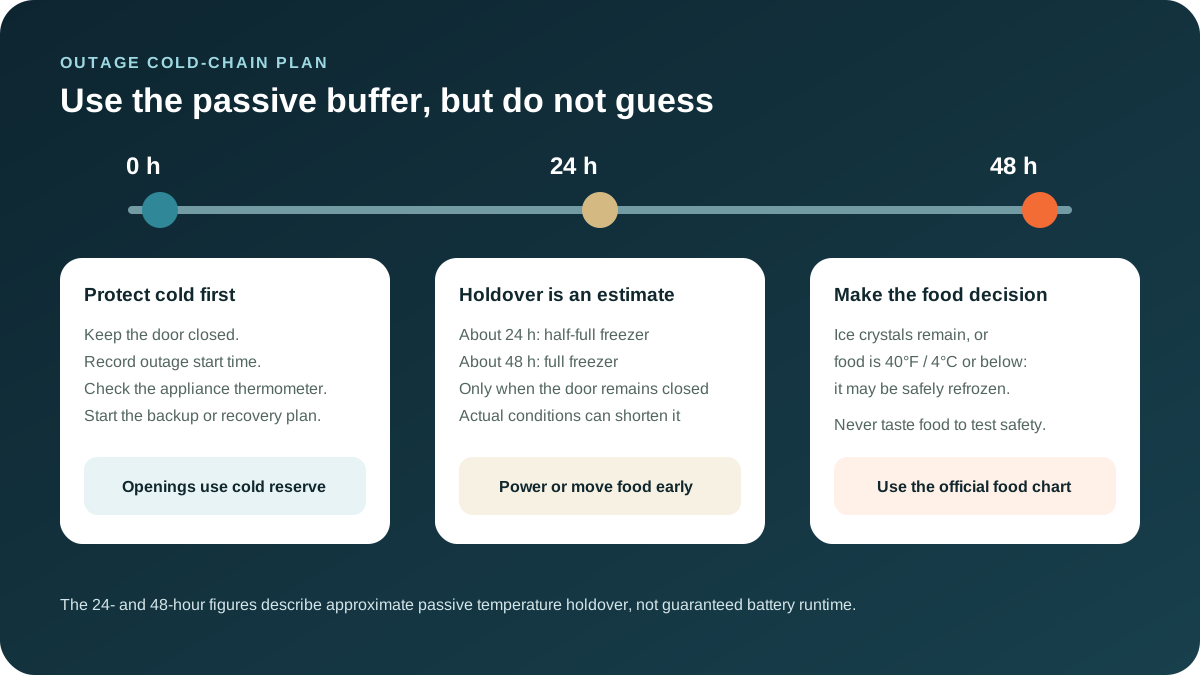
Prepare before the outage by keeping an appliance thermometer in the freezer, organizing food so items can be found quickly, and freezing water containers or gel packs to fill safe empty space. Leave room for expansion in water containers. Do not block the appliance’s required internal air circulation, vents, or external condenser clearance.
Step 9: plan sustained recovery
Generators and hybrid systems should restore cold efficiently, not run without a control plan
A freezer is often a small load relative to a generator’s total output, so the household may combine it with a refrigerator, pumps, battery charger, and selected circuits. The generator still must pass the largest simultaneous motor start, provide the required voltage and waveform, and operate within its continuous rating after temperature and altitude effects.
Power the freezer outdoors through an approved path
Use a listed, properly rated connection method. Never move a portable generator into a garage, shed, porch, basement, or other enclosed or partly enclosed space.
Cool loads and recharge together
A managed window can run freezers and refrigerators while charging a battery, then return the home to quiet stored energy.
Use transfer and load controls
An installed system can prioritize cold storage and shed discretionary loads when output or stored energy is limited.
CPSC says to operate a portable generator outside only, at least 20 feet from the home, with exhaust directed away from the home and other building openings. Never operate one in a house, basement, shed, garage, porch, or carport. Use working carbon monoxide alarms on every level and outside sleeping areas.
A hybrid plan needs verified charging compatibility. Check charger input, generator output quality, maximum AC charging demand, fuel use at the planned load, and whether the battery can power the freezer while charging. Define reserve and restart thresholds before the outage instead of improvising as food temperature rises.
Step 10: choose the delivery path
The correct connection depends on whether you are powering one freezer or a protected circuit
Portable battery nearby
Often the simplest route when the source is indoors, dry, ventilated as required, stable, and within the appliance cord’s safe reach. Follow both manuals.
Outdoor generator to one load
Use only a listed outdoor-rated cord with suitable conductors, length, grounding arrangement, and damage protection. Keep every connection dry and out of walkways.
Protected branch circuit
Use listed transfer equipment or another code-compliant isolation method installed for the actual source, panel, grounding, neutral, and circuit arrangement.
Never backfeed a home through a receptacle. Never splice appliance cords, defeat a grounding pin, use an undersized cord, or create a homemade source-to-panel connection. If the freezer is on a GFCI-protected or shared garage circuit, investigate nuisance trips, circuit loading, and code requirements with a qualified electrician rather than bypassing protection.
Protect food, communications, pumps, heat, and lighting in one design
An essential-load plan makes priority and connection decisions before the outage.
Step 11: stretch the plan safely
Reduce heat gain before trying aggressive manual cycling
The safest energy savings come from preparation and door discipline. Keep the freezer at its normal recommended setting before storm season, verify the gasket closes cleanly, maintain required ventilation, remove excessive frost according to the manual, organize contents, and keep an inventory outside the cabinet. During an outage, decide what you need before opening the door.
Keep useful space filled
Frozen water containers or gel packs can occupy safe empty space and support cold retention. Allow expansion and preserve required airflow.
Map the contents
Label baskets and maintain an external list so the door stays open for seconds rather than minutes.
Respect room limits
Shade and room ventilation can help, but operate the freezer only within the ambient conditions approved by its manufacturer.
Use temperature evidence
A remote alarm can warn of warming without opening the cabinet. Verify sensor placement and battery status.
Do not wrap an operating freezer in blankets or block condenser airflow. Do not lower the setpoint beyond manufacturer guidance to create an improvised thermal reserve. Do not repeatedly unplug and restart a compressor without respecting its controls and restart delay. If conserving power with planned windows, validate the temperature pattern in advance using a thermometer and a safe test load.
Food-safety boundary
After thawing, make the decision from temperature and food condition, never taste
FoodSafety.gov states that frozen food may be safely refrozen if it still contains ice crystals or is at 40°F (4°C) or below, although quality may decline. Its outage chart provides food-specific directions because meat, seafood, prepared food, baked goods, frozen meals, ice cream, and other items are not handled identically. Never taste food to determine whether it is safe.
Ice crystals remain
The food may be safely refrozen under the official guidance, though texture or quality can suffer.
40°F / 4°C or below
Use a food thermometer where appropriate and follow the official chart for the specific food.
Do not guess
Use the FoodSafety.gov chart and discard food when the guidance says to discard. Never rely on smell, appearance, or taste alone.
Keep an appliance thermometer in the freezer before the outage. A remembered setpoint does not prove what happened during power loss.
FDA notes that dry ice can extend freezer cold during a prolonged outage. It can cause severe cold burns and releases carbon dioxide, so use protective gloves, ventilation, and official handling guidance.
Follow product-specific instructions for breast milk, medicines, laboratory materials, or medically necessary food. Household food guidance may not govern those items.
Step 12: choose a resilience level
Three freezer profiles show why the household plan matters
Compact chest freezer in a conditioned room
- Measured energy is modest
- Door stays closed
- Food can be consolidated elsewhere if needed
- Primary route
- portable battery
- Recovery
- grid or focused recharge
- Key check
- compressor start
A measured single-appliance plan may be enough when the outage risk and food value are limited.
Full family chest freezer in a garage
- High food value
- Hot-weather energy can rise
- Long regional outages are plausible
- Primary route
- larger battery
- Recovery
- solar or generator
- Key check
- garage conditions
The source, thermometer, recovery plan, and fuel or solar assumptions should be tested together.
Frost-free upright plus refrigerator
- Two compressors share the source
- Defrost and access raise energy
- Automatic transfer is valuable
- Primary route
- selected circuit
- Recovery
- installed or hybrid
- Key check
- simultaneous starts
Load sequencing or a larger inverter may be needed if both compressors can start together.
Step 13: operate the plan
A simple outage playbook prevents wasted cold and rushed electrical decisions
- 1Record the start time
Confirm the outage, note the time, check the appliance thermometer without leaving the door open, and stop casual access.
- 2Connect only through the approved path
Use the tested battery, transfer equipment, or outdoor generator arrangement. Verify output, alarms, ventilation, cord condition, and carbon monoxide protection.
- 3Confirm a successful compressor start
Watch source power and overload status. Listen for abnormal repeated restart attempts. Shed discretionary loads if necessary.
- 4Track energy and temperature
Log battery state of charge, fuel, freezer temperature, room temperature, and the next recharge or refuel decision time.
- 5Protect recovery before reserve is low
Begin solar or generator recovery while conditions are favorable. Do not wait until the battery cannot support another compressor start.
- 6Make a timely food decision
If cold control is lost, use temperature, ice crystals, elapsed time, and the official food-specific chart. Never taste food to judge safety.
- 7Review after the outage
Record actual watt-hours, starts, temperature behavior, recharge performance, and any failed assumption. Update the plan and labels.
Final selection check
Confirm the complete freezer backup chain before buying or relying on it
- Exact freezer identifiedModel, voltage, current, defrost type, manual, and installation location are recorded.
- Starting peak measuredThe planned source passes compressor start with companion loads active.
- Daily energy measuredMonitoring covers representative room conditions and preferably a defrost event.
- Battery assumptions shownUsable capacity, conversion loss, reserve, age, and temperature are explicit.
- Recovery is credibleSolar, generator, grid, ice, or alternate cold storage is available before reserve becomes critical.
- Connection is approvedNo backfeed, improvised adapter, damaged cord, wet connector, or overloaded branch circuit is used.
- Temperature is observableAn appliance thermometer or tested alarm remains ready and its battery is current.
- Food decisions are documentedThe official outage chart is saved or printed, and the household knows not to taste-test.
Frequently asked questions
Can a 1,000-watt power station run a freezer?
Possibly, but the watt rating alone is insufficient. Verify the freezer’s compressor starting peak, the source’s surge duration and receptacle limits, then compare battery watt-hours with measured daily freezer energy, losses, and reserve.
How long will a battery run a chest freezer?
Runtime depends on usable battery energy and the freezer’s measured watt-hours per hour under actual conditions. Divide usable AC watt-hours by average measured watt-hours per hour, then reduce the result for other loads and planning reserve. The inverter must also pass compressor start.
Should I run the freezer only a few hours each day?
Do not use a generic schedule. Temperature recovery, room heat, fullness, and appliance design vary. If using planned power windows, validate the pattern with an appliance thermometer, follow the freezer manual, and maintain a conservative food-safety threshold.
Does a chest freezer need less backup than an upright?
Often, but not always. Chest designs can retain cold efficiently and many manual-defrost models use modest energy. A specific upright may still consume less than an old or poorly maintained chest freezer. Measure the exact appliance.
Can I use the 48-hour rule instead of buying backup power?
The approximately 48-hour figure applies to a full freezer with the door closed and is not guaranteed. It is a passive emergency estimate. Consider actual outage risk, ambient temperature, food value, thermometer evidence, and what happens if restoration is delayed.
Can thawed food be refrozen?
FoodSafety.gov states that food may be safely refrozen if it still contains ice crystals or is at 40°F (4°C) or below, although quality may suffer. Follow the official food-specific chart and never taste food to determine safety.
Build the freezer plan around measured energy and a timed recovery path
First confirm compressor start. Then calculate battery or fuel from representative daily watt-hours, difficult room conditions, companion loads, and a reserve. Preserve the passive cold buffer by keeping the door closed, but use temperature evidence and official food guidance instead of assuming a fixed safe deadline.
Sources and review notes
- FoodSafety.gov: Food Safety During Power Outage
- FDA: Food and Water Safety During Power Outages and Floods
- U.S. Department of Energy: Refrigerator and Freezer Energy Rating Search Tool
- U.S. Department of Energy: Purchasing Energy-Efficient Residential Freezers
- CPSC: Portable Generator Carbon Monoxide and Fire Safety
This page provides planning education for ordinary household freezers. Use the exact appliance and backup-source manuals, local electrical requirements, qualified installation where required, and official food-specific safety guidance. It does not replace an electrician, appliance technician, public-health authority, or product manufacturer.
Technical and food-safety review: July 26, 2026. No prices are shown because equipment configuration, installation, location, and household requirements vary.