
Refrigerator backup power
A refrigerator is usually a manageable backup load, but the correct system cannot be selected from running watts alone. The source must start the compressor, sustain cycling energy through the outage, tolerate defrost and accessory loads, and connect safely. Measure the appliance you own whenever possible, then preserve a practical food-safety reserve.

Choose refrigerator backup from starting watts and daily watt-hours
The inverter or generator must support the refrigerator’s hardest start while any other connected loads are running. The battery must provide enough usable watt-hours for the appliance’s measured daily energy, conversion losses, expected outage duration, and a reserve. A generator must supply the same power safely from outdoors and continue operating only while fuel and maintenance allow.
For a dependable plan, collect four values: highest running power, highest starting surge, energy used over 24 representative hours, and the time the refrigerator must operate before the source can recharge or refuel. If measurement is not possible, use the appliance manual, nameplate, EnergyGuide information, and a conservative planning margin, then verify the result before the next outage.
Portable power station
Strong for direct plug-in backup when the inverter passes compressor surge and the battery covers the desired runtime.
Compare portable stationsInstalled battery
Strong when the refrigerator should transfer automatically with lights, communications, pumps, and other priorities.
Plan an installed batteryGenerator
Strong for long outages when outdoor placement, carbon monoxide safety, fuel, weather protection, and connection are solved.
Size generator outputBattery plus recovery
Use quiet battery power between focused solar or generator recovery windows.
Plan a hybrid systemStep 1: collect the right data
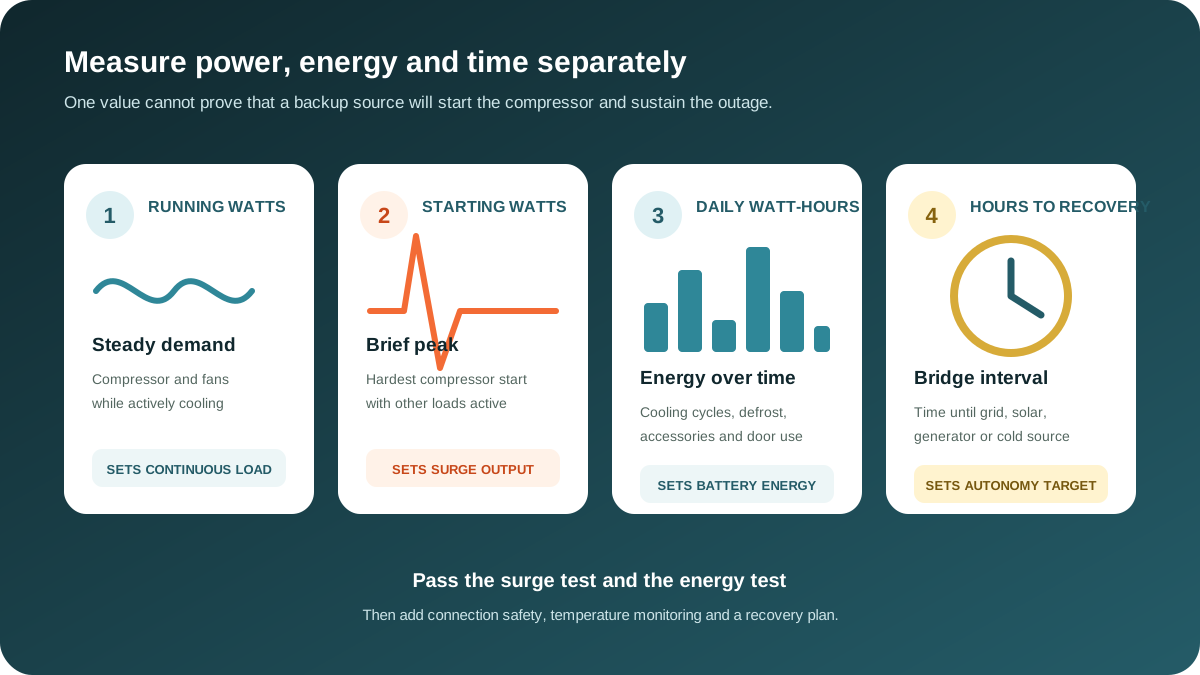
Four numbers control almost every refrigerator backup decision
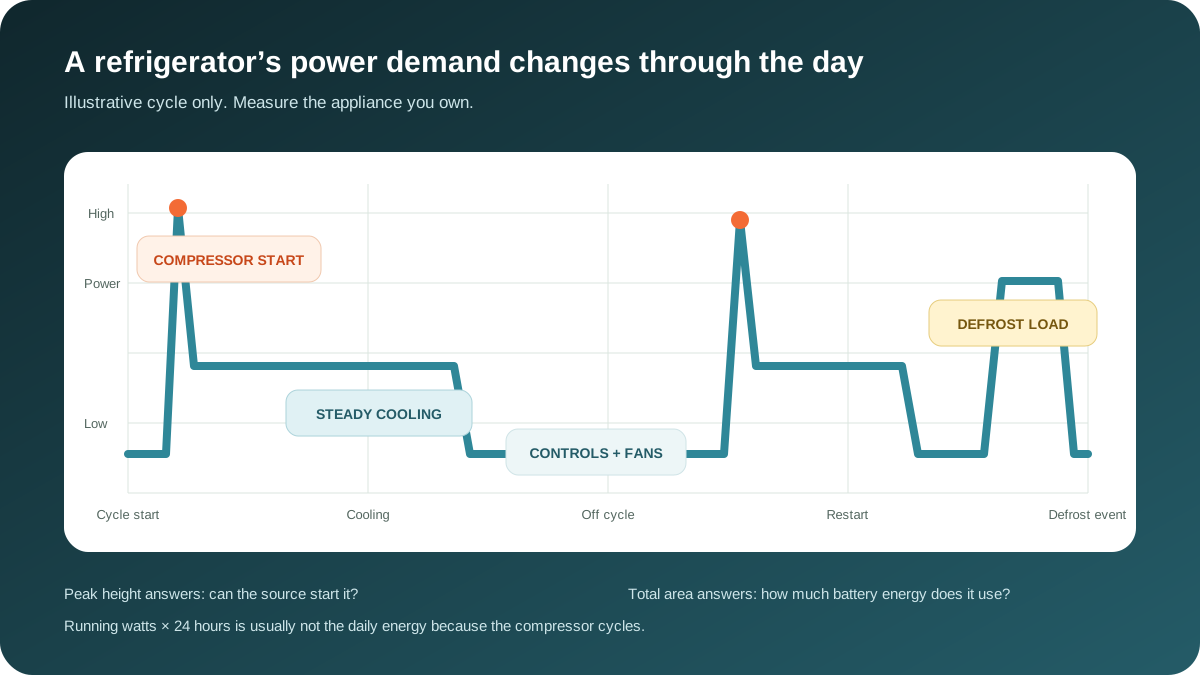
Refrigerators cycle. They draw little or no compressor power for part of the hour, run at a moderate level for another part, and may demand a much larger burst when the compressor starts. Automatic defrost heaters, fans, ice makers, door heaters, controls, and water systems can add other loads. This is why one instant reading cannot describe the complete backup requirement.
Running watts
The highest steady demand observed while the compressor and normal internal fans are running.
Starting watts
The brief peak when the compressor starts, tested with the other loads expected to remain connected.
Daily watt-hours
The energy consumed over a representative 24-hour period with normal temperature and door use.
Hours to recovery
The interval the source must cover before grid return, battery recharge, generator use, or another cold-storage plan.
An EnergyGuide estimate can help establish an average daily energy starting point, but it does not reveal the compressor’s instantaneous start demand or every site condition. Use it together with manufacturer data or direct measurement.
Step 2: understand the load
A refrigerator is several electrical events, not one fixed wattage
The compressor start is usually the hardest short event for the inverter. Once running, the compressor settles at a lower demand. The thermostat later stops it, creating a lower-power interval. Internal fans and electronic controls may continue. At another time, an automatic defrost cycle can create a different sustained load. Features such as ice production or anti-sweat heaters may change the daily total.
| Electrical event | What happens | Why backup sizing changes | Best evidence |
|---|---|---|---|
| Compressor start | A brief inrush occurs as the motor starts against system pressure | The inverter or generator can overload even when average energy use looks small | Peak-capable meter, manufacturer starting data, or professional measurement |
| Steady cooling | Compressor and fans run until the thermostat target is reached | Sets the main running-watt contribution while active | Plug-in power meter or specified input |
| Off cycle | Compressor stops while controls and some accessories may remain active | Reduces average energy below running watts multiplied by 24 hours | Long-duration energy measurement |
| Automatic defrost | A heater may operate periodically to remove frost | Can create a higher sustained load and raise the daily energy total | 24 to 72-hour measurement and appliance documentation |
| Door and accessory use | Warm air enters; lights, fans, ice maker or water features may operate | Raises cooling work and makes daily use household-dependent | Representative measurement under real use |
Variable-speed inverter compressors can behave differently from traditional single-speed compressors. They may ramp more gently, but the exact start behavior, electronics, waveform sensitivity, and protective controls remain model-specific. Never assume a modern appliance has no surge or that a traditional appliance always requires the same multiplier.
Step 3: replace guesses with evidence
Measure long enough to capture weather, cycling, and defrost
For a plug-connected refrigerator within the meter’s rating, a quality energy meter can record watts, peak power, and accumulated kilowatt-hours. Read and follow the meter’s instructions. Do not use undersized adapters, damaged cords, loose outlets, or equipment that is not rated for the appliance. Hardwired or unusual installations should be evaluated by a qualified person.
- 1Record the model and electrical label
Photograph voltage, frequency, current, model number and any separate circuit requirements. Find the owner’s manual and EnergyGuide information if available.
- 2Measure representative daily energy
Run the meter for at least 24 hours and preferably several days. Keep temperature settings and household use normal.
- 3Capture the highest start
Use equipment capable of recording a brief peak. A simple display may refresh too slowly and miss compressor inrush.
- 4Repeat in a demanding season
A hot kitchen, warm garage, frequent door opening, new groceries or heavy ice production can raise energy use.
- 5Test the complete backup source
Confirm that the refrigerator starts while the other loads intended to share the source are active.
If direct measurement is not available, annual kilowatt-hours can be divided by 365 to estimate average daily energy. Treat that result as a planning baseline rather than a guaranteed outage value. Add a conservative allowance for actual temperature, door use, aging seals, defrost behavior, conversion losses, and the reserve you do not want to consume.
Step 4: pass the power test
Size the inverter around the hardest simultaneous start
The source’s continuous output must exceed all loads expected to run together. Its surge capability must support the refrigerator start while those other loads remain on. Check surge duration, output waveform, receptacle rating, per-port limits, system temperature derating, and whether the manufacturer approves motor and compressor loads.
Loads running together
Add refrigerator running watts to every other load that will remain active.
Compressor starts
Replace refrigerator running watts with its measured starting peak.
Do not live at the edge
Allow for measurement uncertainty, temperature, aging and an extra small load.
Some sources have short surge windows, shared receptacle limits, output modes that reduce rating, or protection logic that reacts to motor starts. Verify the published limits and test the real refrigerator before relying on it.
Test the refrigerator with Wi-Fi, lights and other essentials
The main calculator separates running demand, motor-start demand, voltage, daily energy and recharge.
Step 5: pass the energy test
Battery runtime comes from usable watt-hours, not the capacity printed alone
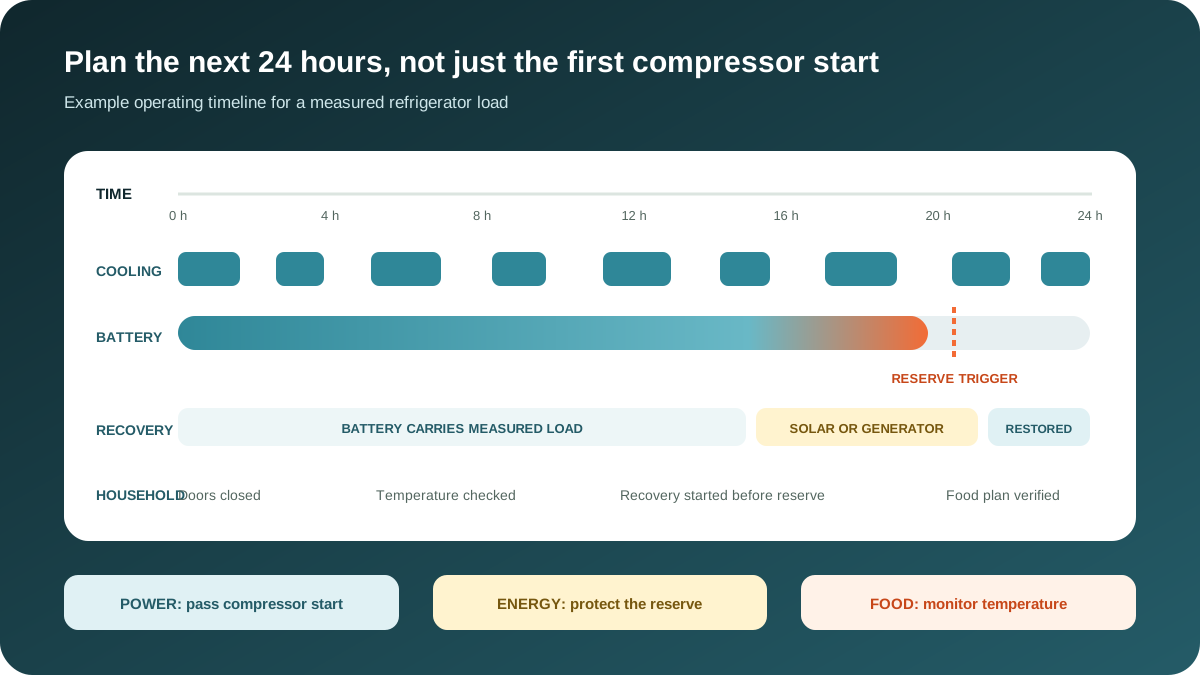
Start with the refrigerator’s measured energy over the intended interval. Then account for the portion of battery capacity the system makes usable, DC-to-AC conversion and standby loss, temperature, aging allowance, other connected loads, and a reserve. For a portable power station, the manufacturer may already specify usable energy behavior differently from the nominal battery rating. Use its documentation where available.
Convert nameplate to usable AC energy
Apply the usable capacity and conversion assumptions transparently.
Use measured daily consumption
Include the refrigerator and every other load sharing the battery.
Compare like units
Divide usable AC energy by the appliance’s average watt-hours per hour.
Do not use refrigerator running watts as the average load for a full day unless the compressor truly runs continuously. Likewise, do not use a low average watt figure to size inverter surge. The most accurate method uses a peak measurement for power and a long-duration kilowatt-hour measurement for energy.
Step 6: calculate transparent examples
Worked examples show why battery size and appliance energy both matter
The following examples use planning assumptions, not promises for a specific appliance or battery. Each battery example assumes 85 percent usable capacity and 90 percent conversion efficiency. Actual equipment may use different definitions and losses.
1,024 Wh battery, 1.2 kWh/day refrigerator
- Usable AC energy: 1,024 × 0.85 × 0.90
- Result: about 783 Wh
- Average refrigerator energy: 50 Wh per hour
- Calculated runtime
- about 15.7 hours
- Before extra reserve
- yes
- Surge test
- still required
Any Wi-Fi, lights, inverter standby use or warmer conditions shorten the result.
2,048 Wh battery, 1.2 kWh/day refrigerator
- Usable AC energy: 2,048 × 0.85 × 0.90
- Result: about 1,567 Wh
- Average refrigerator energy: 50 Wh per hour
- Calculated runtime
- about 31.3 hours
- Practical plan
- recharge within a day
- Surge test
- still required
A planned recovery window protects the battery from an unexpectedly warm or high-use day.
3,600 Wh battery, 1.6 kWh/day refrigerator
- Usable AC energy: 3,600 × 0.85 × 0.90
- Result: about 2,754 Wh
- Average refrigerator energy: about 66.7 Wh per hour
- Calculated runtime
- about 41.3 hours
- Other loads included
- no
- Surge test
- still required
The larger battery lasts longer, but a higher-energy appliance consumes much of the gain.
Calculate usable capacity and interpreted runtime
Enter battery size, usable fraction, efficiency, load watts and reserve assumptions.
Step 7: use fuel power safely
A generator can run a refrigerator for long outages, but location comes first
A refrigerator is a relatively small generator load, so other equipment often determines generator size. Still test the compressor start with all loads intended to run at that moment. Use rated running output for the intended fuel and account for manufacturer guidance, environmental derating, receptacle limits, cord requirements and motor-start behavior.
Current CPSC guidance says portable generators must operate outdoors only, at least 20 feet from homes and buildings, with exhaust directed away from windows, doors, vents and other openings. Never use one in a home, garage, basement, crawlspace, shed, porch or carport, even with doors open. Install and maintain working carbon monoxide alarms on every level and outside sleeping areas.
Outdoor distance and exhaust direction cannot be traded for a shorter extension cord.
Use an approved direct cord route or professionally installed transfer equipment. Never backfeed home wiring.
Follow fuel, weather, grounding, maintenance and shutdown instructions from the generator manufacturer.
Step 8: choose a safe power path
Direct plug-in and panel backup solve different problems
| Method | Best fit | Advantages | Checks and limits |
|---|---|---|---|
| Direct to portable battery | One refrigerator and a few plug-in essentials | Quiet indoor use and simple energy monitoring | Surge rating, receptacle rating, ventilation, cord condition, recharge path and trip hazards |
| Direct to portable generator | Temporary fuel-backed operation | Long duration while fuel and maintenance allow | Outdoor placement, weather, CO, heavy-duty grounded cord, distance and manufacturer instructions |
| Critical-load panel | Refrigerator plus selected circuits | Cleaner household operation and easier load priority | Approved transfer equipment, circuit selection, professional installation and system capacity |
| Managed main panel | Broader installed backup | Automatic transfer and flexible circuit access | Load controls, 120/240V design, source limits, commissioning and local requirements |
Do not run a cord through a doorway or window in a way that prevents proper closure, damages the cable, creates a trip hazard, or allows generator exhaust to enter. Never use a male-to-male cord or any improvised connection to energize household wiring. A structure connection requires the correct listed transfer and isolation equipment for the design.
Step 9: make every watt-hour useful
Small operating choices can preserve hours of backup
Open briefly and intentionally
Know what you need before opening. Warm, humid air increases the next cooling cycle.
Use an appropriate setting
ENERGY STAR recommends refrigerator temperatures of 35°F to 38°F. Follow the appliance manual and use a thermometer.
Keep required clearance
Blocked condenser airflow, dust and poor ventilation can increase work and heat.
Reduce kitchen heat
Avoid adding hot food, direct sun or unnecessary cooking heat near the refrigerator during an outage.
Disable optional high-energy features only when the appliance manual permits it and doing so does not compromise safe operation. Avoid changing settings repeatedly. Moving food between appliances or opening doors to check temperature can consume more energy than the adjustment saves.
Food-safety boundary
Backup runtime does not replace temperature monitoring
CDC guidance says a closed refrigerator keeps food safe for up to four hours during a power outage. After four hours without power or another cold source, move perishable food to a cooler with ice or frozen gel packs if available and keep it at 40°F or below. Do not taste food to decide whether it is safe. When in doubt, throw it out.
A closed refrigerator preserves cold longer. Plan access and group frequently needed items.
Monitor refrigerator and food temperature. A glowing appliance light does not prove safe temperature.
Prepare a cooler, frozen gel packs or another approved cold source before severe weather.
Freezer guidance is different. CDC says a full freezer can keep food safe for about 48 hours and a half-full freezer for about 24 hours if it remains closed. Treat combination refrigerator-freezer compartments according to the applicable temperature and food guidance.
Step 10: compare realistic appliance profiles
Refrigerator type does not determine backup size by itself
Age, ambient temperature, condition, features, compressor design, seals, loading and household behavior can matter as much as external style. The profiles below are calculation examples only. They are not standard ratings for each refrigerator type.
Efficient kitchen refrigerator
- Measured running demand: 85 W
- Measured start: 620 W
- Measured energy: 0.9 kWh/day
- Primary sizing risk
- shared-load start
- Battery emphasis
- daily energy
- Best evidence
- multi-day meter log
A small system may work if it supports the start event and no large loads share the output.
Large family refrigerator
- Measured running demand: 160 W
- Measured start: 1,050 W
- Measured energy: 1.6 kWh/day
- Primary sizing risk
- surge plus accessories
- Battery emphasis
- recovery within a day
- Best evidence
- peak and kWh log
Door use, ice production and defrost behavior make a representative measurement important.
Older garage refrigerator
- Measured running demand: 210 W
- Measured start: 1,350 W
- Measured energy: 2.4 kWh/day
- Primary sizing risk
- heat and condition
- Battery emphasis
- larger energy budget
- Best evidence
- hot-season measurement
A garage appliance in high ambient heat can use much more energy than a similar unit in a conditioned kitchen.
Step 11: operate the plan
Use a simple refrigerator outage playbook
- 1Note the outage start time
Keep the doors closed and record when grid power was lost. Confirm that thermometers are readable.
- 2Connect only through the approved path
Start the battery or safely deployed generator according to its instructions. Verify stable output before adding other loads.
- 3Watch the first compressor cycle
Confirm that the source does not overload, trip, reset or produce an error during startup.
- 4Manage competing loads
Delay microwave, coffee maker, pump, heating or other high-demand use if it could overlap with compressor start.
- 5Track energy and reserve
Compare battery state or fuel use with the planned recovery time. Recharge before the reserve becomes the only remaining margin.
- 6Apply food-safety rules
If safe temperature cannot be maintained, move food to an approved cold source or discard it according to official guidance.
Step 12: compare complete configurations
Check the source, connection and recovery together
- Measured running watts: the source supports steady refrigerator load plus other overlapping loads.
- Measured starting watts: the surge rating and duration pass the hardest compressor start.
- Daily watt-hours: usable battery energy covers the measured interval and reserve.
- Receptacle and cord: voltage, current, grounding, length and condition suit the appliance and source.
- Output quality: manufacturer guidance supports the refrigerator or compressor load.
- Recharge or fuel: the system can restore energy before the protected reserve is consumed.
- Temperature plan: thermometers, cooler and cold sources are available.
- Household procedure: another adult can deploy the plan safely if the primary planner is away.
Common questions
Refrigerator backup power FAQ
What size power station do I need for a refrigerator?
There is no dependable universal size. Choose one whose continuous and surge output pass the measured compressor start with other connected loads, and whose usable watt-hours cover the refrigerator’s measured daily energy for the intended interval plus reserve.
Can a 1,000-watt power station run a refrigerator?
The watt rating alone cannot answer. Some refrigerators may start comfortably while others may exceed the source’s surge behavior. Check continuous watts, surge watts and duration, receptacle limit, battery watt-hours and the appliance’s measured start.
How long will a 2 kWh battery run a refrigerator?
Runtime depends on usable capacity, conversion loss and the refrigerator’s watt-hours per day. Under the example assumptions on this page, a 2,048 Wh battery provides about 1,567 Wh of usable AC energy. A refrigerator using 1.2 kWh per day would calculate to about 31 hours before extra reserve and other loads.
Should I run the refrigerator continuously during an outage?
If the source can safely support it, continuous thermostat-controlled operation is simple and protects temperature. Manually cycling power can miss defrost behavior, create warmer food temperatures or cause difficult restarts. Follow appliance guidance and monitor temperature.
Can I plug a refrigerator into a generator extension cord?
Only through a cord and connection arrangement that follows both manufacturers’ instructions and all safety requirements. The generator must remain outdoors at least 20 feet from buildings with exhaust directed away from openings. Do not route the cord in a way that damages it, prevents doors or windows from closing, or creates an exhaust path.
Does the refrigerator light prove that backup power is adequate?
No. The light and controls use little power compared with a compressor start. The source may illuminate the cabinet and still trip when the compressor or defrost heater operates.
Measure one peak, one day and one recovery interval
That simple evidence gives you the compressor-start target, the energy budget and the time the system must bridge. Add safe connection, temperature monitoring and a recovery plan, and the refrigerator becomes a predictable essential load instead of a guess.
Sources and review basis
- CDC: keep food safe after a disaster or emergency
- FoodSafety.gov: food safety during a power outage
- ENERGY STAR: refrigerator efficiency and operating guidance
- U.S. Department of Energy: refrigerator and freezer energy rating search tool
- U.S. Consumer Product Safety Commission: portable generator safety
Editorial and technical review: July 26, 2026. Appliance instructions, source specifications, qualified installation requirements and local rules control the final configuration.