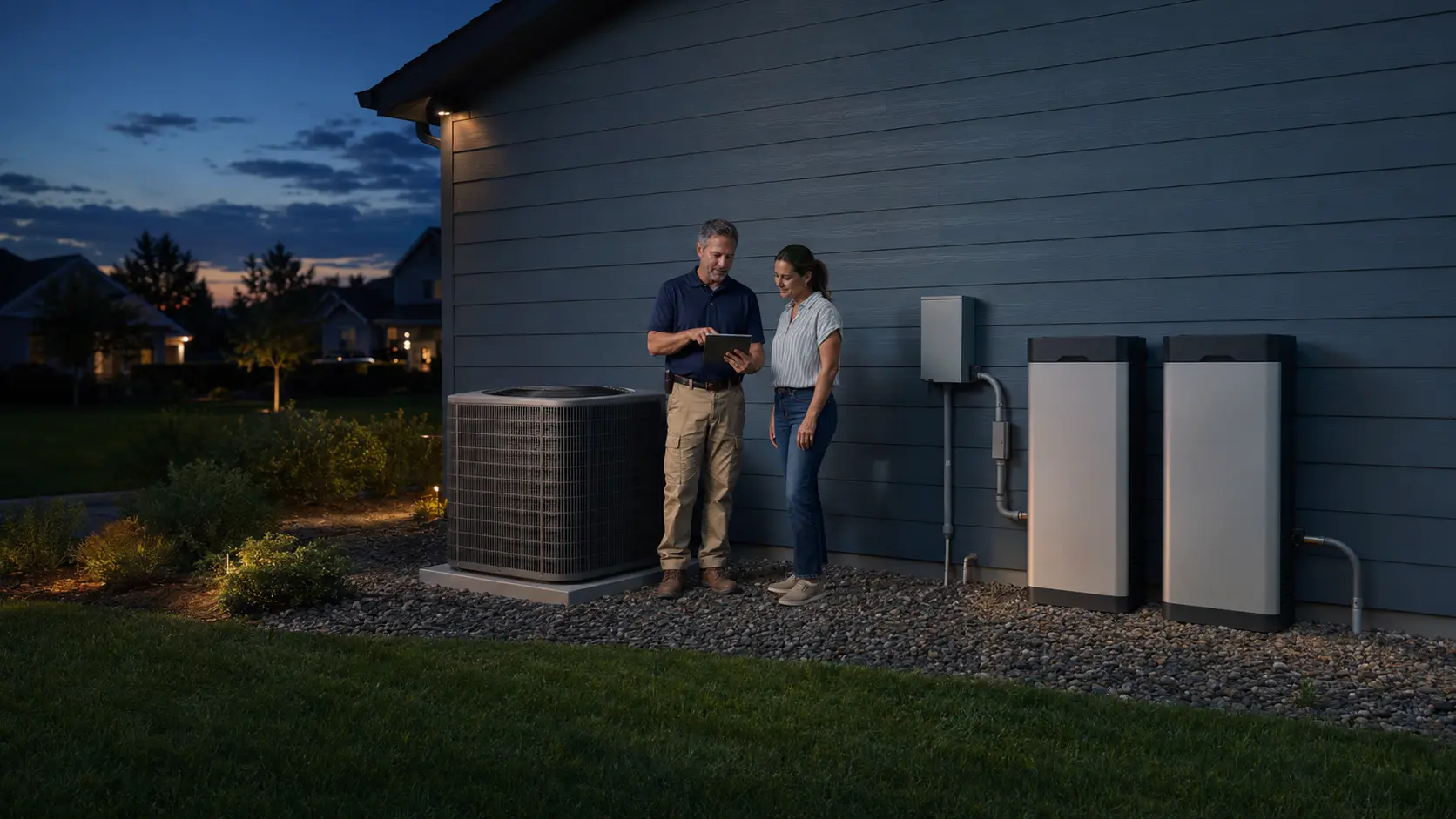
Air conditioner backup power
Air conditioning can be one of the hardest home loads to back up because the source must reproduce the right voltage, operate the compressor and indoor equipment together, survive startup or maximum inverter demand, and supply many kilowatt-hours through the hottest part of an outage. The strongest plan starts with the exact installed system and a defined cooling objective, then proves power, energy, transfer, humidity control, and a safe fallback.

Can a battery or generator run an air conditioner?
Yes, if the backup system supplies every required circuit at the correct voltage, holds stable output through the largest permitted compressor event, and contains or recovers enough energy for the hot-weather operating interval. A central split system may require a 240V outdoor unit plus a separate indoor blower, furnace, air handler, condensate pump, thermostat, zone controls, and communication modules. Powering only the condenser does not create useful cooling.
For a fixed-speed central air conditioner, starting demand may control inverter or generator size. For a variable-capacity system, the source must support the highest input the native controller can request, not only the gentle initial ramp observed on a mild day. In every case, measured hot-hour or hot-day energy controls battery capacity. If whole-home cooling is too large, a properly sized room unit or ductless zone may create a safer, longer-running refuge with far less stored energy.
Portable battery plus room AC
Strong when one compatible plug-connected unit can protect a defined room and the source passes its startup and runtime tests.
Compare portable stationsInstalled battery system
Strong when the design supplies the full HVAC circuit chain, manages other loads, and transfers without unsafe temporary wiring.
Plan an installed batteryGenerator with safe transfer
Strong for longer outages when outdoor placement, fuel, weather operation, maintenance, source quality, and transfer are solved.
Size generator outputBattery plus recovery
Use quiet battery operation between supported solar, grid, or focused outdoor generator recovery windows.
Plan a hybrid systemStart with the outcome, not a product rating
Define what successful air conditioner backup must accomplish
“Run the air conditioner” is not yet a useful design brief. Decide which space must remain usable, the credible outdoor temperature and humidity, how many hours must be covered before recharge or relocation, who is at risk from heat, and which other electrical loads must remain available. Whole-home comfort, one sleeping zone, one accessible refuge room, and short afternoon peak relief are different projects.
A central system may be the right target when it is efficient, well maintained, already zoned, and supported by enough 240V output and storage. It may be the wrong target when its startup event overwhelms the available source, its hot-day energy would empty the battery too early, the ducts lose substantial energy in a hot attic, or only one occupied room truly needs cooling. A smaller room unit or ductless head can be a stronger resilience tool even when the home normally uses central cooling.
Write a measurable success statement. For example: “Maintain one bedroom and adjacent accessible bathroom within the household’s safe temperature plan for eight hot hours, while refrigeration, communications, selected lighting, and medical priorities remain powered, with at least 20 percent battery reserve at the planned recovery time.” This statement gives the HVAC contractor, electrician, and backup-system designer a common boundary.
Cooling scope
Name the rooms or zones to protect and the distribution equipment needed to serve them.
Power proof
Define voltage, highest compressor event, indoor equipment, and allowed simultaneous loads.
Energy proof
Define hot-hour watt-hours, target duration, losses, recovery, and protected reserve.
Safety fallback
Identify when the household will leave for a reliable air-conditioned location.
Severe heat, equipment faults, smoke, flooding, battery depletion, fuel interruption, or an evacuation order can defeat the plan. Keep a destination, transportation method, communication plan, and trigger for leaving.
Classify before sizing
Central, packaged, ductless, room, and portable systems behave differently
Start with the equipment actually installed, not a generic tonnage estimate. Two nominally similar air conditioners can have different voltage, minimum circuit ampacity, overcurrent protection, compressor controls, indoor fan demand, communication requirements, and source-quality limits. The backup design must match the complete system.
Outdoor + indoor circuits
The condenser and compressor are outdoors while a furnace blower or air handler moves air through ducts.
Combined cabinet
Major refrigeration and air-moving components share one package, but controls and accessories may still use other circuits.
One or more heads
An inverter outdoor unit serves indoor heads and can support a defined refuge zone if the exact configuration permits.
Room-scale load
A plug-connected unit can reduce backup scope, but receptacle, cord, startup, drainage, and installation still matter.
Temporary zone cooling
Exhaust routing, condensate, air leakage, hose heat, circuit rating, and actual hot-room performance control usefulness.
A heat pump operating in cooling mode shares much of this electrical logic, but its heating, defrost, and auxiliary-heat behavior adds other requirements. If the same equipment must also provide winter backup, build one combined plan using the dedicated Heat Pump Backup Power guide. Do not approve a summer-only configuration and assume it covers winter.
Evaporative coolers, whole-house fans, and dehumidifiers are not air conditioners. They can be useful in appropriate climates or as supporting loads, but each has a different comfort and safety boundary. Evaporative cooling depends strongly on outdoor humidity. Whole-house fans require suitable outdoor conditions and safe openings. Dehumidifiers add heat to the space while removing moisture. Treat them as separate measured loads.
Map every required conductor and component
A powered outdoor unit is not a functioning cooling system
A typical split central air conditioner can place the compressor and condenser fan on a 240V branch circuit while the indoor blower and controls are supplied through a furnace or air-handler circuit. The thermostat may receive low-voltage power from the indoor equipment. Zone panels, dampers, condensate pumps, float switches, ultraviolet accessories, ventilation equipment, or communicating interfaces can be part of the operating chain. If one required component remains on the non-backed panel, cooling may fail even though the outdoor disconnect is energized.
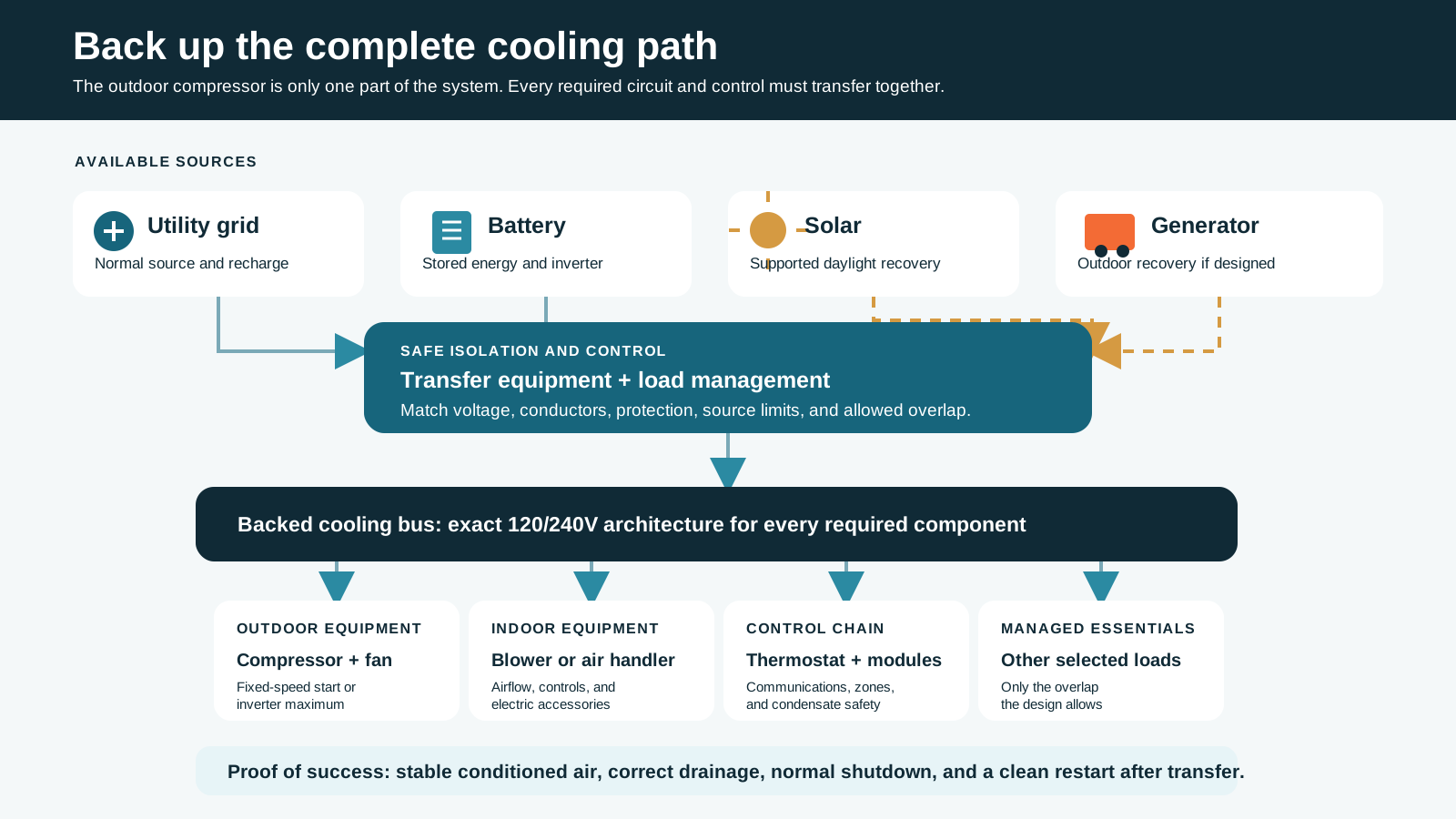
The backup source must reproduce the equipment’s required voltage, frequency, phase arrangement, neutral and grounding conditions, conductor capacity, overcurrent protection, disconnects, and transfer behavior. A 120V power station cannot supply a conventional 240V condenser simply because its total watt rating appears large. A 240V source also does not solve a design that forgets the separate 120V furnace blower. Product adapters and improvised cord arrangements are not substitutes for a permitted architecture.
For a room air conditioner, the architecture can be simpler, but it is still exact. Confirm whether the unit uses 120V or 240V, its plug and receptacle configuration, circuit requirement, cord condition, grounding, drainage, and the backup source’s receptacle rating. Do not use an undersized household extension cord, a loose multi-outlet adapter, a damaged receptacle, or a cord routed through a wet or pinched location.
Permanent or inlet-connected backup requires listed transfer or interlock equipment, correct conductors and protection, required permits, and a qualified installation. The design must prevent the backup source from energizing utility lines.
Build one exact equipment record
Collect labels, manuals, circuit maps, controls, and operating evidence
Photograph the outdoor-unit label, indoor-unit or furnace label, heat-kit label if the air handler contains one, thermostat or controller, zone panel, condensate pump, disconnects, and relevant breaker directory. Save the installation, operation, service, and application manuals. Record model numbers for matched indoor and outdoor components. Rated performance belongs to the matched system, not an outdoor cabinet in isolation.
Record the complete cooling system
Keep this file with the one-line diagram, outage procedure, and commissioning report.
- System typeCentral, packaged, ductless, room, portable
- Electrical supplyVoltage, circuits, breakers, disconnects
- Outdoor equipmentCompressor, fan, controls, heaters
- Indoor equipmentBlower, air handler, furnace, heads
- Controls and safetyThermostat, zones, float switches, condensate
- Measured behaviorPeak, maximum, steady input, hot-hour Wh
Ask for a cooling mode table
Record standby, fan-only, low and high cooling, fixed-speed start, inverter ramp, maximum capacity, condensate pumping, ventilation overlap, and restart after transfer. For each supported mode, note the circuits energized, highest observed demand, typical stabilized input, expected duty, and any source-quality requirement. Mark modes or accessories the backup design intentionally sheds.
| Record | What it tells you | What it does not tell you | Best verifier |
|---|---|---|---|
| Rated voltage and phase | The source architecture the equipment requires. | Actual operating watts or battery runtime. | Electrician and HVAC technician. |
| Minimum circuit ampacity | A circuit-design requirement for conductors. | Normal current or inverter size by itself. | Electrician using equipment documentation. |
| Maximum overcurrent protection | The largest permitted protective-device rating. | Expected running draw or start peak. | Electrician and manufacturer data. |
| Locked-rotor amps | A motor characteristic that may inform fixed-speed starting analysis. | Guaranteed measured start watts at the backup source. | HVAC technician and source designer. |
| Cooling capacity in Btu/h | The rated heat-removal capacity at stated conditions. | Direct electrical demand without efficiency and performance data. | Matched-system performance tables. |
| SEER2 or EER2 | Standardized seasonal or condition-based efficiency information. | Exact outage energy in this home on this hot day. | Certified product data and field measurement. |
| Measured hot-hour Wh | Real energy use during representative operating conditions. | The start event if the instrument cannot capture it. | Qualified measurement and monitoring. |
Resolve maintenance or equipment faults before backup sizing. Dirty filters, restricted coils, incorrect refrigerant charge, weak capacitors, failing contactors, damaged ducts, poor airflow, clogged drains, unreliable float switches, repeated fault codes, or a compressor that struggles on utility power can distort tests and increase demand. Backup power is not a repair.
Demand has shape as well as size
Fixed-speed and inverter compressors challenge a source differently
A fixed-speed compressor can create a brief high-current starting event before settling to its normal operating condition. During that event, the backup source must maintain acceptable voltage and frequency while the indoor blower, condenser fan, controls, refrigeration, pumps, communications, and other selected loads are active. If voltage collapses, the compressor may fail to start, controls may reset, contactors can chatter, or protection may trip. Repeated failed starts are not a valid commissioning method.
A variable-capacity or inverter-driven compressor often ramps more gradually. That can reduce the abrupt start challenge, but it does not make the load small. The source must support the maximum electrical input the native controls can request at high outdoor temperature, the indoor equipment, and other allowed loads. Power electronics can also have requirements for voltage, frequency, waveform, phase balance, grounding, generator compatibility, and restart timing. Confirm the exact equipment documentation.
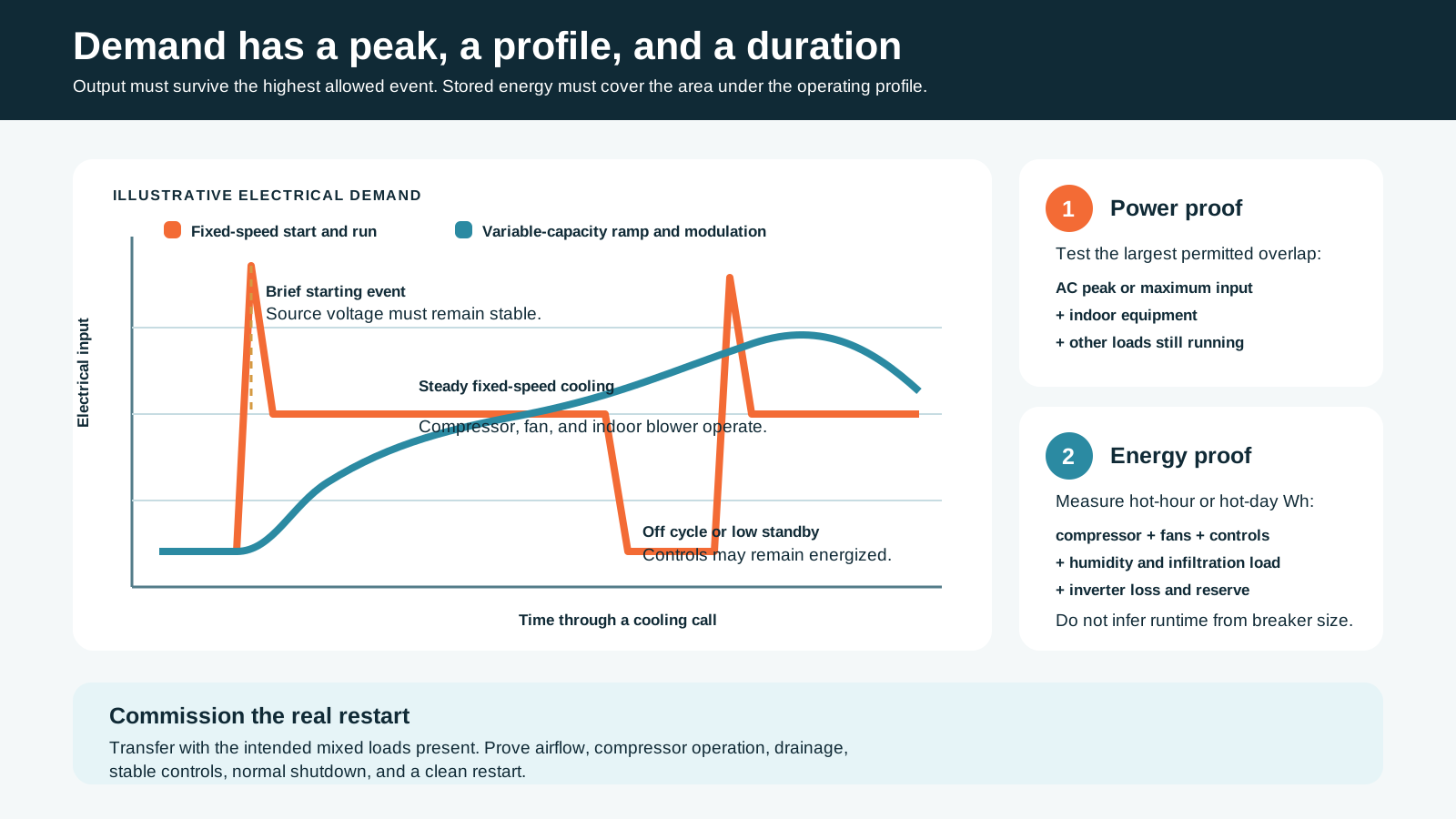
- StandbyControls are ready
Thermostat, boards, crankcase heat, and communicating modules may consume power.
- DemandIndoor airflow begins
Blower, head, zones, dampers, or ventilation establish the air path.
- CompressorFixed start or ramp
The outdoor unit starts and verifies operating conditions.
- CapacityInput follows the load
Fixed cycling, stages, or inverter speed respond to heat and humidity.
- StopDrain and restart
The system shuts down normally and remains ready for the next call.
Test the largest credible overlap after load-management rules. A central air conditioner may increase demand just as a well pump, sump pump, refrigerator, or freezer starts. A managed system can defer water heating, cooking, laundry, vehicle charging, pool equipment, and other discretionary loads. Size to the largest overlap the controls permit, not an impossible all-loads-at-once case and not an optimistic AC-only case.
Useful in the right application, not universal
A compressor soft starter may reduce a fixed-speed start event
A compatible field-installed soft starter can reduce starting current for some single-stage or two-stage fixed-speed compressors. That may allow a properly selected inverter or generator to start an otherwise difficult central air conditioner with less voltage disturbance. It does not reduce the system’s steady hot-day energy by the same proportion, create 240V from a 120V source, add battery capacity, or repair a weak compressor.
Compatibility must be established among the exact compressor and air conditioner, the soft-start manufacturer, the HVAC equipment manufacturer, the backup source, and the installer. Some variable-capacity equipment already uses its own power electronics and should not receive an external soft starter unless explicitly supported. Warranty, fault diagnostics, contactor arrangement, crankcase heaters, service procedures, environmental rating, and enclosure location all matter.
Exact compressor fit
Use model-specific application data, not a generic horsepower or tonnage claim.
Qualified HVAC work
Preserve listed protection, disconnects, enclosure rating, conductor routing, and serviceability.
Before and after
Record utility and backup starts, voltage behavior, peak current, faults, and stable cooling.
Energy is unchanged
The battery must still cover compressor, fans, controls, heat gain, humidity, and losses.
Do not use a soft starter to force undersized equipment through an unreliable start. The source still needs operating headroom, correct voltage, stable frequency, a suitable waveform, thermal capacity, and enough surge duration. Commission at a demanding outdoor condition and with the other loads the system will actually carry.
Replace estimates with a real operating profile
Measure the peak, maximum input, duty cycle, and hot-hour energy separately
Central and hardwired systems require qualified instrumentation and safe access. Ask the electrician or HVAC technician to measure the outdoor unit, indoor blower or air handler, condensate equipment, controls, and whole-home overlap. Capture voltage and frequency at the load where source behavior is relevant. For a fixed-speed system, use equipment capable of recording the start event. For variable equipment, capture low, typical, and maximum input through representative heat and humidity.
Circuit architecture
Every voltage, breaker, conductor, neutral, control, disconnect, and transfer path required for cooling.
Highest demand
The fixed-speed start or variable maximum plus indoor equipment and allowed overlapping loads.
Hot-hour energy
Watt-hours consumed during representative outdoor temperature, humidity, solar gain, and occupancy.
Restart behavior
Transfer, compressor delay, controls, drainage, shutdown, and a clean return to cooling.
Room units within the rating of a quality plug-in energy meter can be easier to measure. Record watts, peak power if the meter can capture it, and accumulated kilowatt-hours over several hot days. Keep the thermostat setting, room use, door opening, window treatment, and installation normal. A single cool evening does not represent the hottest afternoon. Do not exceed the meter, receptacle, cord, or source rating.
Measure energy long enough to include cycling and humidity control. Divide accumulated watt-hours by elapsed hours to obtain average electrical demand for that measured interval. Keep the actual outdoor conditions with the result. If a system uses 12.0 kWh over eight hot hours, its interval average is 1.5 kW even if the compressor alternates between much higher and lower input. Use the measured profile for energy and the highest permitted event for output.
Electrical power is only one half of the problem
Cooling capacity, solar gain, infiltration, ducts, and humidity determine useful comfort
An air conditioner removes sensible heat and, when operating correctly, moisture. The house continually gains heat through walls, roof, windows, air leakage, ducts, occupants, cooking, appliances, and sunlight. Hotter outdoor conditions and stronger sun increase the load. Humid outdoor air entering the home adds a latent load because moisture must condense at the indoor coil and drain away.
Backup power cannot make undersized or poorly installed cooling equipment perform beyond its capacity. Likewise, a system can consume substantial electrical energy without creating a safe result if airflow is wrong, ducts leak in an attic, the filter is blocked, return paths are restricted, the refrigerant charge is incorrect, or doors isolate rooms from the designed air path. Confirm the HVAC system itself before using its measured consumption as a resilience model.
Do not size a new air conditioner from floor area alone. A professional load calculation considers climate, orientation, windows, envelope, infiltration, internal gains, ducts, and design conditions. Oversizing can produce short cycles, poor humidity removal, uneven temperatures, extra starting events, and reduced efficiency. ENERGY STAR and Department of Energy guidance both emphasize proper sizing and matched equipment.
| Building action | Cooling effect | Backup benefit |
|---|---|---|
| Exterior shade and closed blinds | Reduces direct solar gain through glass. | Can lower afternoon duty and preserve stored energy. |
| Air sealing | Reduces hot, humid outdoor air entering the home. | Lowers sensible and latent work when ventilation remains safe. |
| Duct sealing and insulation | Reduces conditioned-air loss and heat pickup. | Delivers more useful cooling per watt-hour. |
| Clean filters and coils | Supports correct airflow and heat transfer. | Reduces avoidable demand and equipment stress. |
| Defined refuge zone | Concentrates cooling where people need it. | Can replace a whole-home load with a smaller measured load. |
| Reduced internal gains | Avoids heat from ovens, dryers, lighting, and electronics. | Preserves battery energy and cooling capacity. |
Do not close central-system registers or isolate rooms in a way the HVAC design does not permit. Excessively reduced airflow can cause coil icing, pressure problems, noise, poor dehumidification, or equipment faults. Use designed zoning, approved damper positions, or a separate room-cooling strategy. Ask the HVAC contractor how to create a refuge zone without harming the central system.
Pass the instantaneous power test
Size output from the largest permitted overlap, not from average energy
Continuous output must cover the air conditioner’s highest supported operating input, all required indoor equipment, and the other loads that remain active. Surge or short-duration output must pass a fixed-speed compressor start while those loads are already running. The source must deliver the exact voltage and maintain acceptable quality through both cases.
Do not multiply locked-rotor amps by nominal voltage and treat the result as a universal generator watt requirement. Motor starting involves current, power factor, voltage drop, duration, compressor condition, control behavior, and the response of the source. Use manufacturer-supported methods and field verification. Do not use breaker size as running current.
Check every limiting layer: whole-system continuous output, short-duration surge, per-leg or phase limits, 120/240V balance, receptacle or hardwire path, transfer-device rating, conductor capacity, ambient-temperature derating, battery discharge limits, expansion-unit limits, and behavior at low state of charge. A large marketing number can hide a smaller limit in the exact mode the air conditioner needs.
Separate running demand, motor start, voltage, energy, and recharge
Add the cooling system and every priority load that may operate at the same time.
Pass the stored-energy test
Battery capacity comes from hot-hour watt-hours and protected reserve
Start with measured energy for the cooling scope and representative conditions. Add every other load sharing the battery, then account for conversion loss, battery availability, standby demand, temperature, aging, and a reserve the operating plan will not consume. Use the backup-system manufacturer’s supported capacity definitions where available.
Example: a defined cooling zone and essential loads average 1,400W over an eight-hour risk interval. The load needs 11,200Wh. If planning assumes 85 percent usable battery capacity and 92 percent delivery efficiency, divide 11,200 by 0.85 × 0.92. The nominal capacity target is about 14,322Wh before adding any further uncertainty or protected reserve. This energy calculation does not prove that the inverter can start or operate the equipment.
A battery can contain enough energy but lack 240V output, start capability, per-leg capacity, or the discharge rate required by the compressor. The opposite can also occur: a high-output battery may start the air conditioner but hold too few kilowatt-hours to cover one hot afternoon. Treat kilowatts and kilowatt-hours as separate gates.
Estimate runtime after usable capacity, efficiency, reserve, and other loads
Use measured hot-hour demand and keep the output test separate.
Transparent planning examples
Three profiles show how cooling scope changes the battery requirement
These examples demonstrate the method. They are not equipment promises. Each uses 85 percent usable battery capacity and 92 percent conversion efficiency. Actual air conditioners, homes, weather, controls, batteries, and losses differ. Each design still requires a separate voltage and compressor-demand test.
One room refuge
- Measured room-AC interval average: 550W
- Battery nameplate: 4,800Wh
- Delivered energy: 4,800 × 0.85 × 0.92 = 3,754Wh
- Calculated runtime
- about 6.8 hours
- Other loads included
- no
- Start test
- still required
A small refuge can be practical, but communications, lighting, fan, medical, and inverter standby demand reduce the result.
Variable ductless zone plus essentials
- Measured interval average: 1,400W
- Battery nameplate: 15,000Wh
- Delivered energy: 15,000 × 0.85 × 0.92 = 11,730Wh
- Calculated runtime
- about 8.4 hours
- Cooling scope
- defined zone
- Recovery
- planned within 8 hours
The calculation uses the measured combined average, not the ductless unit’s lowest modulation or rated seasonal efficiency.
Central AC and selected home loads
- AC system: 3,600W while active at 70 percent duty
- Other selected loads: 450W average
- Combined average: 3,600 × 0.70 + 450 = 2,970W
- Battery nameplate: 26,000Wh
- Delivered energy: 26,000 × 0.85 × 0.92 = 20,332Wh
- Calculated runtime
- about 6.8 hours
- Start or maximum test
- required
- Hotter-day margin
- not included
Whole-home central cooling consumes storage quickly. Load reduction and a reliable recovery source can matter as much as added battery capacity.
Round calculations only after the inputs are clear. Preserve the unrounded result in the project worksheet, record every assumption, and add margin for conditions not captured during monitoring. If the household depends on cooling for health, do not let a theoretical runtime replace a conservative relocation trigger.
Choose the smallest credible system
Match the backup architecture to cooling scope, duration, and recovery
| Architecture | Best fit | Main proof | Main limitation |
|---|---|---|---|
| Portable battery + room AC | One refuge room and direct plug-in operation. | Receptacle, startup, delivered Wh, drainage, and safe cord path. | Limited room coverage and stored energy. |
| Installed battery + selected HVAC | Automatic transfer for a compatible zone or central system. | Complete 120/240V architecture, output, energy, and control compatibility. | High hot-day energy and finite reserve. |
| Whole-home battery + load management | Central cooling with several selected home circuits. | Managed overlap, per-leg limits, stored energy, and recovery. | Large simultaneous and energy demand. |
| Portable or standby generator | Longer outages with permitted transfer and outdoor operation. | Start behavior, continuous output, source quality, fuel, weather, and maintenance. | CO, noise, fuel, placement, and service burden. |
| Battery + generator or solar recovery | Quiet operation with focused refill windows. | Compatible charging path, reserve controls, fuel or solar yield, and fallback states. | More controls and commissioning complexity. |
Do not assume rooftop solar will run air conditioning during a grid outage. Many grid-tied systems shut down unless they include compatible islanding, controls, storage, transfer, and an operating design for changing solar production. Cloud cover, smoke, heat, shading, array orientation, battery state of charge, and inverter input limits change recovery. Model solar as a variable source, not guaranteed daily energy.
A hybrid design can use the battery for instant transfer and quiet nighttime cooling, then recover with solar or a generator during planned windows. The generator may charge the battery at an efficient, stable load rather than running continuously at light load. This requires explicit compatibility among generator, charger, inverter, transfer controls, grounding, neutral treatment, and HVAC operation.
The transfer path is part of the system
Use a connection method that preserves protection and prevents backfeed
Central air conditioning is normally hardwired. Its backup path may use a whole-home transfer system, a backed-up panel, a selected-load panel, a listed manual transfer arrangement, or other approved equipment. The method must isolate the utility, preserve every required conductor and overcurrent device, support the HVAC circuits, and comply with local requirements and manufacturer instructions.
Automatic transfer offers fast response, but it must not automatically reconnect an air conditioner into an overloaded backup source. Load management may delay the compressor, verify source capacity, shed lower-priority loads, or block cooling below a protected battery reserve. Manual operation can be reliable when controls are clear, equipment is accessible, and everyone understands the sequence. Manual does not mean improvised.
After any interruption, compressors may require a restart delay to allow pressures to equalize and controls to reset. Thermostats and equipment often implement their own delay. Preserve it. Do not repeatedly toggle the source, thermostat, disconnect, or breaker to force an immediate start. If the equipment faults, follow the documented process and call a qualified technician.
- 1Transfer the complete chain
Outdoor unit, indoor equipment, controls, zones, condensate safety, and required accessories must remain coordinated.
- 2Prevent utility backfeed
Use listed transfer or interlock equipment installed for the exact panel and source architecture.
- 3Protect source headroom
Apply load management before the compressor starts, not after the inverter has already tripped.
- 4Label the outage mode
Show the approved thermostat setting, shed loads, recovery source, reserve floor, and shutdown sequence.
- 5Test return to grid
Confirm stable retransfer, normal controls, no nuisance faults, and correct restoration of managed loads.
Duration requires strict operating discipline
A generator must pass the electrical test and the outdoor safety test
A generator selected for air conditioning must start or ramp the complete cooling system while the intended other loads are active, then hold voltage and frequency during sustained operation. Check continuous output, motor-start behavior, 120/240V architecture, leg balance, source-quality requirements, temperature and altitude derating, fuel type, expected run time, refueling procedure, maintenance intervals, and the exact transfer path.
Portable generators must remain outdoors, far from doors, windows, vents, crawlspace openings, garages, and other paths that can carry exhaust indoors. Follow the generator manufacturer and current safety guidance. Never operate one in a garage, basement, shed, porch, breezeway, or partially enclosed area. Maintain working carbon monoxide alarms. An open garage door does not make indoor generator operation safe.
Weather protection must be designed for the generator without enclosing exhaust or restricting cooling. Keep hands, cords, connectors, and transfer equipment dry. Do not refuel hot equipment. Store fuel only as permitted and rotate it according to the fuel and equipment plan. A long-outage design also needs oil, filters, service access, load checks, and a tested response if the generator will not start.
Backfeed can energize utility equipment and endanger workers, neighbors, and occupants. The correct solution is a professionally designed inlet, conductors, transfer or interlock method, overcurrent protection, grounding and neutral arrangement, permits, and commissioning.
Spend output and energy where they matter
Load management can make cooling possible without pretending every load is equal
Air conditioning often competes with water heating, vehicle charging, electric cooking, clothes drying, pool equipment, pumps, refrigeration, and other motors. The goal is not necessarily to install a source large enough for every possible overlap. A resilient design identifies the critical loads, defines priorities, and prevents lower-value loads from consuming power or stored energy at the wrong time.
Health and safety
Medical needs, communications, smoke and CO alarms, accessible equipment, and the defined cooling refuge.
Property protection
Sump pump, well controls where needed, refrigeration, security, and selected lighting.
Managed comfort
Cooling stage or zone, fans where appropriate, humidity control, and limited hot-water recovery.
Deferred loads
Vehicle charging, laundry, resistive cooking, pool heating, and other discretionary demand.
Load management can be manual, automatic, or mixed. Automatic controls may monitor source output, battery state of charge, time, temperature, or priority and open selected circuits. Manual plans can use a clear panel card and household roles. Either method must preserve equipment protection and avoid rapid cycling. Do not shed a required furnace blower, air handler, condensate pump, thermostat transformer, or communication circuit while leaving the condenser energized.
Keep the refuge strategy separate from convenience. If only one room must remain safe, do not let whole-home cooling, pool equipment, or an electric water heater consume the reserve by default. The Essential-Load Backup guide helps rank household circuits, while the Whole-Home Backup guide covers larger managed-panel designs.
Operate the outage, not just the equipment
Plan cooling, reserve, recovery, and the exit decision across the day
Summer energy use is not flat. Solar gain can drive afternoon demand, buildings release stored heat into the evening, humidity can remain high overnight, and a deep thermostat recovery can command maximum capacity. The operating plan should protect energy for the period when safe cooling is hardest to replace.
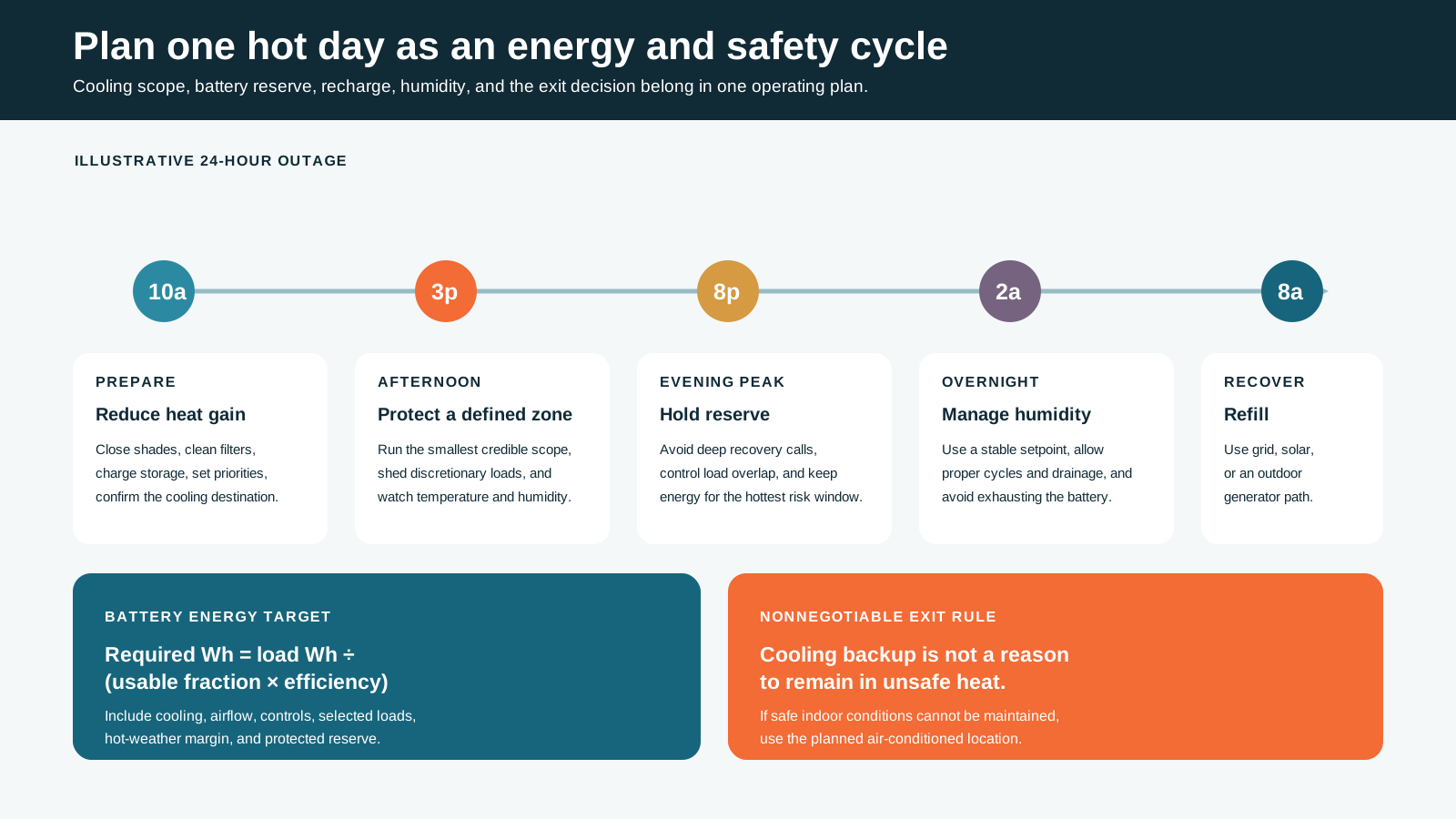
Before the highest heat
Charge storage, cool the defined area reasonably while the grid is available, close exterior shades, clean the filter, verify drains, freeze cold packs, reduce internal heat, charge communications, and confirm the air-conditioned destination. Avoid extreme precooling that creates condensation or comfort problems.
During the outage
Use the approved cooling scope, maintain a stable setpoint, keep doors and windows closed where safe, defer heat-producing loads, monitor indoor conditions and battery reserve, recover energy on schedule, and leave before the household crosses its safety trigger.
Do not use repeated deep thermostat changes as an energy-saving tactic. A large recovery call can push a variable system to maximum input or cause a fixed-speed system to run continuously. A modest stable target, external shading, reduced internal gains, and a smaller conditioned zone are often easier to model. Follow the HVAC contractor’s guidance for the installed equipment.
Set a battery floor for loads that must survive after cooling stops. Refrigeration, medical devices, communications, pumps, lighting, and alarms may still need power. Automatic reserve settings can help, but they must be tested. If the cooling plan consumes the protected reserve, the system has already failed its operating objective even if the air conditioner is still running.
Useful cooling depends on airflow and drainage
Maintain filters, coils, ducts, clearances, and condensate safety
Backup energy is too valuable to waste on avoidable HVAC faults. Replace or clean filters according to the equipment and household conditions. Keep return and supply paths unobstructed. Maintain outdoor-unit clearances and remove vegetation, leaves, lint, and debris without damaging fins or entering energized equipment. Do not cover an operating condenser or place batteries, walls, furniture, or landscaping where they restrict airflow or service access.
The indoor coil removes moisture, which must drain safely. Inspect the drain, trap, pan, condensate pump, float switches, and termination as appropriate. A backed compressor with an unpowered condensate pump can create water damage or trip a safety switch. A float switch that opens the cooling call is a protection device, not a nuisance to bypass. Include it in commissioning.
In humid weather, a portable or room air conditioner may collect condensate differently under high load than during a short test. Confirm whether it evaporates, drains continuously, or requires a tank to be emptied. Route drains according to instructions and avoid slip, mold, electrical, and structural hazards. Never place a battery or electrical connector where condensate can reach it.
Schedule professional service when the system has weak airflow, unusual noise, burning odor, repeated breaker trips, ice, water leakage, error codes, hard starting, damaged insulation, or declining performance. Do not open refrigerant circuits, electrical cabinets, or capacitors without the required qualifications and procedures.
Protect people before equipment
Extreme heat can outlast the backup system
Some people are more vulnerable to heat, including infants and children, older adults, pregnant people, people with cardiovascular or respiratory conditions, people taking certain medications, and people whose disabilities affect temperature regulation, mobility, communication, or access to cooling. Household medical guidance belongs with the backup plan, not inside a generic battery calculation.
Monitor official local alerts and indoor conditions. Know the signs of heat illness and the household’s emergency response. Maintain hydration as medically appropriate, use cool showers or damp cloths, reduce activity, and move to a reliable air-conditioned location when the plan calls for it. Current CDC guidance warns that fans alone may provide comfort but do not prevent heat-related illness when temperatures are very hot.
Choose the cooling destination before the outage. Confirm hours, accessibility, transportation, pet policy, medication and medical-device needs, communication support, and whether the location will remain open during a regional event. A library, mall, community cooling center, hotel, family home, or other public facility may be part of the plan, but availability must be verified locally.
Battery runtime is an estimate, not a medical threshold. If the equipment faults, indoor conditions rise, air quality deteriorates, official authorities advise evacuation, or the remaining reserve cannot support the next risk interval, use the prepared destination or emergency plan.
A paper design is not an outage test
Commission every supported mode through the final transfer path
Commissioning should involve the appropriate HVAC technician, electrician, and backup-system installer. Test the final configuration, not a temporary shortcut. Use realistic selected loads and safe operating conditions. Record source voltage, frequency, per-leg current where relevant, start or ramp behavior, highest input, indoor airflow, thermostat operation, condensate safety, temperature split as professionally interpreted, faults, battery discharge, generator response, load management, and retransfer.
- 1Precheck the HVAC system
Confirm maintenance, correct filters, clear coils, airflow, drains, controls, fault history, and normal utility operation.
- 2Verify every backed circuit
Map outdoor equipment, indoor equipment, thermostat, zones, condensate devices, controls, and intended accessories.
- 3Transfer under a controlled condition
Observe the native restart delay and confirm no control reset, unsafe switching, or repeated compressor attempt.
- 4Test the hardest allowed overlap
Operate the other priority loads the design permits and verify source stability when cooling starts or reaches maximum input.
- 5Test load management and reserve
Confirm shedding, reconnection delays, state-of-charge thresholds, cooling lockout, and the protected energy floor.
- 6Test every recovery source
Verify grid recharge, supported solar recovery, or outdoor generator charging without unsafe overlap or unexpected limits.
- 7Test the failure states
Practice compressor fault, low battery, unavailable generator, condensate trip, communication loss, and relocation decisions.
- 8Document and train
Leave a one-line diagram, labels, setpoints, sequence card, contacts, maintenance schedule, and test record where the household can use them.
Repeat a shorter test before the hot season and after material changes to HVAC equipment, thermostat settings, electrical panels, batteries, firmware, generator, solar, or priority loads. Exercise moving parts and fuel equipment according to manufacturer schedules. Replace stale assumptions with new measurements.
Installer handoff
Air conditioner backup selection checklist
- Protected rooms or zones named
- Outdoor design scenario recorded
- Target hours and recovery window stated
- Heat-safety exit rule documented
- Outdoor and indoor models photographed
- Matched-system manuals retained
- Filters, coils, ducts, and drains checked
- Thermostat, zones, and condensate safety mapped
- Every required circuit and voltage identified
- Fixed-speed start or inverter maximum measured
- Largest permitted overlap calculated
- Per-leg, surge, conductor, and transfer limits checked
- Hot-hour or hot-day Wh measured
- Other selected loads included
- Usable fraction and delivery loss stated
- Reserve, aging, weather, and recovery included
- Utility isolation and backfeed prevention proven
- Permits and inspections complete where required
- Battery, condenser, generator, and openings safely separated
- All equipment remains serviceable and weather protected
- Final transfer path tested
- Cooling, drainage, shutdown, and restart proven
- Load shedding and reserve thresholds proven
- Household sequence card and contacts delivered
Turn cooling evidence into output, energy, voltage, and recovery targets
Keep the exact equipment record beside the calculator results and installer proposal.
Frequently asked questions
Air conditioner backup power FAQ
Can a portable power station run central air conditioning?
Some expandable systems can support compatible central air conditioning when they provide the exact 120/240V architecture, adequate continuous and short-duration output, enough stored energy, approved transfer equipment, and a tested control path. A 120V portable unit connected by an ordinary cord cannot directly power a conventional hardwired 240V condenser. Verify the complete installation with qualified professionals.
How many watts does a central air conditioner use?
There is no reliable universal number. Electrical input changes with system capacity, efficiency, compressor type, indoor and outdoor conditions, airflow, voltage, matched components, controls, and equipment condition. Nameplates and performance tables establish boundaries, while qualified measurement under representative hot conditions gives the strongest backup input.
Can I use the breaker size to choose an inverter or generator?
No. Breaker and maximum overcurrent ratings protect circuits and equipment. They are not the same as normal running demand, actual compressor start behavior, or hot-day energy. Use the correct nameplate values, manufacturer methods, qualified measurement, and final system testing.
Does a soft starter reduce battery capacity requirements?
Not substantially by itself. A compatible soft starter may reduce a fixed-speed compressor’s brief start event, which can help the output test. The battery still supplies the compressor, fans, indoor equipment, controls, heat gain, humidity removal, other loads, and conversion losses for the full operating interval.
Is a variable-speed air conditioner always easy to run on backup?
No. A gradual ramp can reduce abrupt inrush, but the source must still support the system’s maximum requested input, complete indoor and outdoor circuit chain, source-quality requirements, controls, and hot-day energy. Confirm generator and inverter compatibility for the exact model.
Is it better to back up a window unit than central air?
Often, one properly sized room unit can provide a practical cooling refuge with much less output and stored energy than whole-home central air. It must still fit the room and climate, remove humidity effectively, use a safe receptacle and cord path, drain correctly, and pass startup and runtime tests. The correct choice depends on the household and building.
Will solar panels run my air conditioner during an outage?
Only if the solar installation includes compatible islanding, controls, transfer, inverter capacity, and often storage. Standard grid-tied solar commonly shuts down when the grid fails. Even an island-capable system must manage changing sun, clouds, smoke, heat, battery reserve, AC startup or maximum input, and other home loads.
Can I connect a generator through a dryer outlet?
No. Do not backfeed household wiring through a dryer outlet or any receptacle. Use professionally installed, listed transfer or interlock equipment, an appropriate inlet and conductors, overcurrent protection, correct grounding and neutral treatment, permits where required, and commissioning.
What thermostat setting saves the most battery?
There is no universal number. Use the highest indoor temperature that remains appropriate for the household’s health plan and the building’s humidity conditions, while avoiding large swings that command maximum recovery. A smaller protected zone, shading, reduced internal heat, clean equipment, and a stable setpoint can be more useful than repeated deep adjustments.
What happens if the battery cannot maintain safe cooling?
Follow the prepared exit plan before the indoor environment becomes unsafe. Move to a reliable air-conditioned location, maintain communications, take necessary medications and medical equipment, and follow local emergency guidance. Do not rely only on fans during extreme heat.
Cooling equipment, building load, electrical source, transfer controls, and the household plan
Begin with a defined refuge or whole-home objective. Map every cooling circuit, measure the hardest event and hot-hour energy, protect battery reserve, design safe recovery, and commission the final transfer path. If the required system becomes too large, reduce the cooling scope before sacrificing electrical safety or heat-safety margin.