Battery chemistry guide
LiFePO4 is a lithium-ion chemistry. The useful comparison is LFP versus other lithium-ion cathode families such as nickel-rich NMC or NCA, within complete certified systems.
Practical answer
LFP is often attractive for home backup because it combines strong thermal stability, long cycle-oriented product designs, and no nickel or cobalt in the cathode, though it generally has lower energy density. Other lithium-ion chemistries can package more energy into less mass or volume. Chemistry alone does not establish system safety, lifespan, warranty, output, winter behavior, or installation suitability.
Avoid treating LiFePO4 and lithium-ion as mutually exclusive categories.
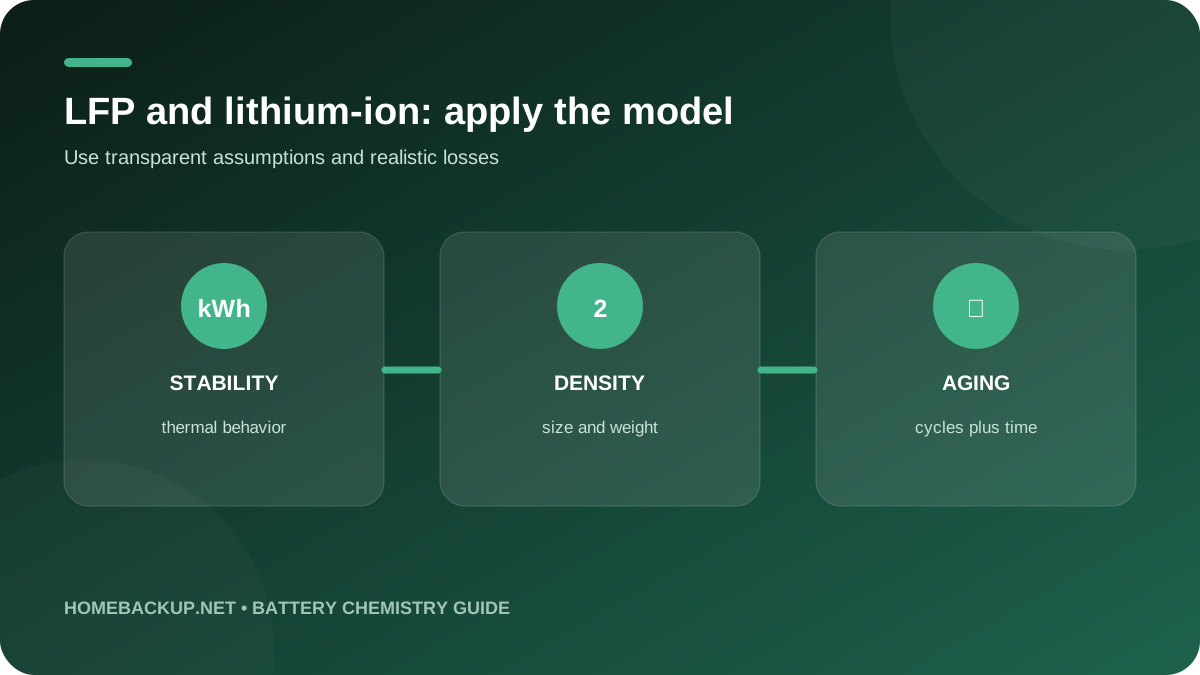
Argonne identifies LFP for strong thermal stability compared with layered cathodes.
Nickel-rich cells can store more energy for a given mass or volume.
Cell chemistry influences aging, but warranty, temperature, and control strategy decide ownership value.
Lithium chemistries can have strict low-temperature charging limits.
Cells, BMS, inverter, enclosure, controls, and installation interact.
Calculator or quick planning method
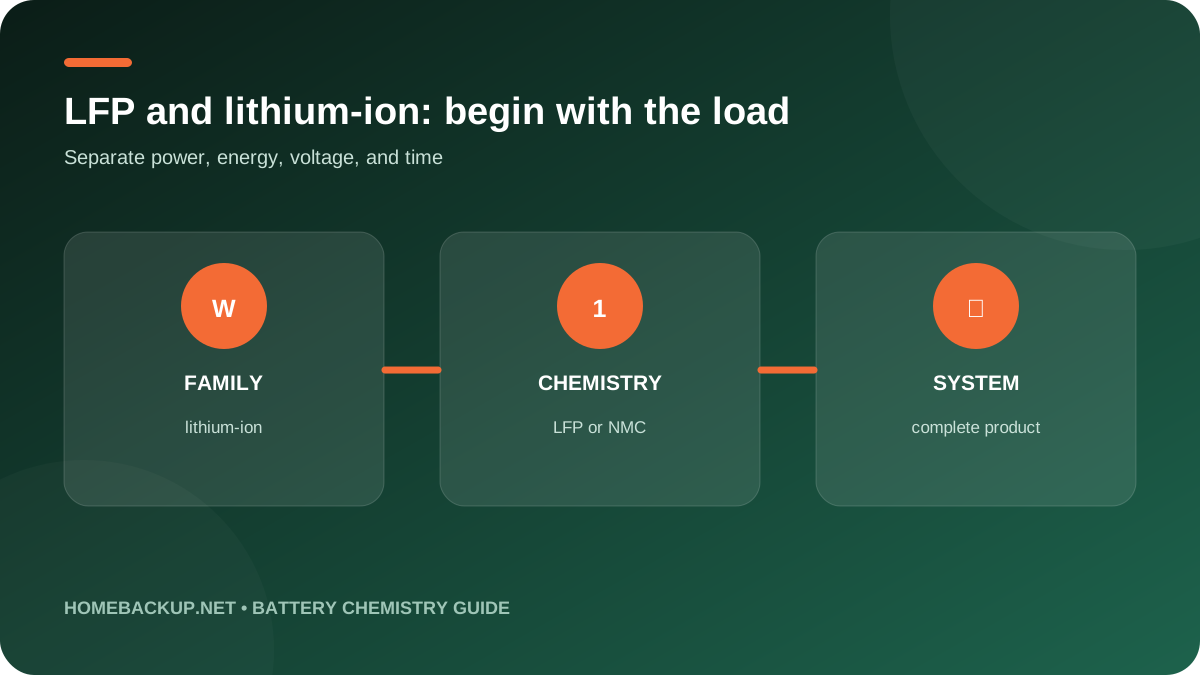
Correct comparison frame: chemistry + cell design + battery management + enclosure + inverter + protective controls + certified system + installation conditions = the practical product.
Do not choose from a single cycle-life headline. Translate the warranty into years, cycles, energy throughput, retained capacity, operating mode, temperature, labor, and exclusions. A battery rated for thousands of laboratory cycles may still have a shorter warranty or calendar-life limit.
The core idea
Lithium-ion describes a broad rechargeable-battery family in which lithium ions move between electrodes. LiFePO4, commonly shortened to LFP, identifies a lithium iron phosphate cathode. NMC and NCA identify nickel-containing cathode families used in many vehicles and some storage products. Saying LFP versus lithium-ion is like saying one member of a family versus the family itself.
Cathode chemistry influences voltage, thermal stability, energy density, cost inputs, and aging behavior, but the finished system adds many more variables. Cell format, manufacturing quality, pack spacing, cooling, sensors, fuses, contactors, software, battery management, inverter limits, enclosure, installation, and emergency controls shape real safety and performance.
Home backup planning works best when power, energy, voltage, transfer behavior, and recovery are kept separate. Power determines whether equipment can run or start. Energy determines duration. Voltage determines whether the source is electrically compatible. Transfer determines how loads move from grid power to backup. Recovery determines whether the system can support a long outage instead of only consuming a finite reserve.
A useful estimate is transparent about its assumptions. It should show which numbers came from an appliance label, meter, manual, or homeowner scenario. It should also leave room for conversion losses, standby demand, weather, temperature, battery reserve, fuel performance, and changes in household behavior. A result with more decimal places is not necessarily more accurate.
Formula and planning method
Compare products at system level. Start with usable kWh, continuous and surge output, 120/240V support, charge and discharge temperature, indoor or outdoor rating, expansion, transfer behavior, solar and generator support, noise, standby demand, warranty, service, and applicable listings. Then use chemistry to understand tradeoffs rather than as a substitute for the rest of the specification.
For longevity, compare the warranty’s retained-capacity promise and throughput. Cycle count without depth of discharge, temperature, rate, end-of-life capacity, and test method is incomplete. A daily-cycled solar battery and an emergency-only backup battery age differently. Calendar aging can matter even when outages are rare.
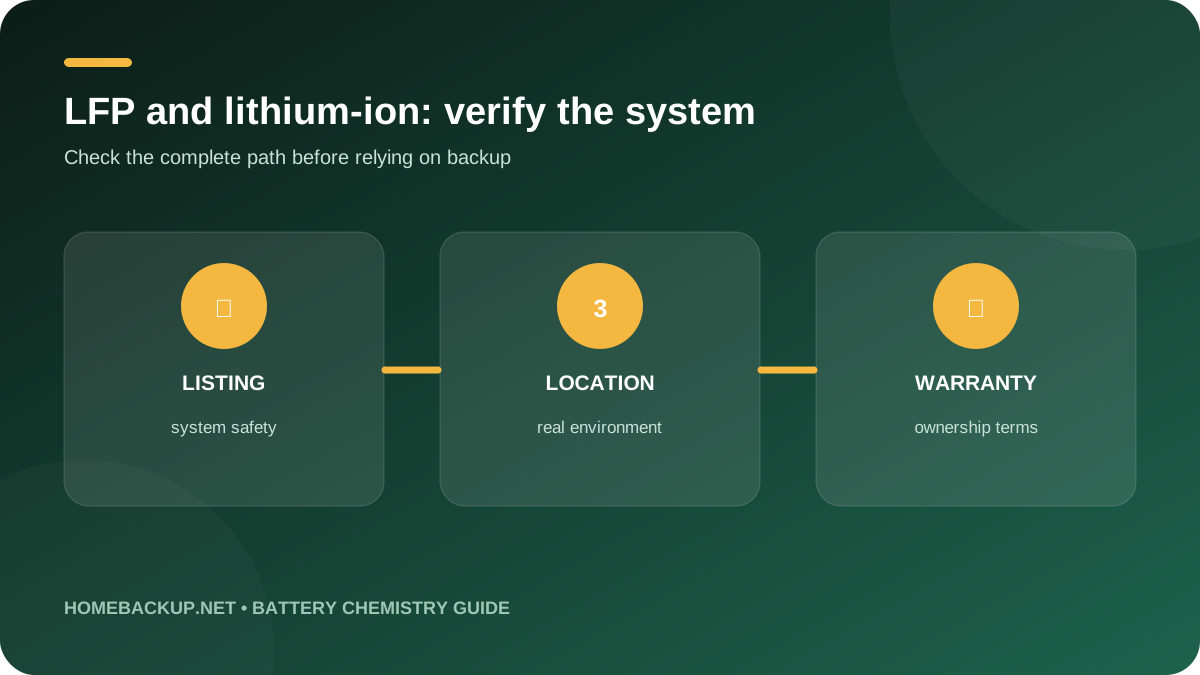
For safety, look for the complete energy-storage system certification and installation requirements relevant to the jurisdiction. UL explains that UL 9540 addresses energy storage systems and equipment, while UL 9540A is a test method for thermal-runaway fire propagation. A reference to one cell standard is not the same as a listed installed system.
LFP and other lithium-ion comparison factors
| Input or condition | Planning treatment | Why it matters | What to verify |
|---|---|---|---|
| Cathode family | Identify LFP, NMC, NCA, or another chemistry | Clarifies the real comparison | Current product documentation |
| Thermal stability | Treat LFP as generally favorable, not hazard-free | Chemistry affects abuse response | System testing, enclosure, BMS, and installation |
| Energy density | Expect many nickel-rich designs to package more tightly | Influences size and weight | Finished-system Wh/kg and dimensions |
| Cycle life | Compare product warranty and test conditions | Cell headline can overstate ownership value | Cycles, throughput, retained capacity, years |
| Calendar life | Consider time as well as cycles | Backup batteries may sit more than they cycle | Warranty term and manufacturer aging guidance |
| Cold charging | Follow chemistry and system limits | Charging below allowed temperature can damage cells | Heater behavior and minimum charge temperature |
| Power capability | Use inverter and battery-system ratings | Chemistry does not set household output alone | Continuous, surge, voltage, and battery count |
| Fire testing | Review applicable system listing and reports | Installation safety is system-level | UL 9540, UL 9540A context, and local authority |
| Serviceability | Check module replacement and support | Long life depends on repair path | Labor, shipping, installer, and parts |
| End of life | Ask about recycling and take-back | Large batteries require responsible handling | Manufacturer and local program |
The rows above should be read as a checklist, not as independent answers. A battery may have enough energy but too little inverter output. A generator may have enough running watts but fail to start a pump. A solar array may be large enough on a clear summer day but inadequate during the season when outages are most likely. Test the complete chain against the same operating scenario.
Three chemistry decisions in context
A traveler may value compact energy density, while a home-only buyer may accept more weight for an LFP platform. Output, port layout, noise, and certification can outweigh chemistry.
LFP does not make every garage location acceptable. Temperature, vehicle impact, clearances, enclosure rating, fire rules, and the complete listing still control placement.
A product with clear daily-cycling warranty terms may be more useful than a larger cycle headline without defined depth, retained capacity, labor, or energy throughput.
These examples are deliberately illustrative. Appliance cycling, thermostat settings, motor condition, power factor, cable length, fuel type, elevation, panel configuration, weather, and user behavior can move the result. Build a conservative plan for critical loads, then decide which conveniences can be added only when spare capacity is available.
What changes the result in a real home?
Temperature influences both performance and degradation. Cold can reduce available power and restrict charging. Heat can accelerate aging. Some systems include heaters or active cooling, which improve the operating envelope but consume energy and add system complexity. Compare the actual enclosure and controls, not a bare-cell chemistry chart.
Depth of discharge and time at high state of charge can affect aging. A backup-only reserve strategy may keep the battery full for long periods, while a solar-self-consumption strategy cycles it daily. The manufacturer’s operating modes and warranty may treat those uses differently.
System design can dominate cell chemistry. A well-engineered product with strong monitoring, conservative limits, certified hardware, and proper installation may be a better choice than a loosely documented product that advertises the preferred cathode. Chemistry is one layer of due diligence.
Outages also change normal behavior. Refrigerator doors open more often, a sump pump may cycle more during the same storm that caused the outage, a furnace may run longer in extreme cold, and a well pump may serve a household that is home all day. At the same time, occupants may turn off discretionary loads. A good model uses an outage scenario rather than an average utility bill alone.
Common battery chemistry mistakes
Most sizing errors are category errors. Watts are treated as watt-hours, a short surge rating is treated as continuous output, a battery nameplate is treated as delivered AC energy, or solar panel watts are treated as guaranteed daily production. Correcting the category usually matters more than changing a safety factor from 20 percent to 25 percent.
How to verify the inputs
Find the exact chemistry in the current datasheet, safety document, or manufacturer support material. Then read the system-level certifications and installation instructions. Ask the installer which model and firmware are included, whether the proposed configuration is listed as a complete system, and whether the installation follows the tested arrangement.
Compare warranty years, cycle or throughput limits, retained capacity, temperature exclusions, internet or registration requirements, labor, transferability, and authorized installation conditions. Ask what happens when one module fails and whether replacement modules will remain compatible.
Check charge and discharge temperature ranges, heater operation, outdoor rating, clearances, ventilation, flooding exposure, direct sun, salt, and vehicle impact. Chemistry cannot correct a location that violates the manual or local requirements.
Start with the appliance nameplate and current manual. OSHA requirements reflect why the nameplate is important: electrical appliances are marked with voltage and amperes or voltage and watts. For a cycling appliance, a plug-in energy meter can reveal daily watt-hours when the equipment uses a normal 120V plug and the meter is appropriately rated. Permanently wired, 240V, or high-current equipment should be evaluated through manufacturer data or qualified measurement.
Record the date, temperature, operating mode, and duration of any measurement. One calm day may not represent a storm, heat wave, or cold snap. For critical equipment, compare more than one scenario and preserve reserve. If a result depends on a specific surge value, transfer time, solar input, or generator charging feature, confirm it in the current manual for the exact model and configuration.
How this affects the backup system
LFP is common in modern portable and modular home-backup products because weight is less critical than in a vehicle and buyers value long-cycle positioning. Installed batteries can use LFP or other lithium-ion families depending on the manufacturer’s design priorities. Compare the complete product pages and system proposals rather than assuming one chemistry automatically wins.
The Home Battery Backup guide explains capacity, inverter output, transfer, solar, and expansion. The home battery lifespan guide separates outage runtime from service life. Both questions need more than a chemistry label.
For a battery-generator hybrid, chemistry does not decide whether generator charging is supported. Input voltage and frequency tolerance, maximum charge power, neutral rules, connectors, communications, and manufacturer approval determine compatibility.
The system should be checked in both directions. First, can the source support the largest instantaneous combination of running and starting loads at the required voltage? Second, is enough usable energy or fuel available for the intended duration? Then check whether the proposed solar or generator recovery can replace the daily energy used. Passing only one of these tests is not enough.
Load management can reduce system size without sacrificing the most important outcomes. Refrigeration, communications, medical planning, water management, and basic heating controls may receive priority. Electric water heating, resistance space heating, clothes drying, EV charging, and central cooling may be delayed or tightly controlled. The correct priority list depends on climate, health, water source, flood exposure, and household needs.
Safety, electrical limits, and local requirements
Use batteries and expansion modules only in supported combinations with approved cables and protective equipment. Do not open packs, bypass the BMS, mix generations without written approval, or use damaged or recalled equipment. Follow transport, storage, charging, and end-of-life instructions.
Installed energy storage requires the applicable listed system, location assessment, clearances, overcurrent protection, disconnects, transfer or isolation equipment, permits, inspections, and qualified installation. UL 9540A information supports fire-propagation evaluation but does not replace the installation design or local authority approval.
Do not treat a consumer power station or a calculator result as guaranteed medical-grade backup. Follow the medical-device manufacturer’s power instructions and the emergency plan agreed with the care team. For flood protection, heating in severe cold, well water, refrigeration of medicines, or other high-consequence loads, use layered contingency planning and alarms where appropriate.
A practical chemistry comparison workflow
- 1
Correct the terminology
Identify the specific lithium-ion cathode family.
- 2
Compare complete-system specifications
Use usable kWh, kW, voltage, transfer, solar, and environmental ratings.
- 3
Read warranty and aging terms
Translate cycles into years, throughput, and retained capacity.
- 4
Review safety certification
Confirm the complete system and proposed configuration.
- 5
Check the installation environment
Temperature, weather, impact, clearances, and local rules matter.
- 6
Choose by homeowner fit
Balance size, weight, service, cost, output, recovery, and ownership needs.
Related completed guides
Frequently asked questions
Is LiFePO4 a lithium-ion battery?
Yes. LiFePO4, or LFP, is a lithium-ion chemistry that uses lithium iron phosphate as the cathode material. The common phrase LFP versus lithium-ion usually means LFP versus other lithium-ion chemistries.
Is LFP safer than NMC?
LFP is generally recognized for strong thermal stability, but complete-system safety also depends on cell quality, BMS, enclosure, cooling, protective devices, certification, installation, and use. Safer does not mean hazard-free.
Does LFP always last longer?
Many LFP products are designed and marketed for high cycle life, but actual service life depends on temperature, depth of discharge, charge rate, calendar aging, controls, and warranty conditions. Compare finished products.
Why are some non-LFP batteries smaller?
Nickel-rich chemistries can provide higher energy density, allowing more Wh in a given mass or volume. Packaging, cooling, enclosure, and inverter design also affect finished-system size.
Can LFP charge below freezing?
Charging limits are product-specific. Many lithium batteries restrict charging at low temperature unless the system warms the cells. Follow the exact manual and do not infer permission from chemistry alone.
What certifications should a home battery have?
Requirements vary by product type and jurisdiction. For installed energy storage, ask the installer and local authority about the complete system listing, inverter certification, fire testing, and the currently adopted electrical and fire rules.
Is the battery chemistry comparison result exact?
No. It is a planning estimate based on the values entered and the assumptions shown. Actual performance changes with appliance behavior, temperature, battery condition, power factor, wiring, configuration, and operating mode. Use current manuals and measured inputs where practical.
How much safety margin should I add?
There is no universal percentage. Twenty percent can be a useful first allowance for ordinary noncritical planning, but motor starting, uncertain duty cycles, severe weather, fuel derating, and high-consequence loads can justify more. Margin does not correct a voltage mismatch or an unsupported connection method.
How this guide was prepared
HOMEBACKUP.net separates verified specifications from planning estimates. The calculation methods show their assumptions, and product-independent guidance is based on current government, laboratory, standards, utility, and manufacturer documentation where appropriate. Illustrative runtimes and appliance values are not presented as measured promises for a particular home.
Before buying equipment, repeat the estimate with current nameplates, manuals, measured energy where practical, and a realistic outage scenario. Installed systems need a qualified professional to confirm service compatibility, conductor and breaker limits, transfer method, grounding and bonding, location, permits, inspections, and the current locally adopted rules.
Sources and review basis
Reviewed July 22, 2026. Calculations are planning estimates, not measured performance or an electrical design.
- Argonne National Laboratory lithium-ion cathode material report
- UL Solutions energy storage system testing and certification
- UL 9540A test method for battery energy storage systems
- NREL storage technology modeling input data report
Equipment specifications, electrical rules, safety instructions, and available accessories can change. Use the current appliance nameplate, product manual, local requirements, and qualified professional review for the actual installation.
Compare the complete battery, not only the cathode
Use the Home Battery Backup guide to compare capacity, output, transfer, recovery, installation, and ownership alongside chemistry.