Battery installation cost
The battery cabinet is only one line in the installed price. Transfer equipment, electrical service, panels, conductors, placement, permits, utility work, commissioning, and future expansion can change the budget materially.
Practical answer
Compare battery proposals by an identical operating outcome and line-item scope. Fix the protected loads, power, usable energy, transfer behavior, outage-mode solar, reserve, placement, and expansion target first. Then separate hardware, design, electrical work, site work, permits, utility processing, commissioning, monitoring, taxes, and optional upgrades. National price averages are weak substitutes for a site-specific proposal.
Compare usable energy, output, expansion, warranty, and the exact number of modules.
Automatic backup often needs approved switching, controls, metering, and communications.
Selected-load panels, service equipment, obsolete breakers, and bus constraints can dominate labor.
Wall type, clearances, weather, flood, bollards, routing, and structural work affect approval and cost.
Plan sets, engineering, permit fees, corrections, and utility review are real project costs.
Warranty labor, connectivity, software, inspections, and replacement access matter after commissioning.
Start with the project boundary
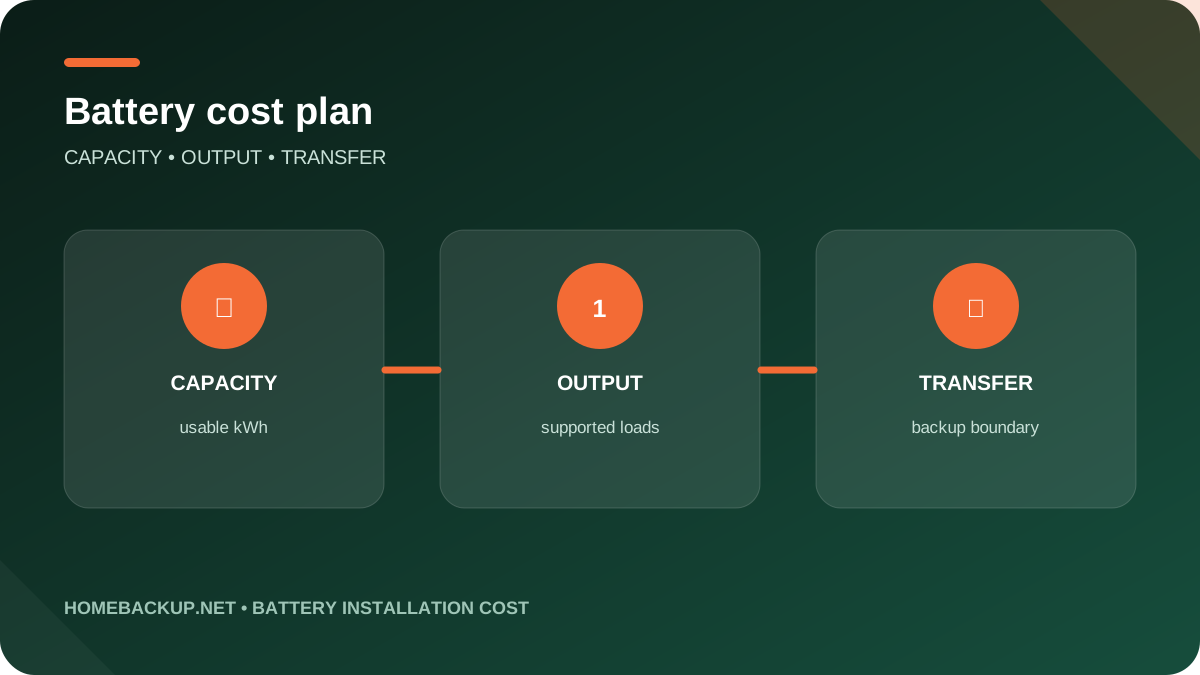
Cost cannot be compared until capability is fixed. One 10 to 15 kWh battery protecting a few circuits is not equivalent to a multi-battery 120/240V system supporting central HVAC. Ask each bidder to price the same protected-load schedule, operating modes, reserve, outage duration, expansion plan, and solar behavior. Use the Battery Runtime Calculator for an energy scenario and the Inverter Size Guide for power.
Separate base configuration from maximum ecosystem claims. A product family may advertise high output or large capacity only with multiple inverters, batteries, gateways, or accessories. The proposal should identify the capability of the exact installed configuration, including output during an outage, capacity available at the protected loads, number of batteries, 240V behavior, transfer rating, and load-management limits.
Treat cost per kWh cautiously. It ignores inverter power, gateway, panel work, selected circuits, solar integration, automatic transfer, warranty labor, and site complexity. It can be useful only when comparing similar architectures and scopes. The least expensive stored kWh may be the wrong system if it cannot start the loads or cannot be approved at the site.
An installation should begin with a written operating scenario. Identify the circuits that must work, the largest loads that may overlap, the required outage duration, the desired transfer behavior, and how the system will recover after stored energy or fuel is used. This prevents the project from being reduced to a product name or a headline power rating.
Keep four checks separate. Electrical capability asks whether voltage, continuous output, surge, conductors, breakers, and transfer equipment match the load. Energy or fuel asks how long the plan can operate. Installation compliance asks whether the equipment, location, plans, permit, utility process, and inspections are acceptable. Ownership asks who will operate, maintain, update, and service the system after commissioning.
What the project actually includes
Battery hardware can include modules, inverter or power-conversion system, gateway, backup controller, meters, current transformers, disconnects, rapid-shutdown interfaces, load controls, expansion cabinet, communications equipment, mounting hardware, and manufacturer-specific accessories. Confirm whether sales tax, shipping, crane or lift access, and extended warranty are included.
Electrical scope can include service disconnect changes, panel replacement, subpanel, breaker relocation, feeders, raceways, trenching, grounding and bonding work, surge protection, labeling, load-control relays, solar reconfiguration, meter-main work, and restoration of walls or landscaping. Ask the contractor to separate known work from allowances and optional improvements.
Project services include load analysis, design, engineering, plan set, permit application, fire review, utility interconnection or permission to operate, homeowner-association documents, inspections, corrections, commissioning, firmware, monitoring setup, homeowner training, warranty registration, and post-install support. A low equipment price that omits these services is not a complete installed comparison.
Battery cost drivers to normalize
| Project decision | What changes | Risk if omitted | Evidence to request |
|---|---|---|---|
| Usable energy | Changes the number and type of battery modules | A nominal kWh comparison can overstate delivered outage energy | Exact configuration and usable-capacity language |
| Continuous and surge output | Changes inverter count and supported loads | The battery may not start HVAC or pumps | Output table for the installed configuration |
| 120/240V architecture | Changes power electronics and panel design | 240V loads may be unavailable despite sufficient energy | One-line diagram and supported voltages |
| Transfer boundary | Changes gateway, switchgear, and conductor scope | Coverage and simultaneous operation may be misunderstood | Protected-load schedule and transfer rating |
| Existing solar | May require compatible controls or inverter changes | Solar may not recharge during an outage | Written outage-mode solar sequence |
| Panel and service condition | Can require substantial electrical upgrades | Change orders appear after the deposit | Site-survey notes and panel photos |
| Battery location | Changes mounting, protection, clearances, and routing | The proposed site may fail inspection | Dimensioned location and listing instructions |
| Permit and engineering | Varies with system and authority | Review delays or redesign are omitted | Named permits, fees, stamps, and responsible party |
| Monitoring and communications | May need networking or subscription | Alerts and warranty diagnostics may be limited | Account ownership and ongoing fees |
| Expansion readiness | May require larger gateway, conduits, wall space, or panel capacity | A later battery costs more to integrate | Written expansion path and reserved infrastructure |
The decisions in this table interact. Moving a battery may change conductor length, fire review, wall construction, communications quality, and labor. Adding central air may change inverter power, battery count, load management, panel work, and commissioning. A lower equipment quote can become the higher installed price when it omits required electrical or site work.
Three battery budget patterns
The budget centers on a battery, inverter or integrated power electronics, backup gateway, critical-load panel or circuit relocation, permits, and commissioning. Existing panel condition and motor surge can move cost more than a small change in capacity.
The installer must verify solar inverter compatibility, outage-mode charging, export controls, gateway placement, metering, utility process, and monitoring ownership. Reusing solar does not guarantee a simple battery add-on.
More capacity and output add equipment, but service-level switching, smart panels or load controls, conductor paths, HVAC integration, utility approval, commissioning, and future expansion planning can be equally important.
These examples are planning patterns, not universal designs or price promises. The authority having jurisdiction, utility, building type, electrical service, fuel supply, available working space, climate, flood exposure, equipment listing, and manufacturer instructions can change the approved solution. A project should be priced against the actual site after those constraints are known.
How cost and quotes should be structured
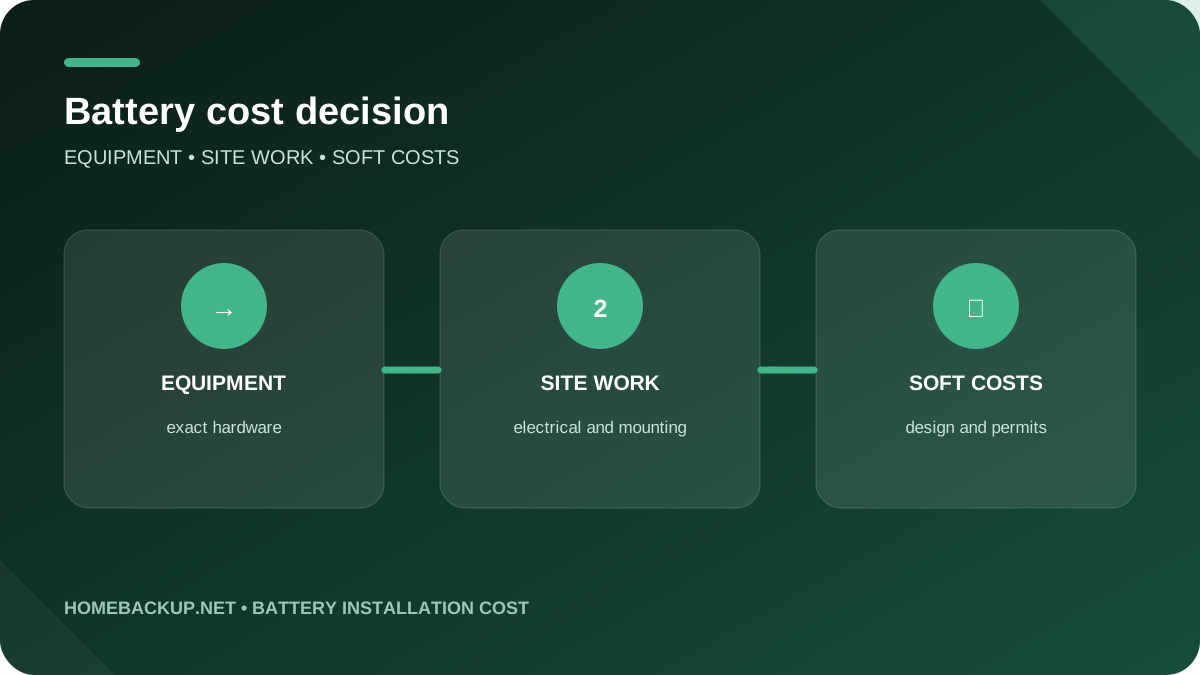
Use a cost worksheet with at least twelve lines: battery modules; inverter or power electronics; gateway or transfer equipment; panels and load controls; balance-of-system electrical materials; design and engineering; electrical labor; site and structural work; permits and utility fees; commissioning and monitoring; taxes and shipping; and options. Ask which lines are fixed, allowances, unit-priced, or excluded.
Avoid publishing or accepting a single national “average” as the quote target. Labor rates, permit fees, service configuration, product channel, freight, wall construction, trenching, fuel integration, utility rules, and local demand vary. NREL benchmarking is useful for understanding cost categories and market trends, but it is not a retail quote for a particular home.
Compare the total before financing. Dealer fees, rate buy-downs, origination charges, liens, prepayment terms, and bundled service can make a low monthly payment expensive. Ask for a cash price and financing disclosure as separate documents. Do not let a terminated federal credit be shown as a guaranteed 2026 discount.
Compare quotes by normalized scope, not only by the total at the bottom. Separate equipment, design, electrical work, fuel work, concrete or mounting, trenching, communications, permit fees, utility fees, commissioning, taxes, monitoring, maintenance, and optional upgrades. Ask which allowances can change and which items are fixed.
In July 2026, a proposal should not automatically subtract a U.S. federal residential clean-energy tax credit from the price. Current IRS instructions state that residential clean-energy credits cannot be claimed for expenditures made after December 31, 2025. State, local, utility, manufacturer, financing, or resilience programs may still exist, but eligibility and funding must be verified directly before they are included in a net-cost claim.
Permits, inspection, utility, and commissioning
Battery projects commonly involve electrical permits and may involve building, fire, structural, zoning, or utility processes. The exact combination depends on location, energy capacity, placement, building type, solar interconnection, service changes, and the locally adopted codes. Ask whether the quoted permit fee includes corrections and reinspections.
Placement affects review. The authority may examine equipment listing, unit spacing, separation from doors and windows, garage protection, working clearance, egress, habitable spaces, structural support, flood exposure, and manufacturer instructions. UL 9540 is a system-level certification framework; UL 9540A is a fire-propagation test method used in code and authority review. They are related but not interchangeable labels.
Final approval should include electrical inspection and any separate fire, building, or utility closeout. Ask the installer to provide the approved plans and inspection record. If a utility permission-to-operate step applies, identify whether the system can provide backup before export or parallel operation is authorized.
The National Electrical Code is a benchmark for safe electrical design and installation, but it becomes enforceable through adoption. The locally adopted edition and local amendments matter. The authority having jurisdiction may include electrical, building, zoning, planning, and fire officials. A utility may have a separate review when equipment can operate in parallel with the grid, export energy, change service equipment, or participate in a program.
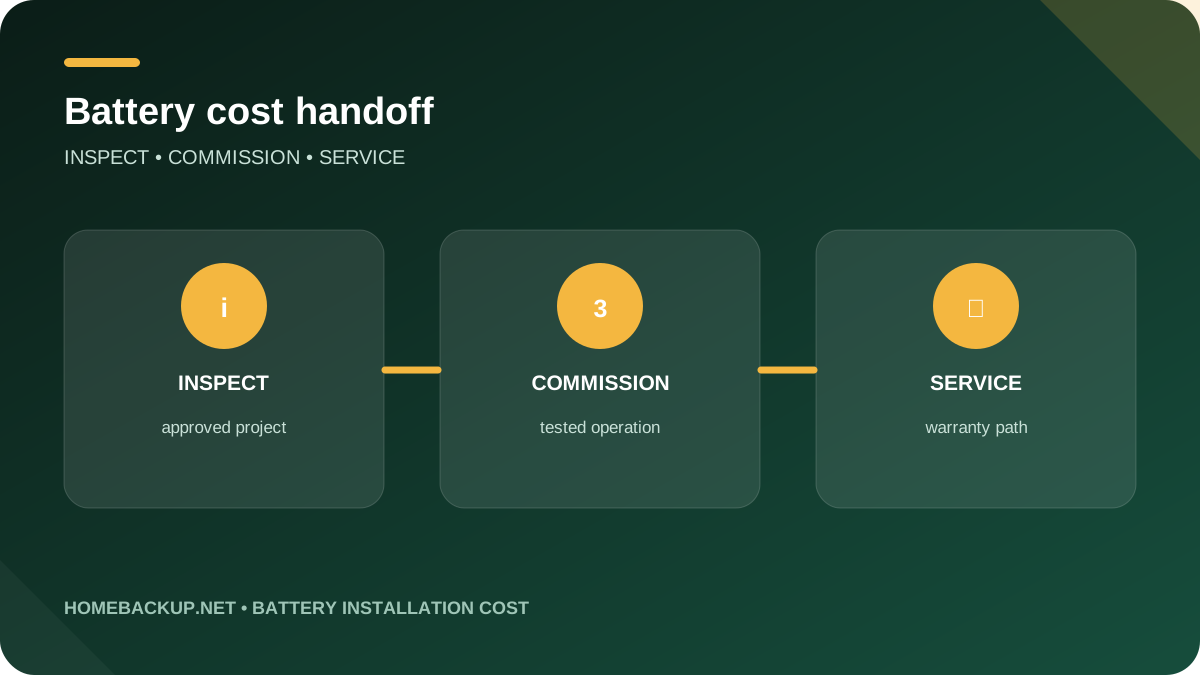
Keep the approved plans and final records. A complete handoff commonly includes permit closeout, inspection approval, utility authorization where required, equipment serial numbers, warranty registrations, as-built diagrams, settings, shutdown instructions, monitoring access, maintenance schedule, and test results. A system that turns on is not necessarily a closed project.
What changes in a real home?
Battery capacity can scale more cheaply than the first unit because some fixed equipment is already present, but this is not universal. A second battery can require additional wall space, protection, conductor changes, permits, or an upgraded inverter. Some systems increase both energy and output with expansion; others add only energy. Ask for an expansion quote now.
Service equipment is a frequent cost pivot. A modern meter-main with space and compatible breakers may simplify work. An older split-bus panel, obsolete brand, crowded service, inadequate bus rating, damaged equipment, or poor clearance can require more extensive work. Treat a panel replacement as a property upgrade with its own scope, not as a hidden battery accessory.
Warranty value depends on service. A long equipment warranty may exclude diagnostic labor, travel, removal, shipping, reinstallation, wall repair, or lost monitoring. Ask who is responsible if the original installer closes, whether another authorized provider can service the system, and whether the homeowner or installer owns the monitoring account.
Existing conditions frequently control the schedule. Older panels, crowded gutters, obsolete breakers, inadequate working clearance, mixed neutrals and grounds, unpermitted alterations, weak walls, flood-prone locations, long conductor routes, missing gas capacity, and unreliable communications can all require redesign. A site survey should find these before equipment arrives.
Household priorities matter too. A sump pump during a storm, a furnace during extreme cold, refrigeration for medicine, a well pump, and medically necessary equipment need a different reserve strategy than entertainment or convenience loads. The project should document which loads may be shed, which must restart automatically, and which need a second independent contingency.
Common battery-cost mistakes
A common thread connects these errors: the buyer is shown a component while the home needs a system. The battery, generator, inlet, panel, transfer device, controls, fuel source, utility service, and selected loads must work together under normal power, outage power, restoration, maintenance, and failure conditions.
What to verify before signing and before final payment
Ask each bidder to complete the same quote matrix: exact equipment and quantities, usable energy, output, surge, voltage, transfer, protected loads, solar behavior, expansion, location, panel and service work, permits, utility tasks, commissioning, monitoring, warranty labor, taxes, allowances, exclusions, payment milestones, and cash-versus-financed price.
Before final payment, confirm installed model and quantity, approved location, completed permits, utility authorization where required, working selected circuits, motor starts, reserve, solar recovery, monitoring, labels, homeowner access, warranty registration, as-built documents, and a successful outage-restoration test. Reconcile any credits or change orders in writing.
Verify business and trade credentials with the issuing authority, not only with a logo on a proposal. Confirm who holds the contract, who pulls the permit, who performs electrical and fuel work, who provides engineering when required, and who will answer warranty calls. If subcontractors are used, ask for their company names and applicable credentials before work begins.
The Federal Trade Commission recommends multiple written estimates, a detailed written contract, contractor identity and license information, start and completion timing, and avoiding full payment upfront. Payment rules vary by state. Keep changes in writing and tie the final payment to the contract milestones, completed inspection, working commissioning test, and receipt of promised documents.
Safety boundaries
Do not reduce safety certification to the chemistry label. LFP is one lithium-ion family, but safe stationary installation depends on the complete listed system, battery management, power conversion, enclosure, controls, communication, location, protection, and instructions. Ask for the certification and installation documentation for the exact combination being proposed.
Do not place a battery based solely on convenience or available wall space. The product rating, mounting surface, clearances, temperature, moisture, flood risk, vehicular impact, egress, fire review, access, and local rules all matter. Do not relocate or expand a stationary system without professional and permit review.
Portable generators must operate outdoors and away from the home, doors, windows, vents, garages, crawlspaces, and other enclosed or attached areas, following current CPSC guidance and the manufacturer’s instructions. Use working carbon monoxide alarms. A transfer switch or interlock prevents source overlap; it does not make unsafe generator placement safe.
A battery cost-comparison workflow
- 1
Fix the protected-load scenario
Use one load schedule, duration, transfer behavior, and solar assumption for every bidder.
- 2
Complete the site survey
Identify panel, service, location, routing, solar, communications, and structural conditions.
- 3
Request line-item cash proposals
Separate equipment, labor, permits, utility work, commissioning, tax, allowances, and options.
- 4
Normalize capability
Compare exact energy, power, voltage, transfer, expansion, and outage-mode solar.
- 5
Verify credentials and approvals
Confirm contractor, electrician, permit, utility, and product authorization requirements.
- 6
Tie payment to closeout
Use written milestones through inspection, commissioning, documentation, and homeowner handoff.
Related completed guides
Frequently asked questions
How much does a home battery cost to install?
There is no reliable national answer for a specific home. Capacity, power, gateway, selected circuits, service and panel condition, solar integration, placement, permits, utility process, labor market, and warranty scope can change the total materially. Obtain site-specific line-item quotes.
Is a larger battery always better value?
Not necessarily. Additional capacity may share fixed equipment, but it can also require more power electronics, mounting, protection, permits, or service work. Compare the incremental capability and the loads it enables, not only the added kWh.
Does the price include a transfer switch?
Do not assume it does. Battery systems may use a gateway, backup controller, automatic transfer equipment, or selected-load panel. Ask for the exact device, rating, supported sources, and installation scope.
Can I claim a federal battery tax credit in 2026?
Current IRS instructions state that residential clean-energy credits cannot be claimed for expenditures made after December 31, 2025. Verify any later legislative change directly with the IRS and obtain tax advice for your circumstances.
Should permits be a fixed price?
Ask whether the proposal includes expected permit and utility fees, design, corrections, and reinspections. Authorities can add requirements after review, so the contract should explain how unexpected official requirements are handled.
What is the best way to compare financing?
Request the cash price, total financed amount, APR, term, dealer fees, rate buy-downs, prepayment terms, lien or security interest, and total payments. Compare the system cost before applying uncertain incentives or energy-bill savings.
Can I use this guide as an electrical design?
No. This guide organizes homeowner decisions and quote questions. It does not select conductors, breakers, overcurrent protection, grounding, bonding, transfer configuration, fire separation, or service equipment for a property. Use the current product instructions and appropriately qualified professionals.
Which code edition applies to home battery installation?
The edition adopted by the state or local authority having jurisdiction, including local amendments, applies. The newest published NEC or NFPA standard is not automatically the enforceable edition. Ask the permit office and installer to identify the adopted requirements used for the plans.
How this guide was prepared
HOMEBACKUP.net separates product capability from site approval and installation design. This guide uses current government, standards-organization, testing, credentialing, and manufacturer material where appropriate. It does not reproduce a local code, approve equipment, provide engineering, create a contractor relationship, or replace the current instructions for the exact system.
Requirements change with the locally adopted code edition, amendments, product listing, site conditions, utility rules, and project scope. Treat dates, incentives, fees, and cost bands as items to recheck. Obtain a site-specific design and written quote from appropriately qualified professionals before purchasing installed equipment.
Sources and review basis
Reviewed July 22, 2026. Installation, cost, permitting, code, and incentive information can change and must be verified for the property.
- NREL: PV-Storage System Cost Benchmarking
- UL Solutions: Energy Storage System Testing and Certification
- UL Solutions: UL 9540A Test Method for Battery Energy Storage Systems
- U.S. Department of Energy: Permitting and Inspection for Rooftop Solar
- IRS: Instructions for Form 5695 (2025), termination of residential credits
- Federal Trade Commission: How To Avoid a Home Improvement Scam
Product listings, installation instructions, code editions, utility programs, permits, contractor rules, fees, and incentives can change. Use current documents and the authority having jurisdiction for the actual project.
Request a comparable installation quote
Prepare the load plan first, then use the installation quote request and compare the result with the installer selection checklist.