Power fundamentals
Watts describe how fast electricity is being used. Watt-hours describe how much energy is used over time. A home backup system must satisfy both.
Practical answer
Use watts to check whether an inverter or generator can run the simultaneous load and start motors. Use watt-hours or kilowatt-hours to estimate battery capacity and outage duration. A 2,000 W inverter and a 2,000 Wh battery are not equivalent: one is a power limit, while the other is an energy quantity.
A 1,000 W load asks the source to deliver power at that rate while it operates.
A 1,000 W load running for two hours uses 2,000 Wh.
Generators and installed inverters often state continuous output in kW.
Batteries and utility bills commonly state energy in kWh.
Motor starting can exceed normal running watts without adding much daily energy.
Usable delivered Wh divided by average W gives an estimated number of hours.
Calculator or quick planning method
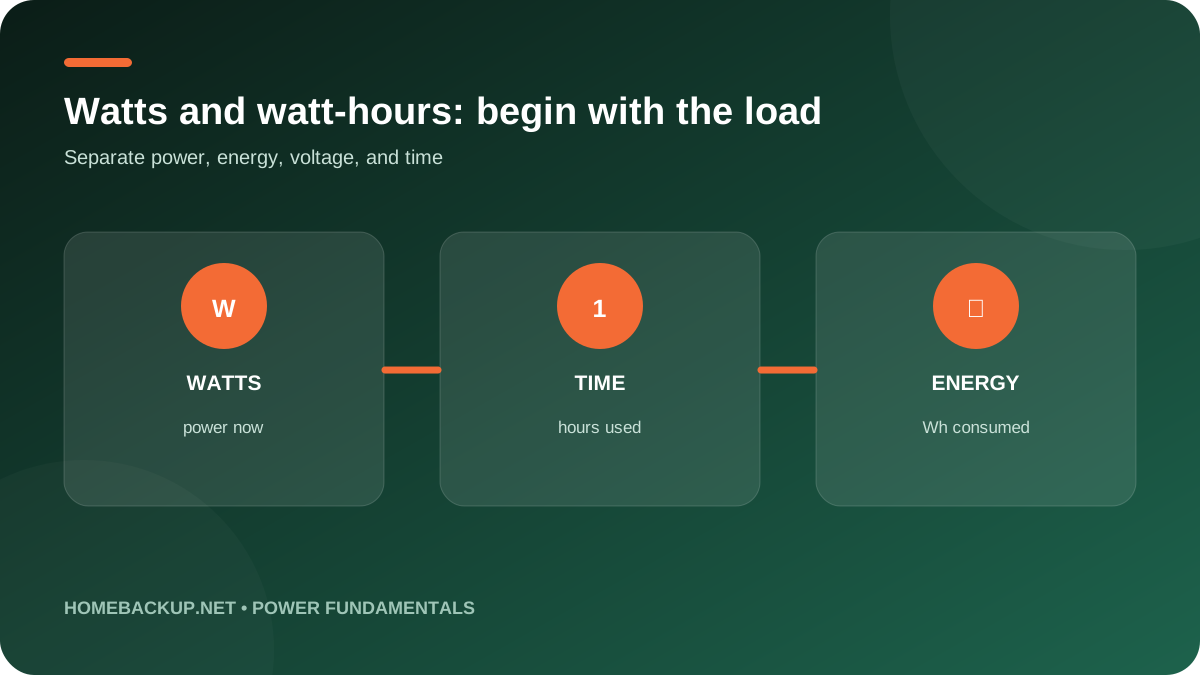
Power-to-energy formula: watt-hours = watts × hours. Kilowatt-hours = watts × hours ÷ 1,000. Rearranged for a steady load, hours = usable watt-hours ÷ watts.
A 100 W router, modem, and small network stack operating for 10 hours uses about 1,000 Wh, or 1 kWh. A 1,200 W microwave operating for ten minutes uses about 200 Wh. The microwave needs far more instantaneous power but may use less energy because it runs briefly.
The core idea
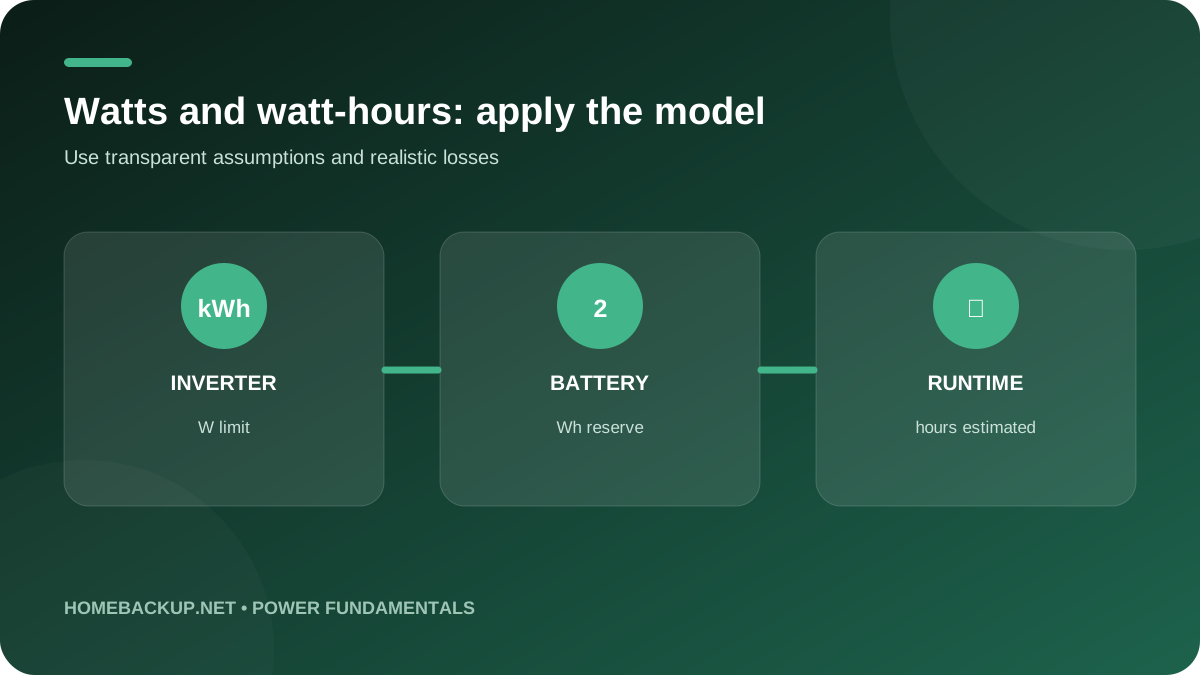
The difference between watts and watt-hours explains why home backup products publish both an inverter rating and a battery capacity. The inverter is the doorway: it limits how much power can pass at once. The battery is the reservoir: it limits how long the demand can continue. A wide doorway attached to a small reservoir can run a large load briefly. A narrow doorway attached to a large reservoir can run modest loads for a long time but may reject a high-power appliance.
Generators are primarily rated by power in watts or kilowatts because fuel can be added as the machine runs. Their duration is expressed through fuel consumption and runtime at a stated load. Batteries store a finite quantity of energy in Wh or kWh, so both capacity and output are central. Solar panels are rated in watts, while their daily harvest is measured in Wh or kWh.
Home backup planning works best when power, energy, voltage, transfer behavior, and recovery are kept separate. Power determines whether equipment can run or start. Energy determines duration. Voltage determines whether the source is electrically compatible. Transfer determines how loads move from grid power to backup. Recovery determines whether the system can support a long outage instead of only consuming a finite reserve.
A useful estimate is transparent about its assumptions. It should show which numbers came from an appliance label, meter, manual, or homeowner scenario. It should also leave room for conversion losses, standby demand, weather, temperature, battery reserve, fuel performance, and changes in household behavior. A result with more decimal places is not necessarily more accurate.
Formula and planning method
First, list each appliance’s running watts and the time it will operate. Multiply to estimate Wh. For cycling loads, use average watts or measured daily Wh rather than assuming the compressor or motor runs continuously. Sum the energy for the chosen outage duration, then adjust for reserve and system losses to estimate battery capacity.
Second, add the running watts of equipment that may operate at the same time. Compare that number with normal continuous output. Check the largest relevant motor start separately. A low-energy sump-pump cycle can still require high starting power. A resistance heater has little surge but can consume enormous energy when used for hours.
Third, keep voltage in the model. Watts equal volts × amps for simple DC or resistive AC relationships, while AC motors and electronics can introduce power factor and waveform considerations. A watt total cannot make 120V equipment compatible with 240V or prove that a receptacle and breaker can carry the required current.
How power and energy appear in backup planning
| Input or condition | Planning treatment | Why it matters | What to verify |
|---|---|---|---|
| Appliance running value | Use watts for the instantaneous load | Determines inverter or generator continuous demand | Nameplate, manual, or measured watts |
| Operating duration | Multiply watts by hours | Converts power into energy | Actual outage schedule or duty cycle |
| Battery capacity | Use Wh or kWh | Defines the stored-energy starting point | Nominal versus usable capacity |
| Inverter rating | Use normal continuous watts | Limits simultaneous load | Voltage, outlet, and configuration-specific rating |
| Motor startup | Use starting watts or current | Can exceed continuous demand briefly | LRA or manufacturer start data |
| Solar array | Panels are rated in watts | Power varies through the day | Exact array, controller, and conditions |
| Solar production | Use kWh per day | Determines daily recovery | Peak sun hours, orientation, shading, and losses |
| Generator output | Use running and starting watts | Determines supported loads | Fuel-specific model rating |
| Generator runtime | Use hours at a stated load and fuel amount | Connects fuel storage with duration | Manufacturer curve and real fuel plan |
| Utility bill | Use monthly kWh cautiously | Shows average energy, not outage priority or peak power | Interval data and appliance-level measurements |
The rows above should be read as a checklist, not as independent answers. A battery may have enough energy but too little inverter output. A generator may have enough running watts but fail to start a pump. A solar array may be large enough on a clear summer day but inadequate during the season when outages are most likely. Test the complete chain against the same operating scenario.
Watts and watt-hours in three homes
The power requirement is small, but continuous operation uses 1,200 Wh per day. A modest inverter can support it; capacity and standby overhead determine duration.
The inverter must supply 1,200 W, but the meal uses only about 200 Wh before losses. Power is the tighter constraint than energy.
A fifteen-minute total daily runtime uses only about 200 Wh, yet the source must still handle the short starting event. Storm inflow can increase both starts and daily energy.
These examples are deliberately illustrative. Appliance cycling, thermostat settings, motor condition, power factor, cable length, fuel type, elevation, panel configuration, weather, and user behavior can move the result. Build a conservative plan for critical loads, then decide which conveniences can be added only when spare capacity is available.
What changes the result in a real home?
Duty cycle changes energy without changing the appliance’s basic running power. A refrigerator compressor may run 20 percent of a mild day and much more during extreme heat or frequent door opening. A furnace blower may draw similar watts whenever active but operate for far longer during severe cold. Measure energy across realistic conditions when possible.
System overhead consumes watt-hours even when household loads are small. Inverter idle demand, gateways, smart panels, displays, battery heaters, communications, and cooling all draw power over time. A 25 W overhead seems minor, but it uses 600 Wh in a full day.
Power and energy can also interact through battery limits. Some systems deliver lower maximum output at a low state of charge, in very cold conditions, or with only one battery module. Expansion may increase kWh and sometimes kW, but those are separate product-specific effects.
Outages also change normal behavior. Refrigerator doors open more often, a sump pump may cycle more during the same storm that caused the outage, a furnace may run longer in extreme cold, and a well pump may serve a household that is home all day. At the same time, occupants may turn off discretionary loads. A good model uses an outage scenario rather than an average utility bill alone.
Common watts and watt-hours mistakes
Most sizing errors are category errors. Watts are treated as watt-hours, a short surge rating is treated as continuous output, a battery nameplate is treated as delivered AC energy, or solar panel watts are treated as guaranteed daily production. Correcting the category usually matters more than changing a safety factor from 20 percent to 25 percent.
How to verify the inputs
Read the appliance nameplate for volts and amps or volts and watts. OSHA’s electrical requirements reflect this marking practice. For ordinary plug-connected loads, use an appropriately rated power and energy meter to observe both instantaneous watts and accumulated Wh. A meter that displays only one value may not capture startup behavior accurately.
Use manufacturer specifications for battery capacity, inverter continuous output, surge duration, voltage, and outlet current. Verify whether the capacity is nominal or usable and whether the output rating changes with battery count or mode. Record measured daily energy for the refrigerator, freezer, networking, office, and other long-duration loads.
Start with the appliance nameplate and current manual. OSHA requirements reflect why the nameplate is important: electrical appliances are marked with voltage and amperes or voltage and watts. For a cycling appliance, a plug-in energy meter can reveal daily watt-hours when the equipment uses a normal 120V plug and the meter is appropriately rated. Permanently wired, 240V, or high-current equipment should be evaluated through manufacturer data or qualified measurement.
Record the date, temperature, operating mode, and duration of any measurement. One calm day may not represent a storm, heat wave, or cold snap. For critical equipment, compare more than one scenario and preserve reserve. If a result depends on a specific surge value, transfer time, solar input, or generator charging feature, confirm it in the current manual for the exact model and configuration.
How this affects the backup system
Use the Home Backup Calculator to combine the two dimensions. It estimates daily appliance energy and simultaneous power separately. Then use the Battery Runtime Calculator when you know the load and battery configuration.
When choosing between a battery and generator, watts influence equipment size while watt-hours influence stored energy or fuel use. A generator can keep producing as fuel is supplied, but it still has a continuous and starting watt limit. A battery can be expanded for more kWh while retaining the same inverter kW limit.
Load management works on both dimensions. Preventing a microwave, pump, and air conditioner from operating together reduces peak watts. Lowering thermostat demand, shortening cooking time, and turning off unneeded electronics reduces watt-hours.
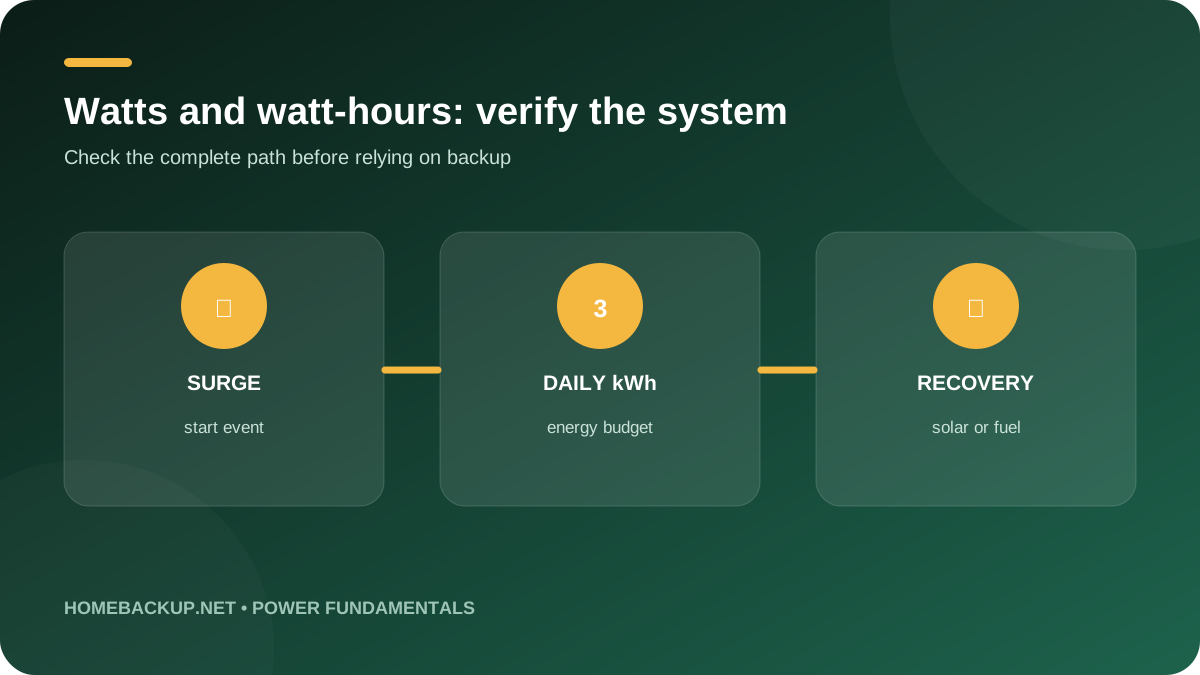
The system should be checked in both directions. First, can the source support the largest instantaneous combination of running and starting loads at the required voltage? Second, is enough usable energy or fuel available for the intended duration? Then check whether the proposed solar or generator recovery can replace the daily energy used. Passing only one of these tests is not enough.
Load management can reduce system size without sacrificing the most important outcomes. Refrigeration, communications, medical planning, water management, and basic heating controls may receive priority. Electric water heating, resistance space heating, clothes drying, EV charging, and central cooling may be delayed or tightly controlled. The correct priority list depends on climate, health, water source, flood exposure, and household needs.
Safety, electrical limits, and local requirements
Do not use a watt calculation to justify an improvised electrical connection. Receptacle voltage and current, cable rating, overcurrent protection, grounding and bonding, transfer equipment, and local rules still apply. Never connect a source to a wall receptacle to energize household wiring.
A product label such as solar generator does not remove battery or combustion hazards. Battery equipment must follow its location and charging instructions. Combustion generators remain outdoors with carbon monoxide precautions regardless of how small the selected wattage is.
Do not treat a consumer power station or a calculator result as guaranteed medical-grade backup. Follow the medical-device manufacturer’s power instructions and the emergency plan agreed with the care team. For flood protection, heating in severe cold, well water, refrigeration of medicines, or other high-consequence loads, use layered contingency planning and alarms where appropriate.
A simple watts-to-watt-hours workflow
- 1
Record running watts
Use the appliance label, manual, or measurement.
- 2
Estimate operating time
Use hours, minutes, or a measured duty cycle.
- 3
Calculate watt-hours
Multiply watts by hours and sum the outage period.
- 4
Calculate simultaneous watts
Add loads that may overlap and check starting events.
- 5
Apply system losses and reserve
Convert appliance energy into a realistic battery target.
- 6
Test the plan
Measure actual use and revise the load schedule before storm season.
Related completed guides
Frequently asked questions
Is 1,000 watts the same as 1,000 watt-hours?
No. One thousand watts is a rate of power. One thousand watt-hours is energy. A 1,000 W load uses 1,000 Wh only when it operates at that rate for one hour.
How many watt-hours are in one kilowatt-hour?
One kilowatt-hour equals 1,000 watt-hours. A 2.5 kWh battery has a nominal energy quantity of 2,500 Wh before reserve and delivery losses.
Why can a 2 kWh battery have a 3 kW inverter?
The battery and inverter describe different dimensions. The 3 kW inverter can deliver high power, while the 2 kWh battery limits how long that output can continue. At maximum load, duration would be well under an hour after losses and limits.
Do starting watts add many watt-hours?
Usually the individual event is brief, so it adds little daily energy. It still matters because the inverter or generator must supply the momentary power without tripping or excessive voltage sag.
Can I use amps instead of watts?
If voltage and current are known, volts × amps gives volt-amperes. For resistive loads, VA and W are close. Motors and electronic loads can have power factor, so use real-watt or manufacturer data when available.
What does a utility kWh bill tell me?
It shows total energy over the billing period. It does not identify essential loads, simultaneous peak power, starting demand, or the portion used during a specific outage scenario.
Is the watts versus watt-hours guide result exact?
No. It is a planning estimate based on the values entered and the assumptions shown. Actual performance changes with appliance behavior, temperature, battery condition, power factor, wiring, configuration, and operating mode. Use current manuals and measured inputs where practical.
How much safety margin should I add?
There is no universal percentage. Twenty percent can be a useful first allowance for ordinary noncritical planning, but motor starting, uncertain duty cycles, severe weather, fuel derating, and high-consequence loads can justify more. Margin does not correct a voltage mismatch or an unsupported connection method.
How this guide was prepared
HOMEBACKUP.net separates verified specifications from planning estimates. The calculation methods show their assumptions, and product-independent guidance is based on current government, laboratory, standards, utility, and manufacturer documentation where appropriate. Illustrative runtimes and appliance values are not presented as measured promises for a particular home.
Before buying equipment, repeat the estimate with current nameplates, manuals, measured energy where practical, and a realistic outage scenario. Installed systems need a qualified professional to confirm service compatibility, conductor and breaker limits, transfer method, grounding and bonding, location, permits, inspections, and the current locally adopted rules.
Sources and review basis
Reviewed July 22, 2026. Calculations are planning estimates, not measured performance or an electrical design.
- OSHA electrical glossary
- OSHA 1910.305 appliance nameplate and wiring requirements
- U.S. Department of Energy solar and storage basics
- Generac explanation of running and rated wattage
Equipment specifications, electrical rules, safety instructions, and available accessories can change. Use the current appliance nameplate, product manual, local requirements, and qualified professional review for the actual installation.
Use both dimensions in one estimate
Open the Home Backup Calculator to estimate simultaneous watts and daily watt-hours from the same load list.