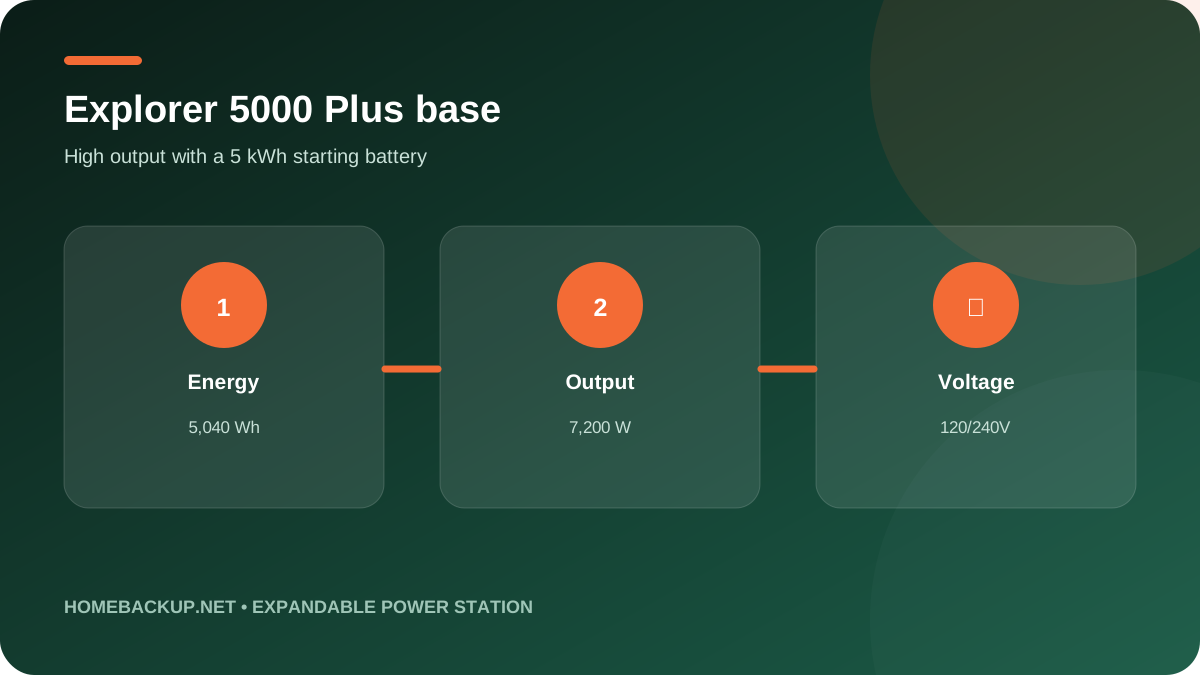
Explorer 5000 Plus is a wheeled 5,040 Wh LFP power station with 7,200 W continuous output, 120/240V support, solar input, expansion, and optional smart transfer equipment for selected household circuits.
Quick decision table
| Decision point | Published or planned value | Homeowner check |
|---|---|---|
| Base energy | 5,040 Wh | Runtime is modest at high output |
| Continuous output | 7,200 W | Use outlet and branch limits too |
| Surge | 14,400 W published | Confirm motor compatibility and duration |
| Voltage | 120/240V | Useful for selected split-phase loads |
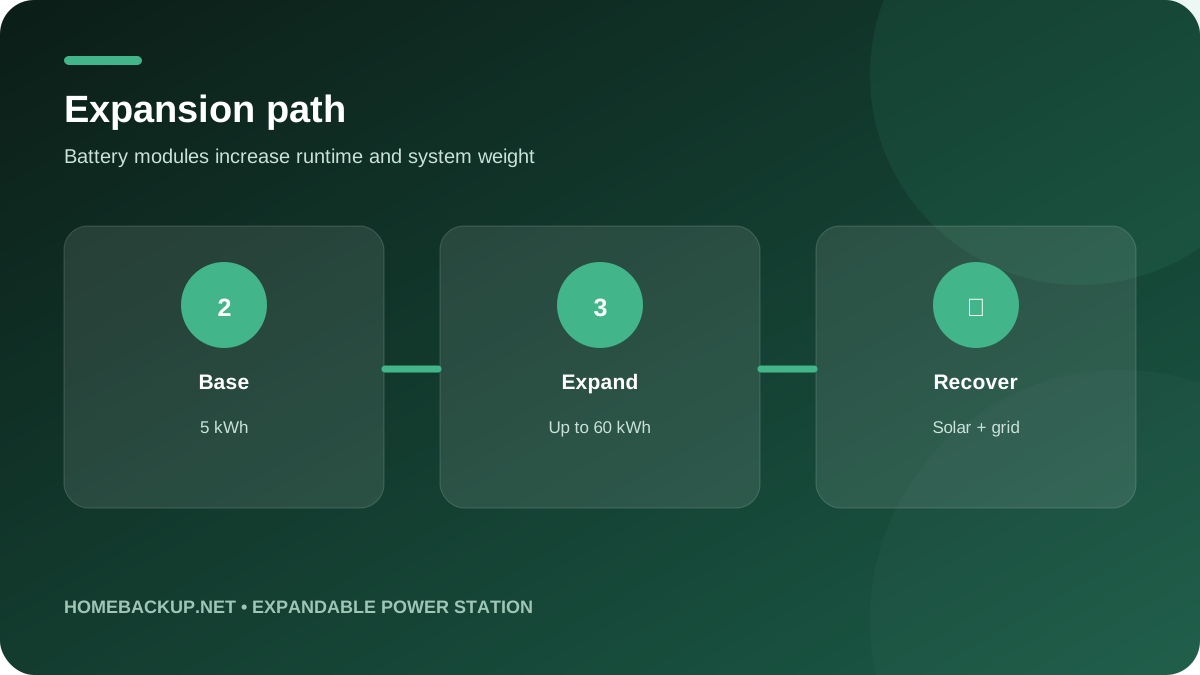
| Expansion | Up to 60 kWh published | Requires many modules and a complete plan |
| Solar input | Up to 4,000 W | Array conditions control real harvest |
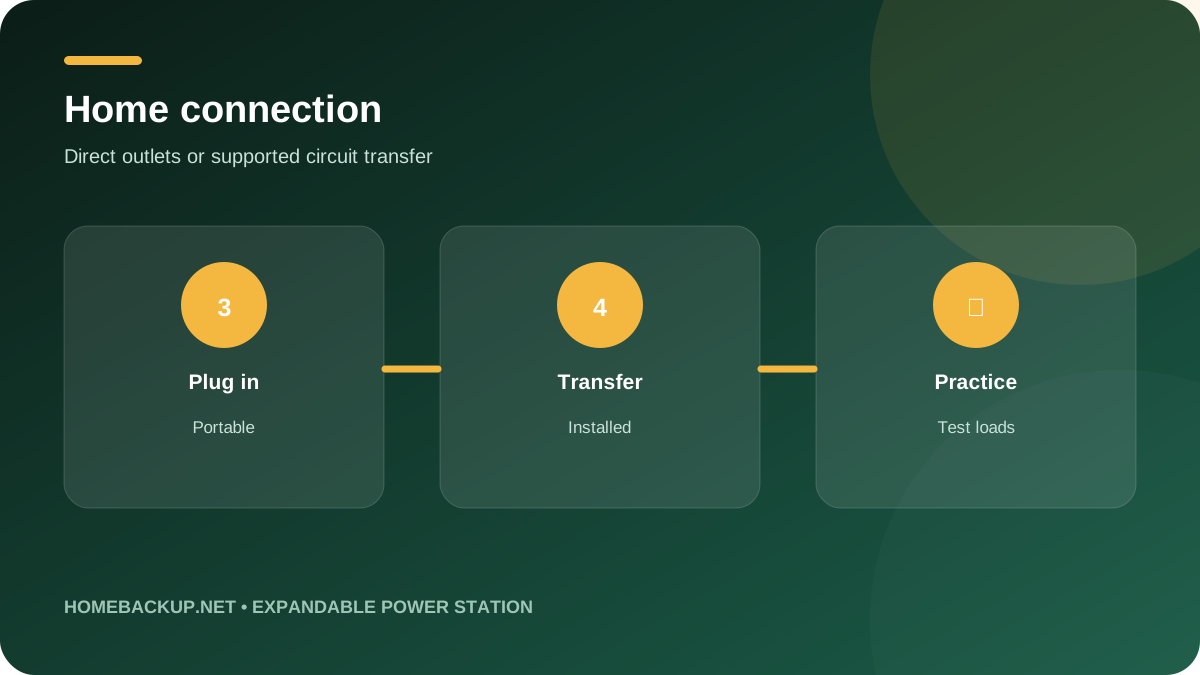
| Circuit transfer | Optional 60 A smart switch | Qualified installation and circuit map required |
| UPS claim | 0 ms for defined use | Sensitive loads still need validation |
What this guide is deciding
This guide covers the current Explorer 5000 Plus base unit, compatible expansion batteries, solar charging, and supported 60 A smart transfer equipment. Jackery publishes a much larger ecosystem maximum, but the base unit remains a 5.04 kWh battery. Every runtime and home-circuit claim must state the battery count and transfer configuration.
For expandable power station, the objective is a repeatable homeowner decision, not a score made from unrelated maximums. Jackery Explorer 5000 Plus should be judged against the same measured load sheet, outage duration, reserve, and recovery assumptions used for every alternative.
Start with the outage problem, not the largest number on a product page. Write down the loads that must operate, their measured running watts, any motor or compressor startup demand, daily energy use, required voltage, and the longest outage the plan should cover. A system can have enough inverter output but too little energy, or ample battery capacity but no supported way to energize the required household circuits.
Every published maximum needs a configuration beside it. Base units, added battery modules, parallel inverters, transfer equipment, solar hardware, and generator accessories change the result. This guide keeps those layers separate so a multi-unit headline is not mistaken for one-box capability. Verify the current manual and itemized bill of materials before ordering because regional versions and supported accessories can change.
- List essential loads and outage duration.
- Separate continuous watts, startup demand, and daily energy.
- Compare exact configurations at the same duty level.
Architecture and configuration
The main unit combines battery, inverter, charger, 120/240V outlets, wheels, controls, and communications. Expansion packs add energy, while a supported transfer switch can route selected circuits. This architecture can serve direct plug-in loads without permanent wiring or become a larger household system through qualified installation.
Architecture changes daily operation as much as capacity. For Jackery Explorer 5000 Plus, document which component performs conversion, storage, isolation, monitoring, load control, and recovery. The system boundary should be understandable without marketing shorthand.
Treat the complete backup design as a chain: energy source, inverter, battery, isolation or transfer device, protected circuits, controls, and a recovery source. The usable system is limited by the weakest link. A powerful inverter does not correct an undersized circuit, incompatible battery, missing neutral strategy, or unavailable transfer accessory. Ask the installer to label each component and explain what remains powered if one component or internet service is unavailable.
Proprietary integration can make setup and monitoring simpler, but it also creates long-term dependencies. Record model numbers, firmware, approved battery combinations, cable types, breaker sizes, and commissioning settings. Keep manuals offline. If an expansion is planned, confirm that later modules may be mixed with the installed generation and that warranty or code rules do not require a particular installation sequence.
- Name every inverter, battery, controller, panel, and cable.
- Confirm generation compatibility before planning later expansion.
- Document local operation when internet or cloud service is unavailable.
Continuous output and motor starting
Jackery publishes 7,200 W rated output and 14,400 W surge. That is enough normal output for a substantial scheduled load set, but it can empty the base battery in well under an hour near full output. Motor claims still need actual starting current, outlet limits, conductor rating, and simultaneous-load control.
Power planning for Jackery Explorer 5000 Plus should include a normal day, the worst simultaneous protected load, and the single hardest motor start. Record what must be turned off before a high-demand appliance is enabled and who is responsible for that action.
Use continuous output for sustained planning. Surge, peak, boost, or timed modes may help start a motor, but they are not a substitute for the normal rating. For HVAC, wells, pumps, refrigerators, and other motors, obtain nameplate running current and locked-rotor or startup information. A soft starter may reduce demand, but it must be selected and installed for the exact equipment and does not guarantee that every backup source can start the load.
Also check the limit of the individual outlet, branch circuit, transfer connection, and protected-load panel. Total inverter output can be higher than the power available from one receptacle or circuit. Build a simultaneous-load schedule for cooking, water heating, HVAC, pumps, and EV charging. Load management is often more economical and reliable than sizing the system so every large appliance can run at once.
- Use continuous output for sustained design.
- Measure motor startup instead of relying on a generic appliance table.
- Check outlet and branch-circuit limits, not only total inverter watts.
Battery capacity and realistic runtime
The 5,040 Wh base is useful for refrigeration, communications, lights, office equipment, and short operation of larger appliances. Jackery publishes expansion up to 60 kWh across supported hardware. A large maximum means more heavy modules, cables, storage space, and cost, so compare the 5, 10, and practical household configurations separately.
Use at least three runtime scenarios for Jackery Explorer 5000 Plus: quiet overnight essentials, active daytime essentials, and a short high-load interval. This exposes whether the design is limited by stored energy, output, or the ability to recharge before reserve is exhausted.
Runtime begins with usable watt-hours, not the battery name alone. A practical estimate subtracts the required reserve, conversion losses, standby consumption, cold or hot weather effects, and battery aging. Divide the remaining energy by the average load, then test the result against a daily energy budget. Cycling appliances need measured daily kilowatt-hours because their duty cycle changes with weather, door openings, household behavior, and maintenance condition.
Do not confuse expansion energy with added inverter power. Some battery modules increase runtime while output remains fixed; other platforms need added power modules to raise both. Compare a small, medium, and long-outage configuration. The long-outage case should include recovery, because buying enough battery for every possible event can be less practical than combining controlled loads with solar or properly operated generator charging.
- Reserve energy for the end of the outage.
- Use measured kWh per day for cycling loads.
- Model battery aging and difficult weather.
120V, 240V, circuits, and load control
Native 120/240V operation is a major advantage for U.S. backup projects. Jackery’s supported transfer equipment is presented for up to twelve 120V or six 240V circuits. The electrician must still confirm panel compatibility, neutral and grounding, maximum current, inlet or transfer topology, and which loads need interlocks or shedding.
A panel diagram for Jackery Explorer 5000 Plus should identify 120V and 240V circuits, leg assignment, breakers, transfer boundary, and controlled loads. Ask for a written explanation of what the homeowner can safely operate at the same time during an outage.
In a U.S. home, 120/240V split-phase capability matters for central air, heat pumps, electric water heating, ranges, dryers, wells, pool equipment, and EV charging. A 240V receptacle does not automatically mean the system can start every 240V load or energize an entire service. Confirm voltage, frequency, neutral and grounding method, maximum current, breaker protection, and whether both legs remain balanced in the intended backup mode.
A circuit plan should show which loads are always protected, which are shed automatically, and which require the homeowner to turn something else off first. Essential-load panels make the boundary visible. Smart panels can add control but also add compatibility and software questions. Direct plug-in operation avoids household backfeeding, yet it still requires correctly rated cords and an operating plan that does not create trip or fire hazards.
- Confirm 120/240V split-phase support where needed.
- Map every protected circuit and load-shedding rule.
- Verify neutral, grounding, breaker, and inlet requirements.
Solar, grid, and generator recovery
Jackery publishes up to 4,000 W solar input and a fast-recharge path under suitable conditions. Actual solar production depends on voltage window, panel wiring, weather, and array placement. Grid or generator charging should be planned around input limits and the need to keep loads running while energy is restored.
Recovery is part of capacity. For Jackery Explorer 5000 Plus, calculate expected energy added during a winter day, a cloudy day, and a short generator or grid window. Compare that result with the protected loads’ daily consumption rather than the theoretical maximum input.
A multi-day plan must replace energy at least as quickly as the protected loads consume it. For solar, compare the array voltage window, current limits, maximum input, number of MPPT channels, shading, season, orientation, and realistic peak-sun hours. The maximum solar input is an equipment ceiling, not an all-day production promise. Grid charging speed matters before a forecast outage and during short restoration windows.
Generator charging can reduce fuel use because a generator may run at an efficient load while batteries cover quiet periods. Confirm the supported input, cord, grounding and bonding instructions, charging power, and whether charging can occur while loads operate. Combustion generators must stay outdoors and away from building openings. Automation does not remove carbon-monoxide, exhaust, fuel-storage, noise, or maintenance responsibilities.
- Model realistic daily solar harvest.
- Confirm maximum charge rate and input window.
- Operate combustion equipment only outdoors and as instructed.
Outage transfer and operating behavior
Jackery publishes zero-millisecond UPS behavior for defined outputs and a smart transfer option for home circuits. Those are different operating modes. Ask which circuits switch automatically, whether the station can be removed without disabling household wiring, how reserve is managed, and what happens when the unit is depleted.
A successful outage test for Jackery Explorer 5000 Plus should cover grid loss, stable island operation, low-battery behavior, source recovery, and return to utility service. Record any devices that restart incorrectly and update the operating plan before relying on the system.
Separate outlet-level UPS behavior from household transfer. A product may switch a protected receptacle quickly while home circuits remain unpowered. Circuit backup needs a listed isolation method that prevents energizing the utility grid. Determine whether transfer is manual or automatic, whether solar remains active during an outage, how the system behaves at minimum state of charge, and how it returns to grid power after service is restored.
Sensitive electronics may have their own continuity requirements. Even a published millisecond value does not guarantee that every computer, medical device, motor control, or network appliance will ride through. Keep a dedicated UPS where interruption cannot be tolerated and confirm device-manufacturer guidance. Practice the outage sequence so every adult in the home understands load shedding, restart order, alarms, and safe shutdown.
- Distinguish receptacle UPS from household transfer.
- Verify utility isolation and return-to-grid behavior.
- Test the sequence with real protected loads.
Installation, permits, and commissioning
Direct outlet use can remain portable, although the unit and batteries are heavy. Household transfer, high-current solar, or fixed wiring requires qualified installation. Plan a level route, ventilation and clearance, cable protection, dry placement, battery-module stability, panel capacity, permits, and a safe manual bypass or service procedure.
The final proposal for Jackery Explorer 5000 Plus should state who handles design, permits, utility communication, site preparation, electrical and fuel work, commissioning, warranty registration, and homeowner training. Undefined responsibility is a project risk.
Fixed connections belong in an itemized project scope prepared by qualified professionals. The authority having jurisdiction decides which adopted electrical, building, fire, and mechanical rules apply. Utility approval may also be required for grid-connected solar or export. Placement can affect clearances, temperature, flooding exposure, vehicle impact, egress, communications, conductor length, and service access. A national product listing does not replace local approval.
Commissioning should prove more than app connectivity. Test a real outage, transfer in both directions, selected circuits, motor starting, solar operation while islanded, generator charging if included, reserve behavior, alarms, manual shutdown, and homeowner access. Collect permits, inspection sign-off, as-built diagrams, photos of concealed work, model and serial numbers, warranty registration, installer contacts, and a written explanation of future expansion limits.
- Use qualified installers for fixed wiring.
- Obtain local permits and inspection approval.
- Keep as-built documents and commissioning results.
Safety, placement, and emergency operation
The absence of combustion exhaust makes the battery suitable for many indoor plug-in uses when installed as directed. It is not permission to block exits, use damaged cords, overload a receptacle, or expose batteries to water or impact. Any generator used for recharge remains outdoors at the manufacturer-required distance.
Safety claims for Jackery Explorer 5000 Plus apply only to the documented configuration and intended environment. Follow labels and manuals, keep emergency shutdown access clear, and make sure first responders or building staff can identify the equipment when appropriate.
Use listed equipment in approved combinations and follow the current manufacturer instructions. Do not improvise high-current cables, adapters, neutral connections, transfer methods, or household backfeed. Keep batteries dry, protected from damage, within their allowed temperature range, and clear of exits or required ventilation paths. Stop using equipment that is swollen, damaged, wet, unusually hot, giving off odor, or reporting a serious fault.
Build a layered emergency plan rather than relying on one device. Maintain smoke and carbon-monoxide alarms, flashlights, communications, medication plans, and a way to leave if the building becomes unsafe. Keep emergency contacts and shutdown instructions accessible without internet. Backup power protects selected functions, but it does not make a flooded, fire-damaged, structurally unsafe, or carbon-monoxide-contaminated home safe to occupy.
- Use approved combinations and undamaged cables.
- Protect equipment from water, impact, heat, and blocked egress.
- Maintain a non-electric emergency and evacuation plan.
Warranty, service, software, and expansion
A modular portable system may be easier to replace than a fixed battery, but large components are still difficult to ship. Confirm battery warranty terms, cycle assumptions, service process, firmware support, transfer-switch labor, and whether future packs will remain compatible. Practice rolling, connecting, and shutting down the system before an outage.
The ownership plan for Jackery Explorer 5000 Plus should name the local service company, response process, maintenance schedule, spare or replacement path, app account owner, and records kept with the home. Review it after any expansion or major firmware change.
Compare warranty years with throughput limits, retained-capacity terms, labor coverage, shipping responsibilities, required internet connectivity, maintenance duties, and transferability. A long equipment warranty can still leave the owner paying for diagnosis, access, removal, freight, or reinstallation. Ask who can provide local service, what replacement parts are stocked, and how long the home can operate if a proprietary controller or cloud feature is unavailable.
Software adds scheduling, storm preparation, monitoring, and remote service, but it also changes during ownership. Record critical settings after commissioning and review release notes before major updates. Confirm whether essential backup still works locally without broadband. For modular systems, price the cables, panels, batteries, labor, permits, and floor or wall space required for the next expansion, not only the initial unit.
- Read warranty exclusions and labor terms.
- Confirm local service and replacement-part access.
- Price the full future expansion path.
Who should choose it and what to compare next
Explorer 5000 Plus fits homeowners who value one-unit 120/240V output, direct outlets, movable hardware, and later energy expansion. Anker F3800 Plus has a different generator-bypass and battery ecosystem. EcoFlow DELTA Pro Ultra X targets higher whole-home scale, while an installed battery may offer cleaner automation for permanent solar and daily cycling.
A strong final decision on Jackery Explorer 5000 Plus can be explained in one paragraph: which loads are protected, for how long, how they recover, how transfer works, who installs and services the system, and which limitations the household accepts.
A defensible shortlist uses the same load sheet and outage scenario for every candidate. Ask each seller to identify the exact configuration, normal continuous output, usable energy, supported voltage, transfer method, solar and generator recovery, environmental rating, warranty, local service path, and total installed scope. Reject a comparison that mixes a base price or base unit with another brand’s fully expanded capability.
Before committing, compare at least one alternative architecture. A portable system may be better for renters or direct appliance loads. An installed battery may be better for quiet automatic operation and solar use. A standby generator may be better for repeated long outages with a reliable fuel source. A hybrid can balance quiet operation and duration. The right answer is the smallest complete system that meets the measured need with a safe recovery plan.
- Compare itemized systems against one load sheet.
- Require written assumptions and exclusions.
- Choose an architecture that can be operated safely by the household.
Frequently asked questions
How long does the base battery last?
At a 300 W average load and an 85 percent delivered-energy allowance, about 14.3 hours. At 3,000 W, about 1.4 hours. Actual reserve and losses change the result.
Can one unit provide 240V?
Jackery publishes native 120/240V output from one Explorer 5000 Plus. Confirm the exact outlet, current, and circuit-transfer method.
Can it run central air?
Potentially, if startup current, running demand, outlet or transfer limits, and battery energy fit. The published five-ton example is not a substitute for an equipment-specific study.
Does adding batteries increase the 7,200 W output?
Expansion batteries primarily add energy. Confirm whether raising output requires another main power unit in the selected Jackery architecture.
Can it power home circuits automatically?
Jackery offers supported smart transfer equipment. The exact circuit count, transfer behavior, reserve, and installation scope must be confirmed.
Can solar refill it in two hours?
Only under strong conditions near the maximum compatible input. Weather, array voltage, shading, orientation, and simultaneous loads can lengthen recharge.
Is it safe to use indoors?
It has no combustion exhaust, but it must be dry, undamaged, stable, within temperature limits, and connected with correctly rated equipment.
How is it different from HomePower 3000?
Explorer 5000 Plus has greater output, native 120/240V support, and a much larger expansion path. HomePower 3000 is a smaller fixed-capacity essentials station.
Continue planning
Sources and review basis
Reviewed July 23, 2026. Product configurations, manuals, availability, software, warranties, codes, and utility rules can change.
- Jackery Explorer 5000 Plus product page
- Jackery user guide center
- Jackery Battery Pack 5000 Plus
- CPSC carbon monoxide safety center
Manufacturer specifications are configuration dependent. HomeBackup.net separates normal output, short peak or surge, base energy, expanded-system maximums, and transfer equipment. Verify the current U.S. manual, local approval, and itemized installer scope before purchase.